Author: gknow81

  • PCB Drone Motor – 03

    PCB Drone Motor – 03

    Computational Estimation of Magnetic Flux Density for Layered Annular Sector Coils

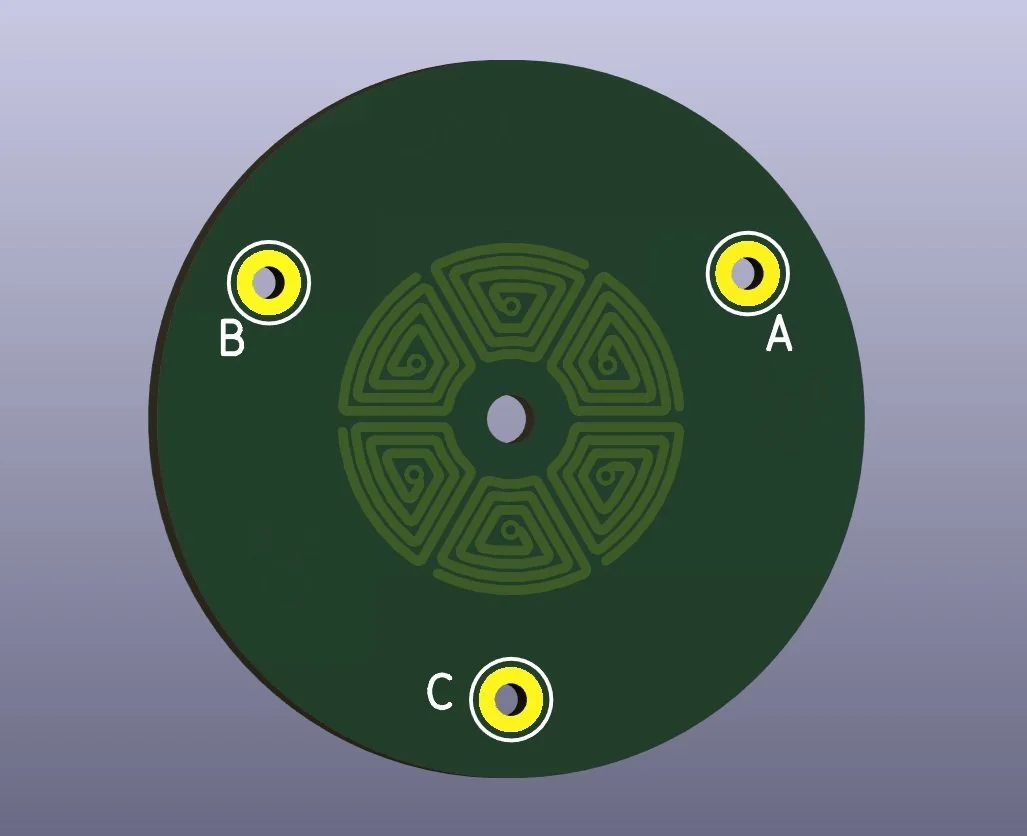
    Building on my first attempt using circular loops, this post details a more refined Python analysis of airgap flux density. This version increases realism by modeling windings as multi-layer annular sectors – a shape better reflecting my design – calculated using the Biot-Savart law. For windings supported by materials like FR4 PCB (µᵣ ≈ 1, similar to air), the Biot-Savart ‘air’ calculation holds well. Consequently, these results should be reasonably close to FEA simulations configured to neglect secondary effects. Finite Element Analysis (FEA) is still the logical progression and my planned next step in evaluating this design.
    (The Python notebook can be downloaded at the bottom of the page)
    Motivation: Towards Realistic Coil Geometry

    A real motor winding isn’t just a single loop. It consists of multiple turns wound layer upon layer. To capture this more accurately, this simulation models each layer as a series of contracting annular sectors. Imagine starting with the outermost boundary of the coil cross-section and then winding inwards, turn by turn, with a defined spacing. Furthermore, multiple such layers are stacked axially, offset slightly from each other. This approach provides a much better geometric approximation of the actual current distribution compared to a single, simple loop.

    The Approach: Iterative Geometry and Grid-Based Biot-Savart

    1. Generating the Winding Paths:

      • The core shape is an annular sector (a slice of a doughnut).

      • The create_single_sector_perimeter_angled_closed function generates the points defining the perimeter of one such sector.

      • The key generate_disconnected_loops function takes the initial outer/inner radii and angle and iteratively calculates the geometry for subsequent turns within a layer. It reduces the outer radius and increases the inner radius by the SPIRAL_SPACING for each “turn,” also adjusting the angular width slightly to approximate constant wire width. This continues until the inner and outer radii meet or a maximum loop count (MAX_LOOPS_PER_LAYER) is reached.

      • This process creates a list of 2D loop paths representing the turns within a single layer.

      • Multiple layers are then created by copying this 2D loop list and assigning different Z-coordinates based on NUM_LAYERS and LAYER_OFFSET.

    2. Defining the Calculation Space:

      • Instead of calculating the field everywhere (computationally expensive), we define a specific region of interest: the airgap.

      • The annulus_grid_points_xyz_angle function generates a grid of points within an annular sector located at the specified AIRGAP_DISTANCE from the first layer. The density of this grid is controlled by NUM_RADIAL_GRID and NUM_ANGULAR_GRID.

    3. Applying Biot-Savart:

      • The standard biot_savart_segment_at_point function remains the workhorse. It calculates the infinitesimal magnetic field vector (dB) produced by a short, straight segment of current-carrying wire (dl_vec) at a specific point in space (point).

      • The main calculation loop iterates through every point in the airgap grid.

      • For each airgap point, it then iterates through every segment of every loop in every layer.

      • It calls biot_savart_segment_at_point for each segment and sums up all the resulting dB vectors to get the total magnetic field vector B = (Bx, By, Bz) at that specific airgap grid point.

    Visualization and Results:

    The script generates three key visualizations:

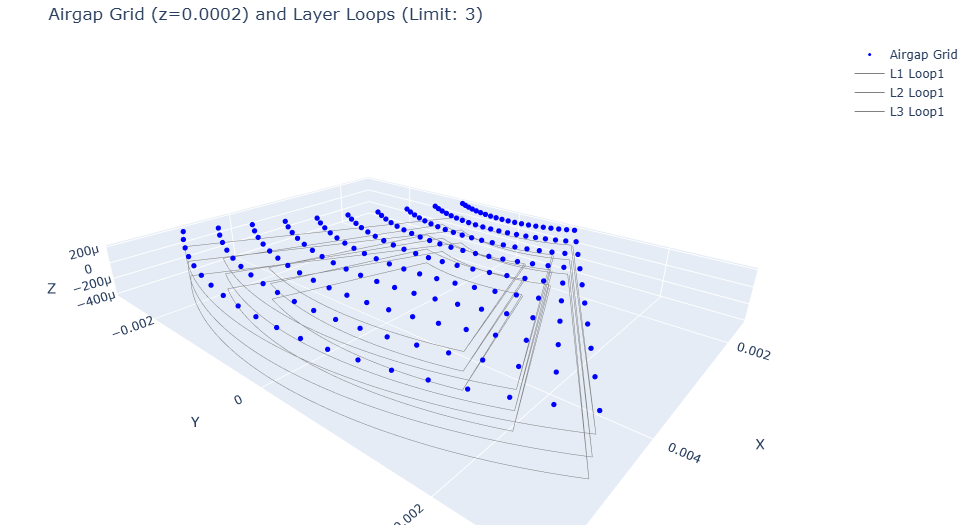
    1. 3D Grid & Paths: Shows the physical layout of the multi-layer coil loops (grey lines) and the grid points in the airgap (blue dots) where the field is calculated. This helps verify the geometry setup.

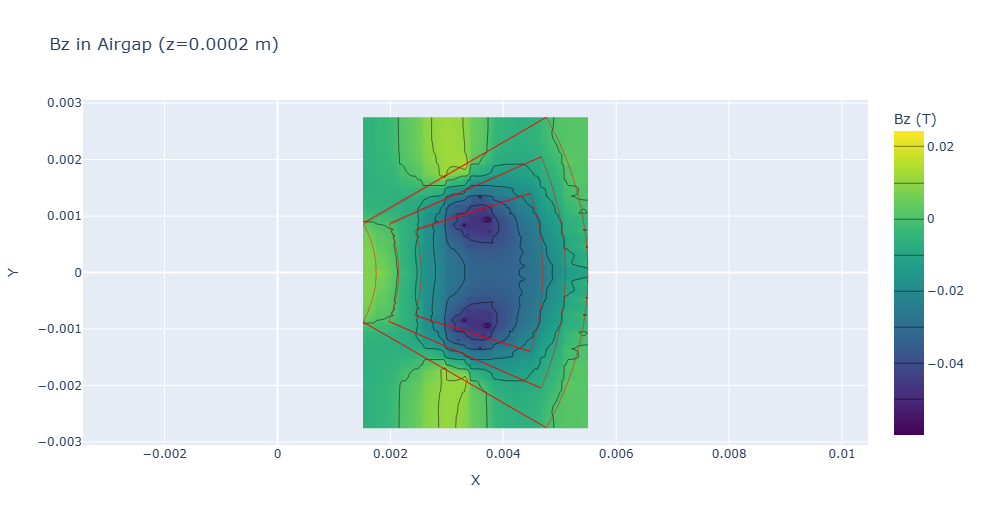
    2. Bz Heatmap: Displays the calculated Z-component of the magnetic field (Bz) as a 2D heatmap on the airgap plane. The outlines of the 2D loops are overlaid in red for context. This is often the most critical component for axial flux machine performance.

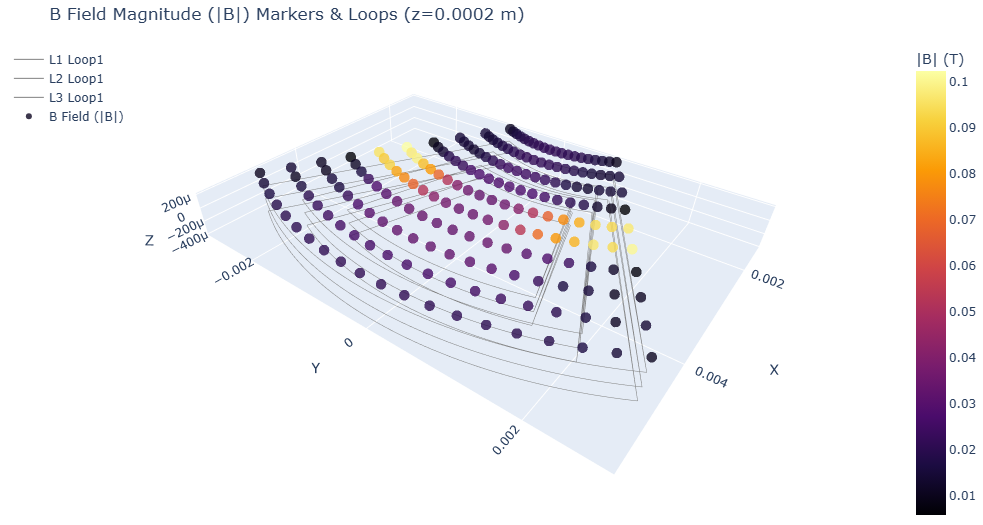
    3. B-Field Magnitude Markers: A 3D plot showing the coil loops again, but this time with markers at the airgap grid points. The color of each marker represents the magnitude (|B|) of the magnetic field at that point. (Initially, go.Cone glyphs were used to show direction, but rendering issues with Plotly v6.0.1 when combining many cones and lines necessitated this switch to markers for reliability).

    Limitations of the Analytical Approach

    While more refined, this model still relies on assumptions and has limitations:

    • Idealized Geometry: Assumes perfect annular sectors and uniform current density within wires.

    • No Eddy Currents: Doesn’t account for induced currents in conductive materials.

    • Computational Cost: Calculating the field from every segment for every grid point can become slow, especially with high point densities or many layers/turns.

    Next Steps: Embracing FEA

    These limitations highlight why Finite Element Analysis (FEA) is the standard tool for detailed motor design. FEA can:

    • Model complex 3D geometries accurately.

    • Incorporate non-linear material properties like B-H curves and saturation.

    • Calculate eddy currents and other secondary effects.

    My next step in this learning journey will be to explore open-source FEA tools (like FEMM for 2D) to model this same axial flux motor configuration and compare the results.

    Conclusion and Comparison:
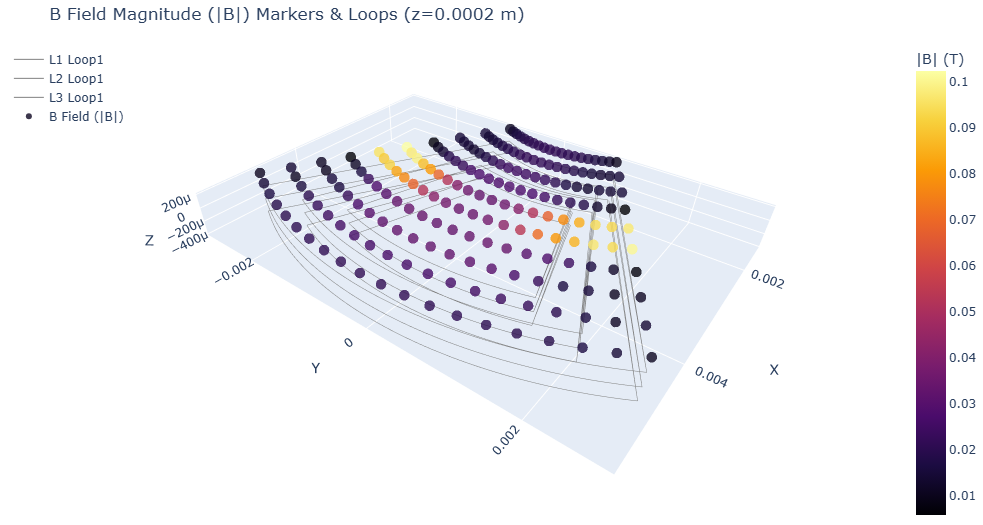
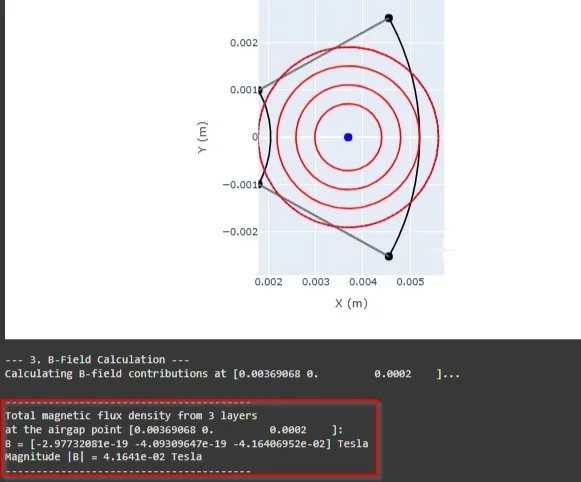
    Comparison of magnetic flux density calculations reveals good agreement between the simplified circular estimation and the detailed spatial analysis near the geometric centroid, both yielding approximately 0.04 T. However, the detailed analysis highlights significant spatial variation missed by the simpler model, with flux density increasing to nearly 0.1 T towards the radial edges. The next step will involve Finite Element Analysis (FEA) to provide a more comprehensive simulation and further validate these analytical findings.

    (Full Python Notebook will be added in the next 2 days)
  • PCB Drone Motor – 02

    PCB Drone Motor – 02

    Computational Estimation of Magnetic Flux Density for Layered Annular Sector Coils

    This post details my vision for a first attempt at estimating the airgap flux density generated by the stator coils in an axial flux motor topology using Python. Future iterations will include a grid-based Biot-Savart approach (calculating the field over an area) and eventually leveraging open-source 2D/3D FEA tools. I know there are many excellent commercial and open-source programs that perform these calculations already, but my primary motivation here was to further understand the underlying physics and calculation methods from first principles, specifically as applied to axial flux machines.
    (The Python notebook can be downloaded at the bottom of the page)

    This script demonstrates a workflow integrating geometric analysis with fundamental physics:

    1. Geometric Foundation: Using numpy, the code precisely defines the 2D cross-section of an annular sector (a “doughnut slice”), representing the physical space for the windings. Parameters like radii and arc angle define the core geometry.

    2. Centroid & Characteristic Dimension: The geometric centroid of the sector is calculated. Following this, a characteristic “average distance” from this centroid to the sector’s perimeter is determined. This metric provides a basis for positioning the current elements in the model.

    3. Coil Representation & Layering: The core of the model represents the winding pack. Instead of discretizing a potentially complex spiral path, this implementation utilizes concentric circular current loops centered at the geometric centroid.

      • The radii of these loops are derived from the calculated “average distance,” stepping inwards with a defined TRACE_DISTANCE. This structured approach creates a model of the current distribution intended to capture the primary magnetic contributions within the sector.

      • The model effectively handles multiple layers stacked vertically (NUM_LAYERS), incorporating the specified LAYER_SPACING between them.

    4. Physics Engine – Biot-Savart Law: The magnetic field calculation leverages the Biot-Savart Law directly. A dedicated function (biot_savart_loop_at_point) numerically integrates the field contributions from infinitesimal current segments (dl) around each modeled circular loop to determine the magnetic field vector (B) produced at any target point in space.

    5. Targeted Field Evaluation: The script computes the total B-field by vectorially summing the contributions from all modeled loops across all layers. This calculation is performed at a user-defined point, typically located in the ‘airgap’ region relevant to the device’s operation (e.g., a specific distance above the top layer’s centroid).

    6. Visualization with Plotly: Interactive plots generated using plotly are used throughout. They visualize the defined geometry, centroid, average distance metric, the positions of the modeled current loops, and the field evaluation point, providing crucial validation and insight into the model setup.

    Advantages of this Method:

    • Direct Physics Implementation: Applies the Biot-Savart law directly to the defined current sources, offering a clear link between the model geometry and the resulting field.

    • Model Transparency & Control: Python implementation allows full control over the geometric parameters and the current loop representation.

    • Computational Speed: For field calculations at specific points arising from known currents in linear media (like air), this direct summation is generally significantly faster than setting up, meshing, and solving a full FEA domain.

    • Educational Insight: Provides a practical platform for exploring how different coil parameters and layering strategies influence the magnetic field.

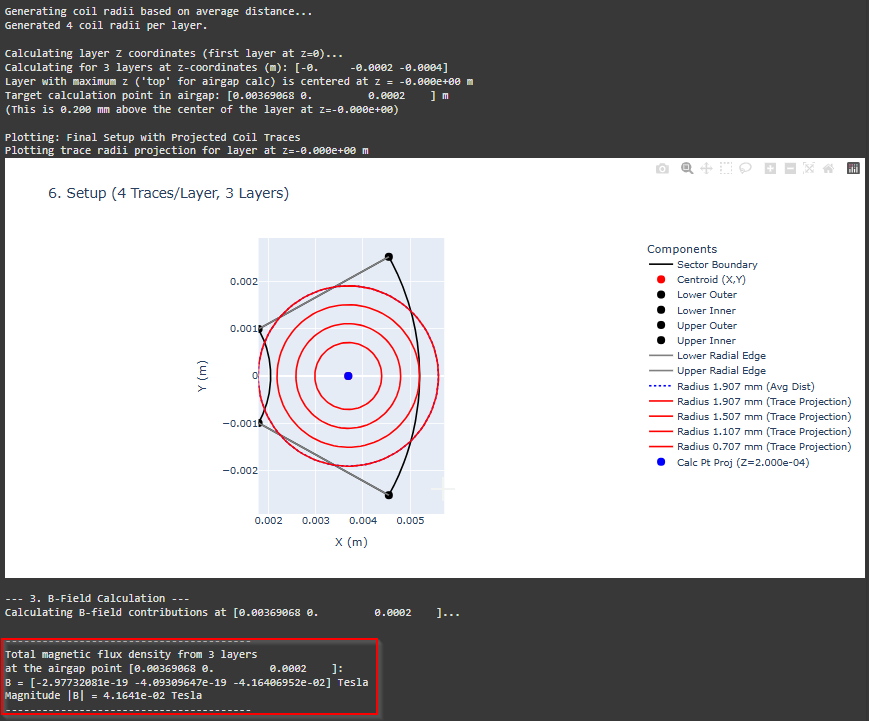
      The output of my script from a 3-layer design
    The output of my script from a 3-layer design

    Considerations:

    • This method models the current distribution using defined circular elements. It’s most suited for problems where the field is primarily determined by the source currents in air or linear materials.

    • It doesn’t inherently include the effects of complex magnetic cores (saturation, hysteresis) or solve for fields within those materials, which are strengths of FEA.
    • Consequently, while this direct calculation approach offers compelling speed advantages for rapid estimations, it may not achieve the same level of accuracy as a detailed FEA model, particularly for complex geometries or when material effects are dominant. The trade-off is speed for potentially reduced precision

  • Boost Converter

    Boost Converter

    Let’s start with a short inductor review:

    • Faraday’s Law drives inductors: current through a wire creates a magnetic field.

    • The voltage across an inductor is V= L ⋅ (dI/dt), proportional to the rate of current change and inductance (L).

      • Faster current shifts result in a bigger voltage spikes

      • If there is steady current (rate of change is 0), the output voltage from an inductor = 0

      • In the layout of a boost converter the voltage applied to the inductor is equal to the Vin, which results in a linear current rise that builds the magnetic field.

    • Typically a coil, an inductor stores energy in its magnetic field, often enhanced by a ferromagnetic core like ferrite—though air-core versions exist too

    Boost Converter Design

      Hand Calculations Passive Components
    Hand Calculations Passive Components

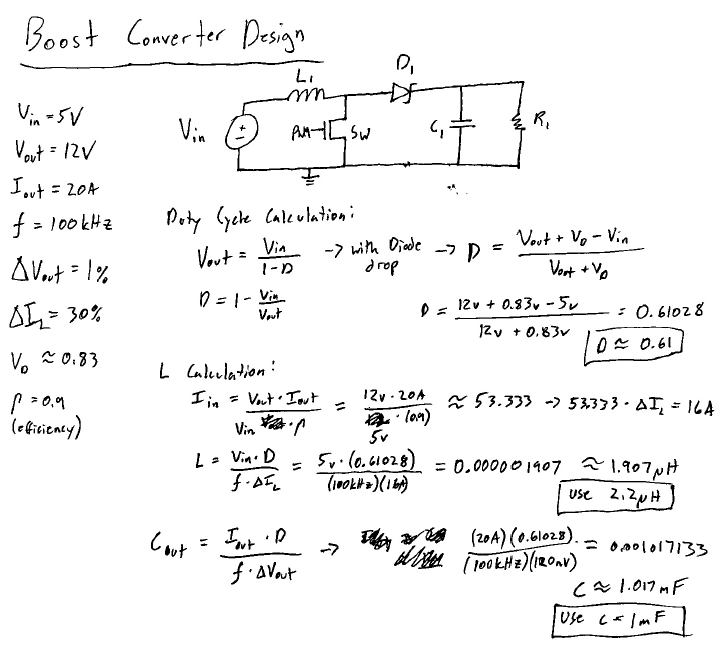
    At work I am used to high-power equipment, so for this boost converter, I chose 5 V in, 12 V out, and 20 A for 240 W of power output. Big designs like this punish sloppy math, and my first attempt proved it. I picked unrealistically tight ripple targets and messed up the input current, using Vout​ in the denominator Vin. This resulted in a on oversized capacitor by a factor of 10, which did not produce a pretty output.

    To fix that I used some common percentages—1% voltage ripple (0.12 V), 30% current ripple, and calculated a 53.33 A input current. With 90% efficiency my spice model output came together.

      LTspice Model
    LTspice Model

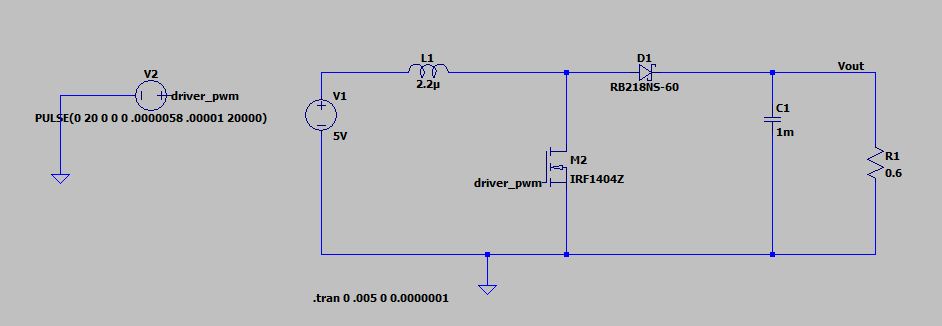
    In designing my boost converter circuit, I encountered a few practical challenges that underscored the importance of component selection and compatibility. One oversight occurred when I initially entered the capacitor’s equivalent series resistance (ESR) as 0.02 ohms instead of the intended 0.002 ohms. This seemingly small error significantly amplified the output voltage ripple, as ESR directly influences how effectively the capacitor smooths the boosted voltage. Correcting this brought the ripple under control, but I noticed the average output voltage remained slightly above my 12V target. To address this, I reduced the switch’s duty cycle from 61% to 58%, which aligned the output closer to 12V without noticeably affecting the ripple amplitude.
    I was able to reduce the duty cycle partly because I used an inductor larger than the ideal calculated value. A bigger inductor stores more energy in its magnetic field, which let it keep boosting the voltage even with a lower duty cycle. This ties into a core idea with boost converters: you don’t want the inductor’s magnetic field to fully collapse when the switch is off, since it needs enough energy to add to the next cycle to increase the voltage. The output voltage settles when the energy going into the inductor matches what’s delivered to the load and capacitor (minus losses, of course). This shows how critical it is to pick components that work together, especially since the switching frequency heavily influences the inductance needed to avoid dropping into discontinuous mode.

    For the diode, I opted for a Schottky type due to its efficiency advantages, well-suited to my moderate output voltage. Unlike traditional PN junction diodes, Schottky diodes feature a metal to N-type semiconductor junction, reducing the forward voltage drop to ~0.3V (vs. 0.7V for PN diodes) and eliminating recovery time by relying solely on majority carriers (electrons). This enables faster switching and lower power losses—critical for a boost converter’s high-frequency operation. The trade-off is an increased reverse leakage current when reverse-biased, due to the reduced Schottky barrier height, though this posed no significant issue for my 12V design. In applications with significantly higher output voltages, however, a different diode or an active switch might be necessary to handle reverse bias conditions.

    This experience reinforced how interconnected component choices are in power electronics. From capacitor ESR to inductor sizing and diode characteristics, each decision ripples through the system, shaping efficiency, stability, and performance.

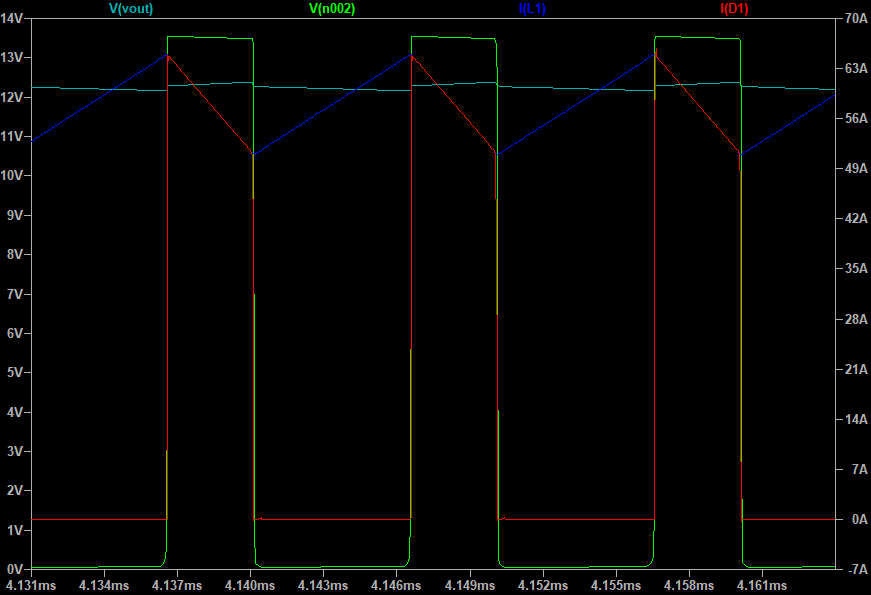
      Vout, V at Inductor, Current through diode, Current though Inductor
    Vout, V at Inductor, Current through diode, Current though Inductor

    To break down my boost converter’s operation, let’s define two phases: T1, when the switch is on and the inductor current (I_L1​, blue trace) rises, and T2, when the switch is off and the current falls.

    T1: Switch On

    • During T1, the input voltage (Vin​) drives the inductor (L), causing its current to increase linearly as the magnetic field builds. This follows V = L * (di/dt), visible in the blue trace’s upward slope.

    • When the switch is closed, the voltage at the switch node (Vn002​, green trace) falls to near zero because of the minimal resistance in the switch and inductor, while the voltage across the inductor remains equal to Vin.

    • Meanwhile, the capacitor (C) sustains the output voltage (Vout​) by supplying current to the load (R).

    • You’ll notice a slight dip in the Vout trace, evidence of voltage ripple as the capacitor discharges.

    • The diode, reverse-biased here, blocks any backflow from the output to ground, as confirmed by the red trace showing zero diode current.

    T2: Switch Off

    • When the switch opens in T2, the inductor’s magnetic field collapses, driving current through the diode to the capacitor and load at a steadily declining rate. This induces a voltage across the inductor (V = L * (di/dt)), which adds to Vin to produce the “boosted” Vout​.

    • The green trace Vn002​ spikes as the inductor’s voltage reverses polarity (voltage adds to Vin), driving the boost effect. This process transfers energy to the capacitor, which stores it to stabilize Vout​, smoothing the output and supplying current to the load.

    • The red trace now shows forward biased diode current flowing, matching the inductor’s discharge.

    These phases highlight how the inductor and capacitor work together: L stores energy in T1, then releases it in T2, while C ensures a stable output.

    Websites and References Used:

  • February 2025 – Cosmetic Details

    In February the main project was the bathroom in my unit, but did several other little touchups around the house. We also got brand new water heaters, the old ones were both leaking, not holding consistent temperatures and at the end of their life.

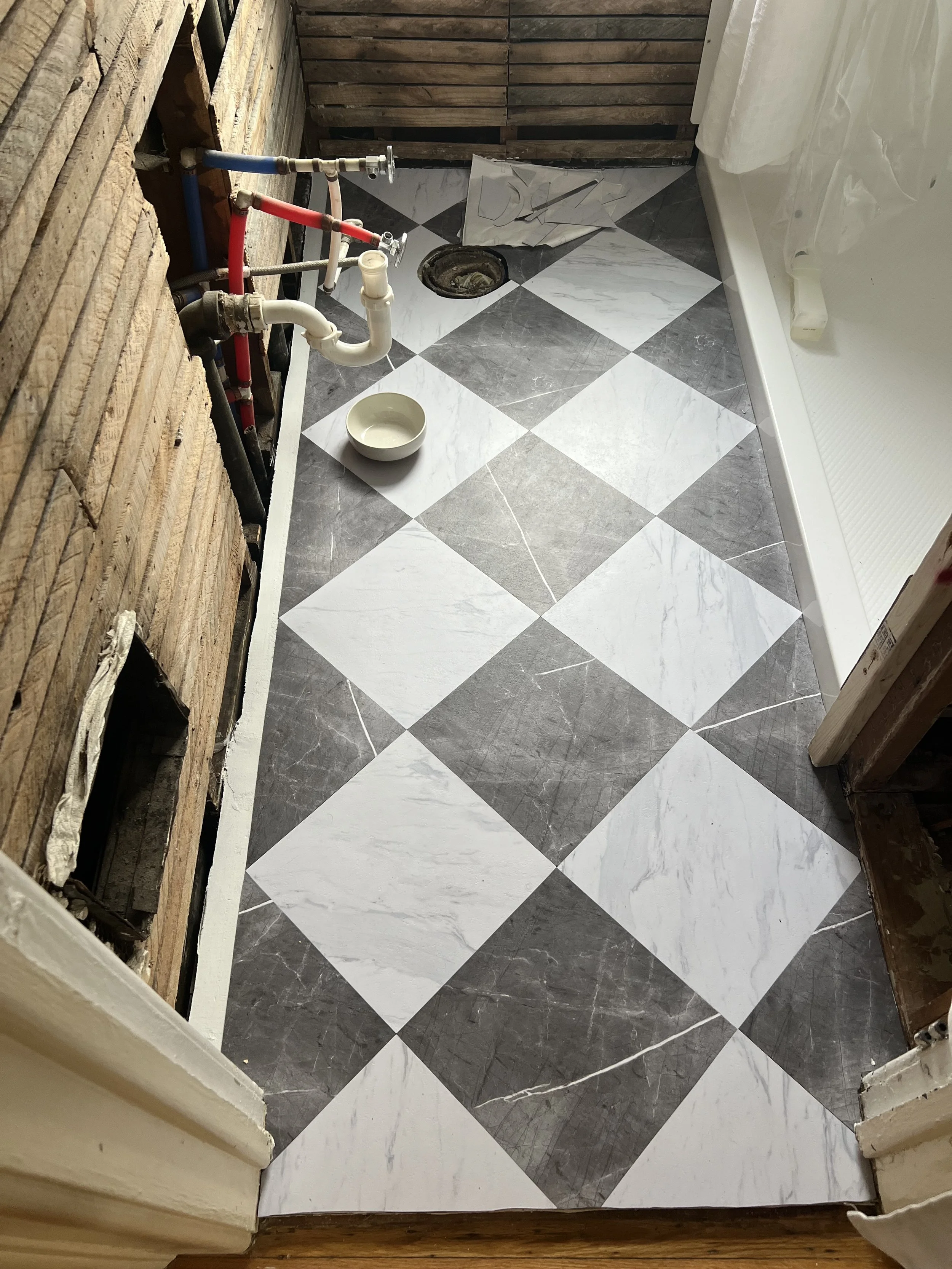
    Before installing the tiles, we started by applying a latex primer over the Hardie board. I then carefully cut and installed the tile.

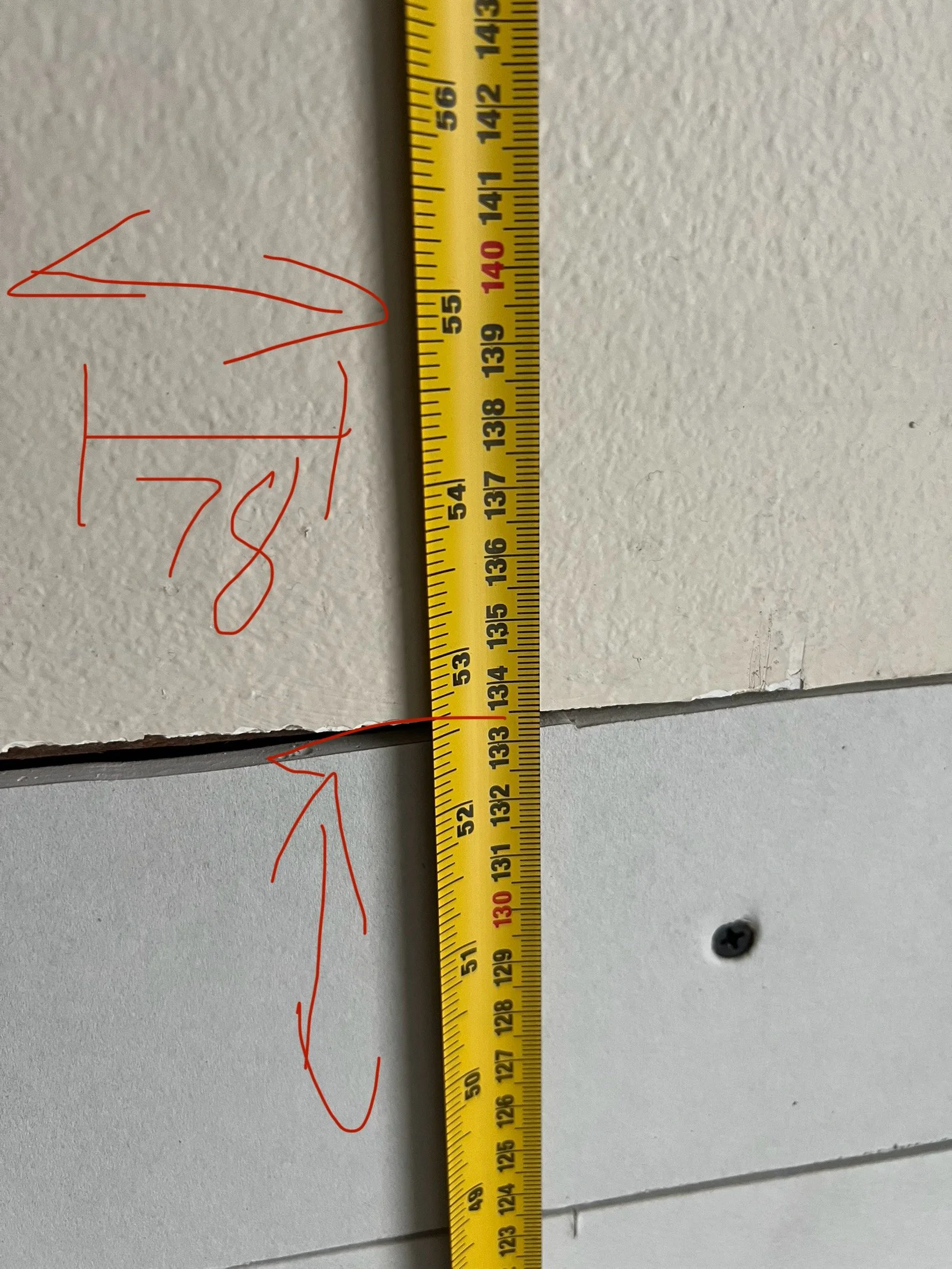
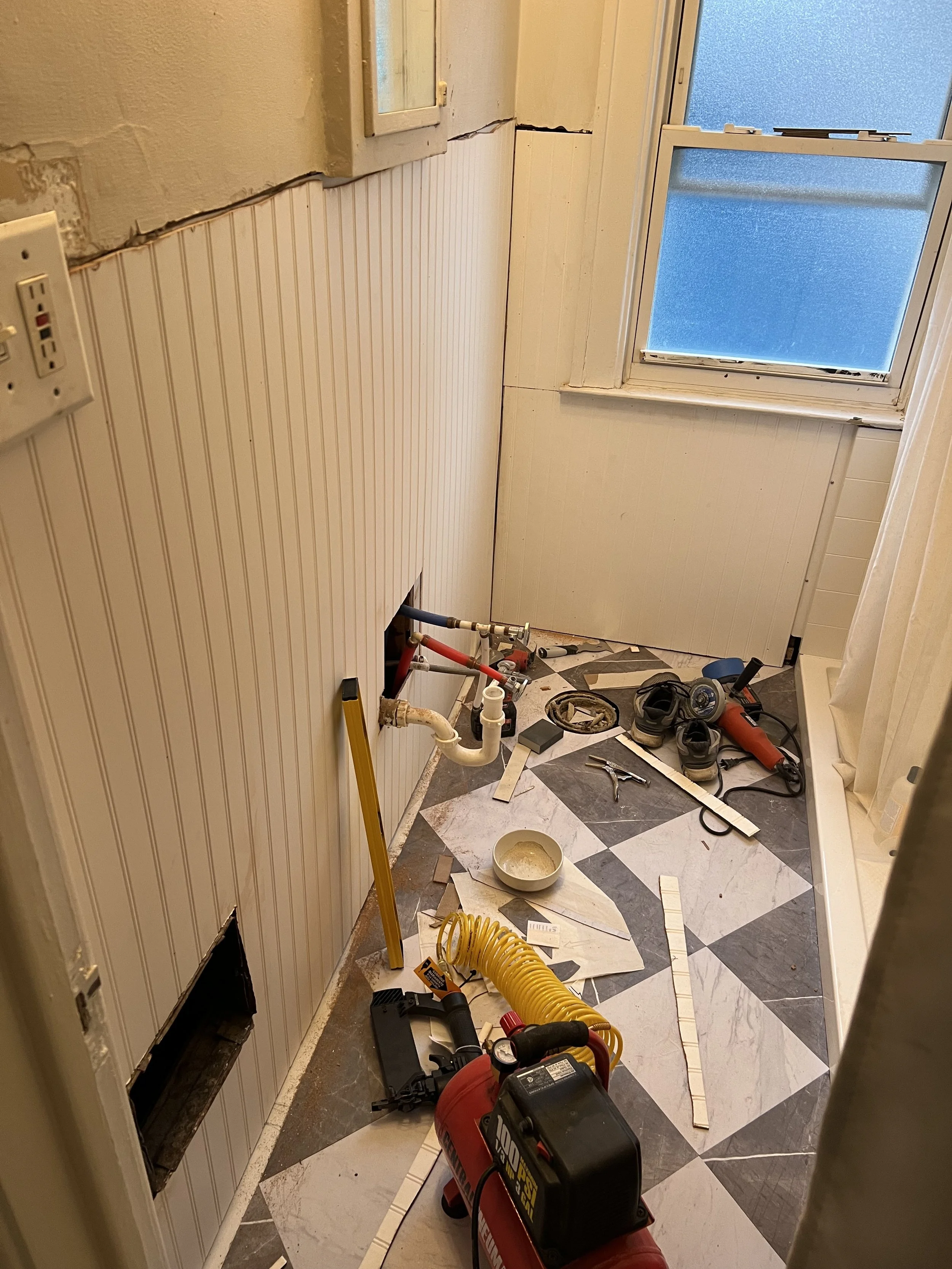
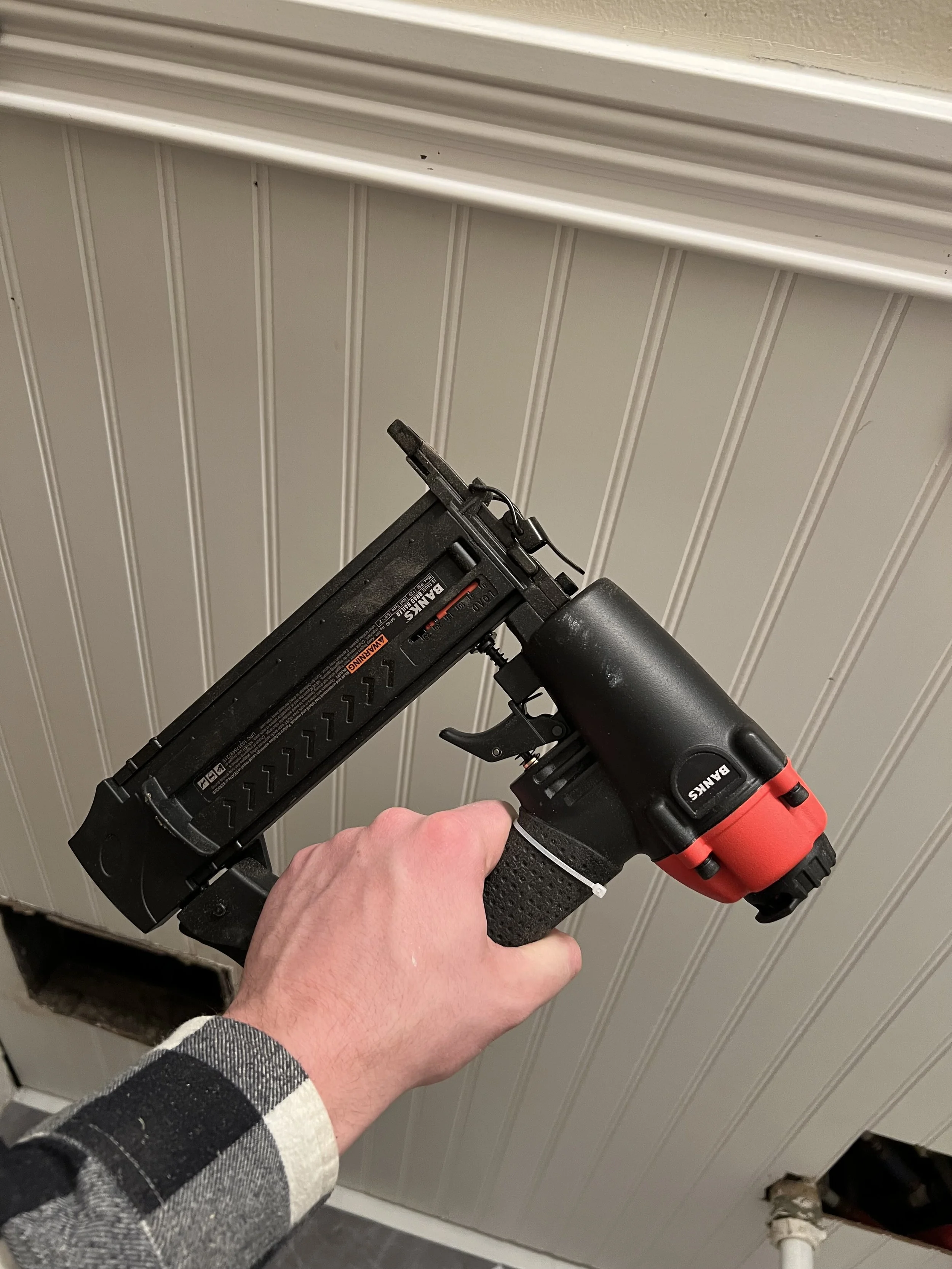
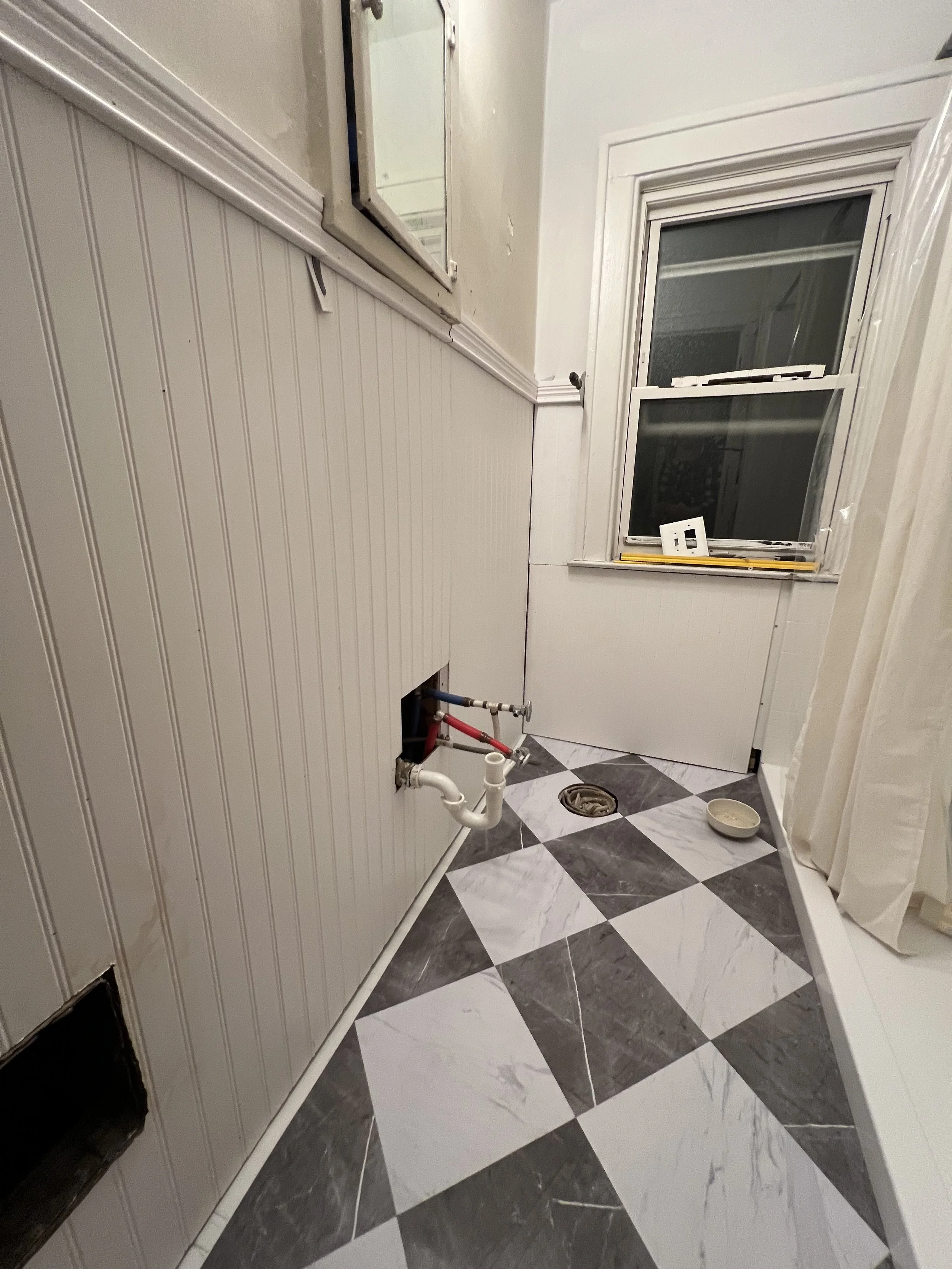
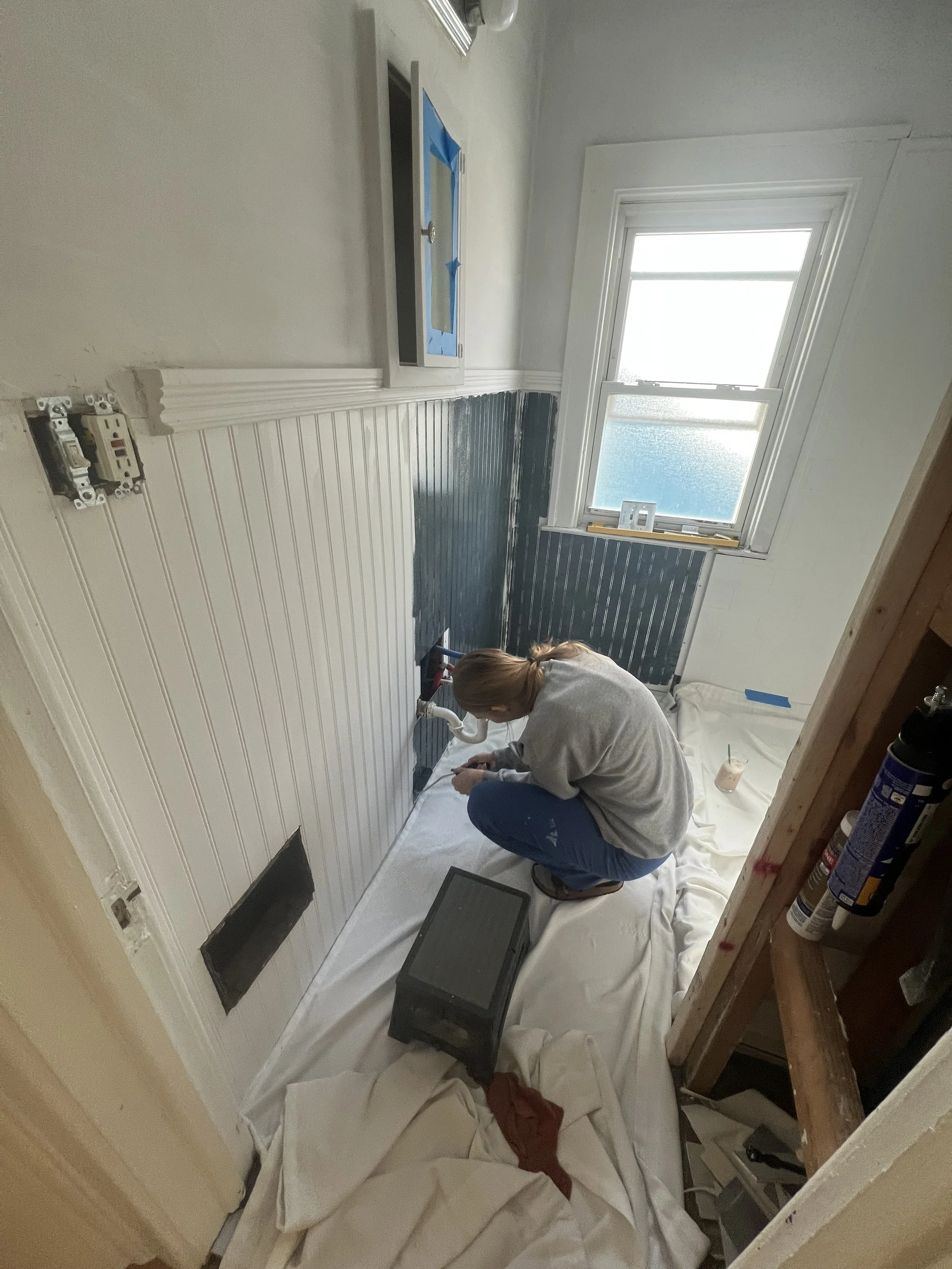
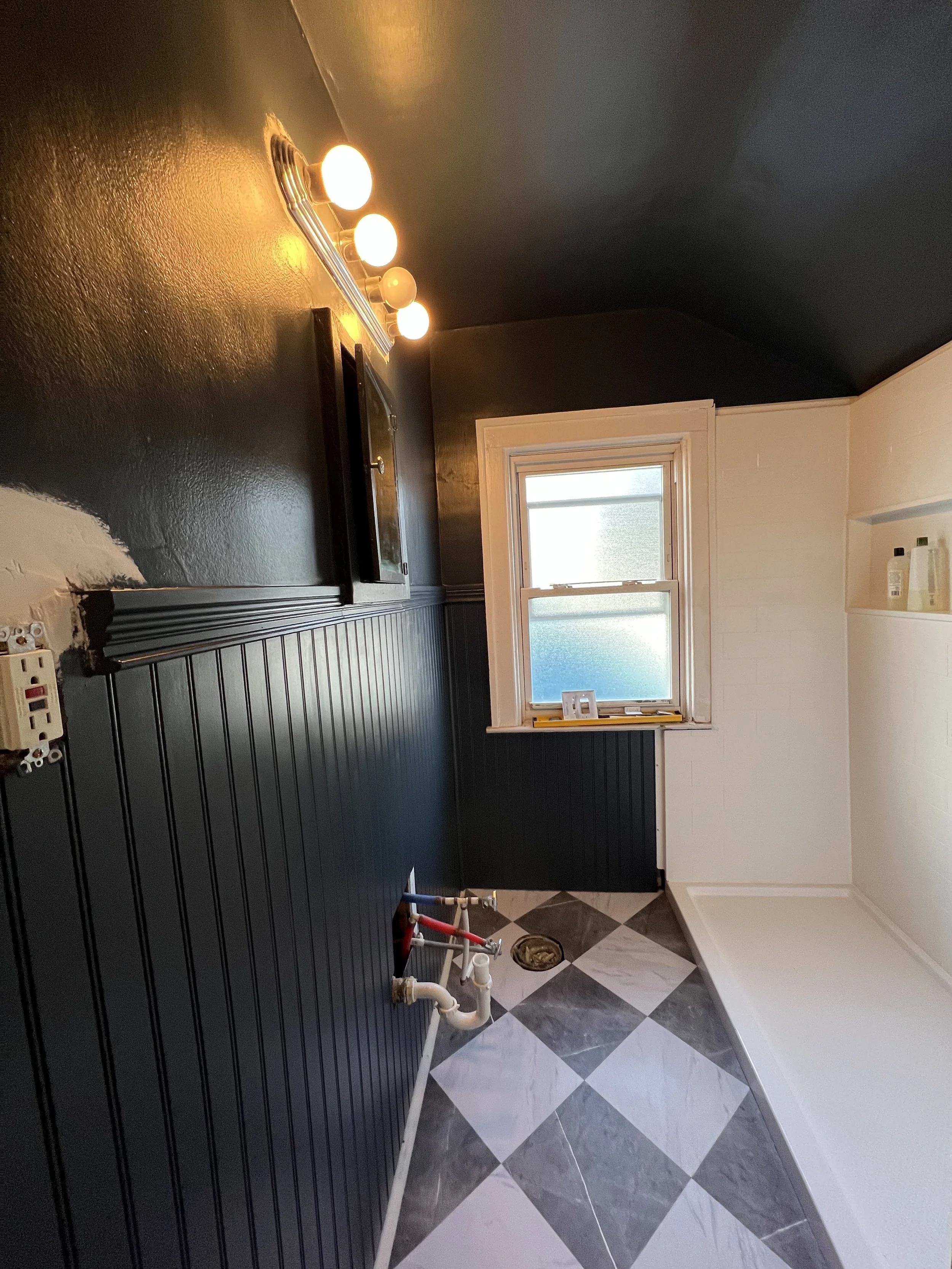
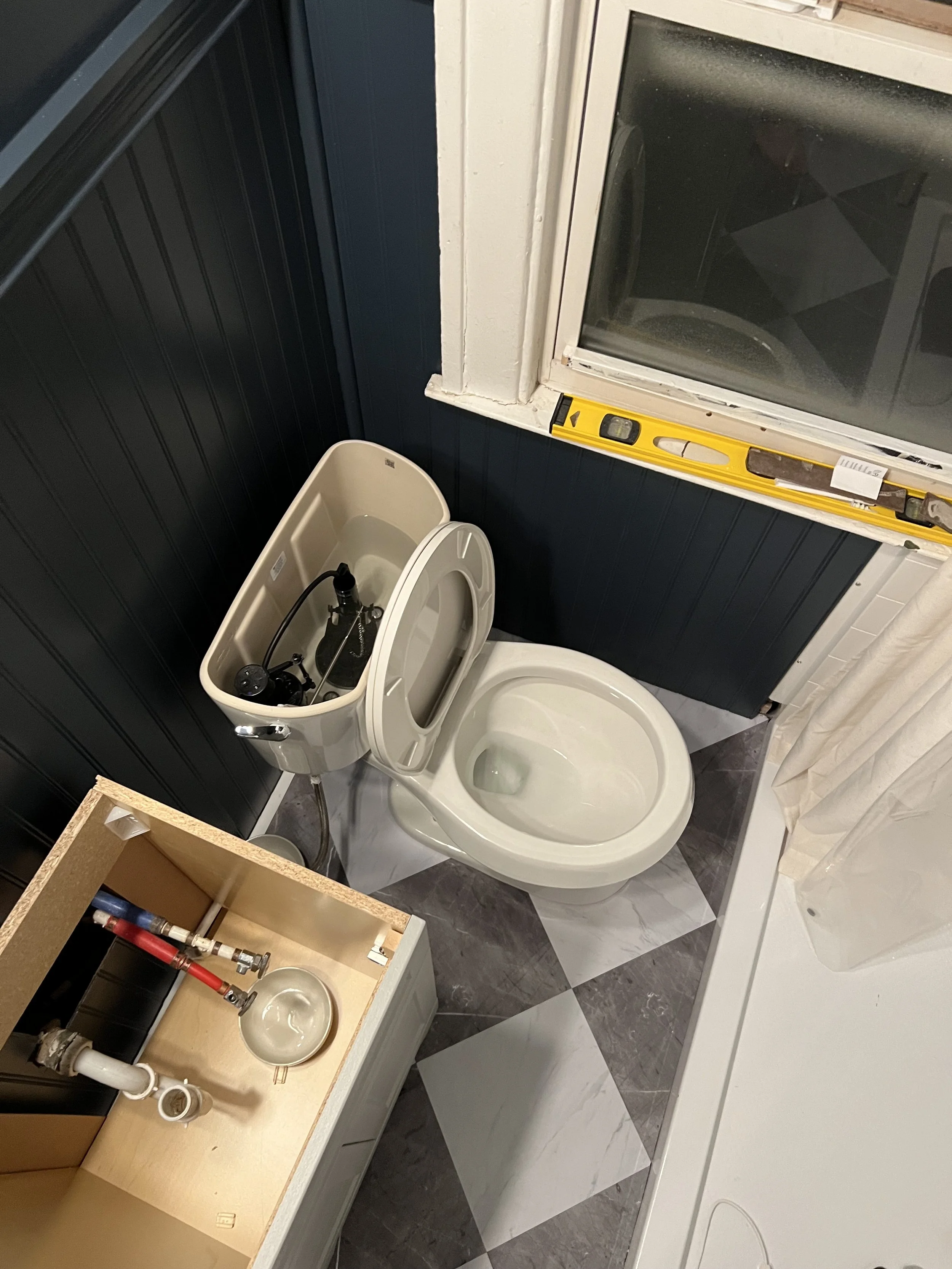
    The existing lathe and plaster on the wall was quite uneven, with about a half-inch of plaster over the lath. To create a smooth base for the finishing beadboard, I screwed in 1/4-inch drywall directly over the lath. If you don’t already own one and plan on doing any trim or finishing work like this, I highly recommend buying a brad nailer. I learned this the hard way downstairs, where I spent two hours carefully hammering in nails to avoid damaging the paint or finish of the bead boards. The brad nailer, which cost only $30 at Harbor Freight, saved me several hours and neatly buries the nails, making them easy to fill or paint over. Once the beadboard and trim were up, we moved on to caulking and painting the walls. After the vanity base and toilet were installed, I added an extra rounded corner piece on the left wall to seamlessly bridge the gap between the wall and the tile.

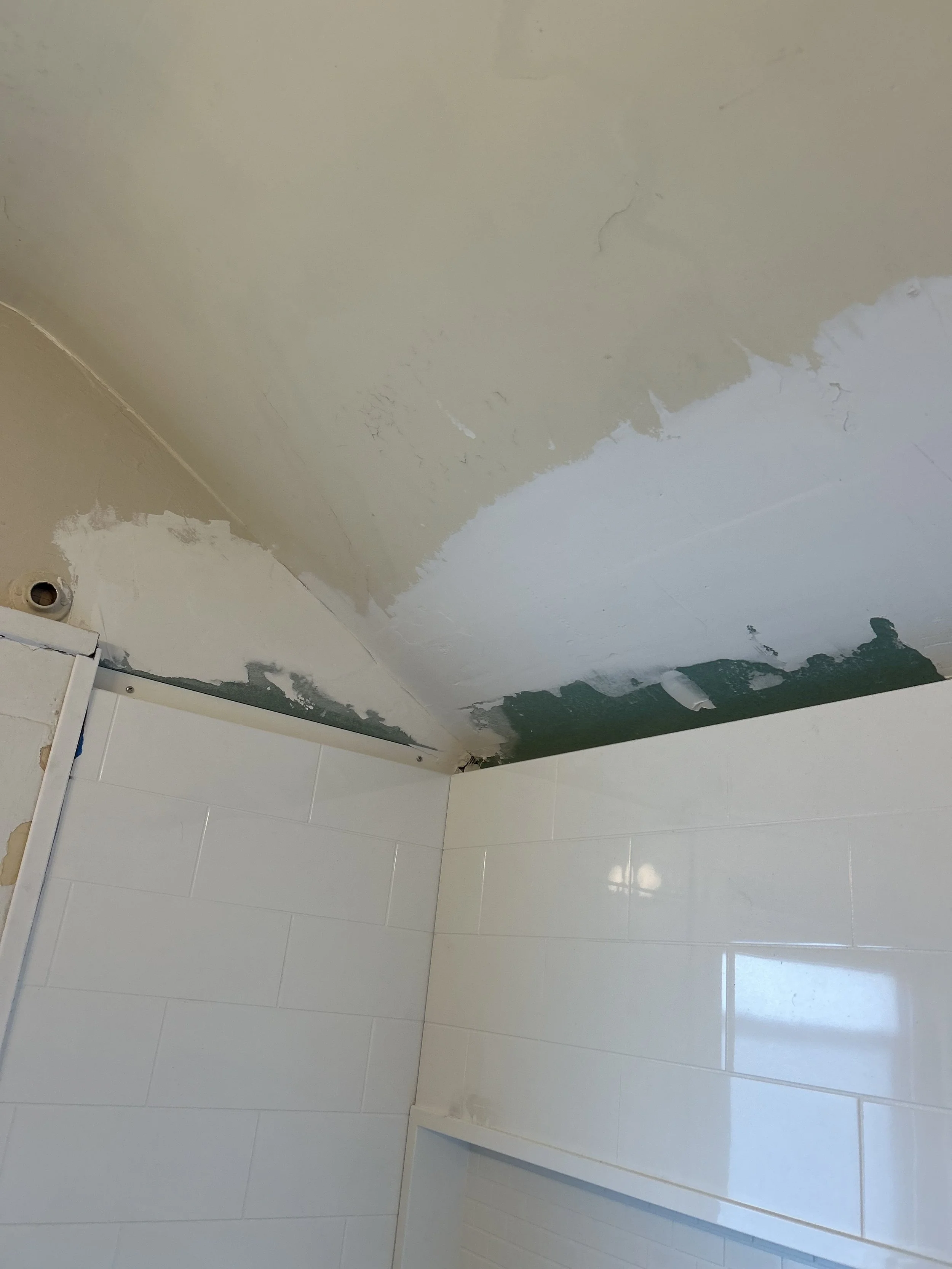
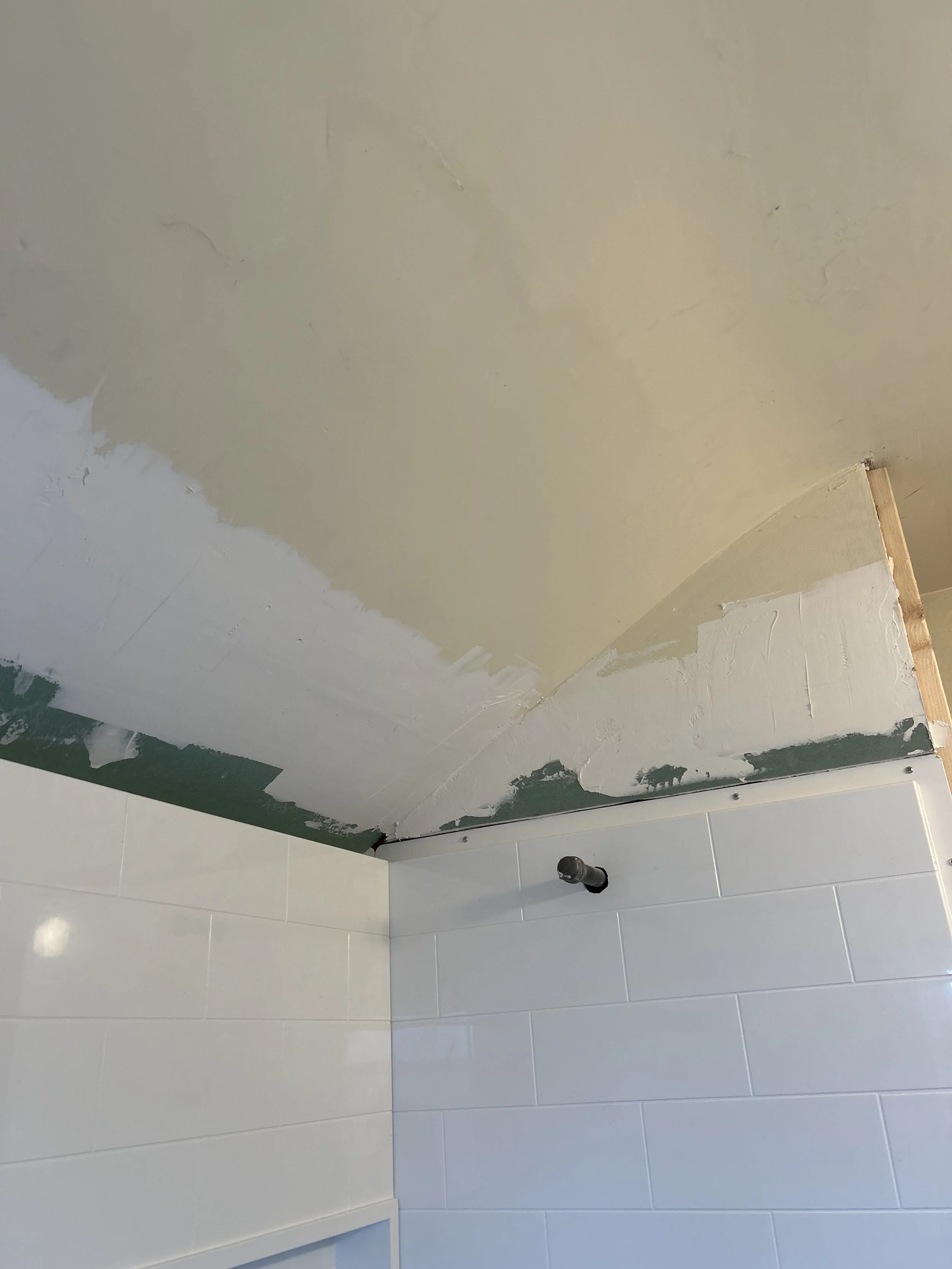
    Due to a crooked and old cast iron toilet base drain, I had to use two wax rings and an adapter to ensure a good seal. Before painting, we scraped and applied joint compound to several spots on the ceiling where the paint was peeling due to water damage. For the new paint, I used the same semigloss finish as in the downstairs kitchen. We applied two coats of primer and three coats of the semigloss paint to thoroughly seal against water and steam.

  • January 2025 – Bathroom x Bathroom

    After getting married in December, I had to finish up the bathrooms for obvious reasons. I have been using the the bottom unit bathroom while the top one is gutted, but the bottom unit has been leaking into the basement.

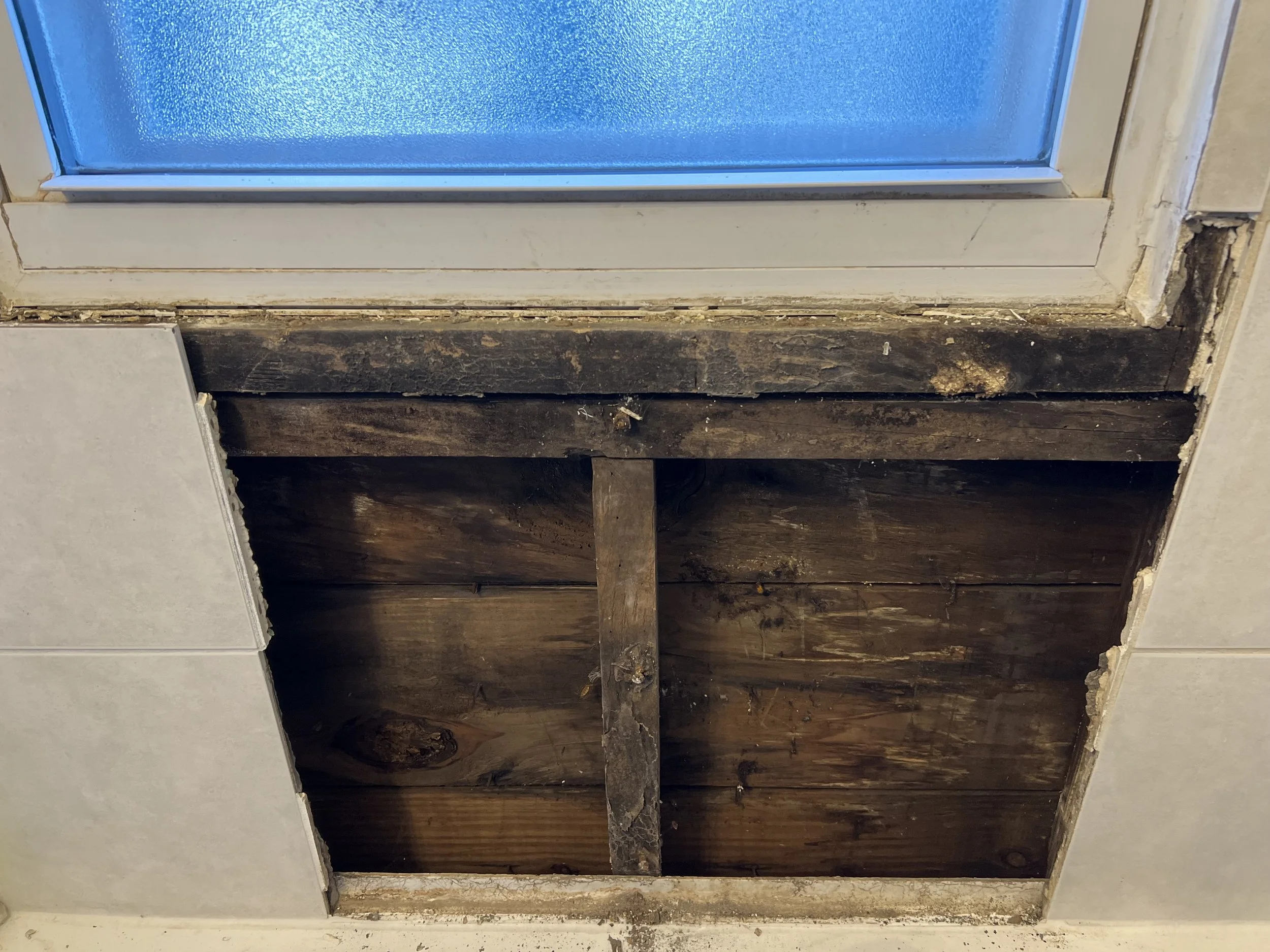
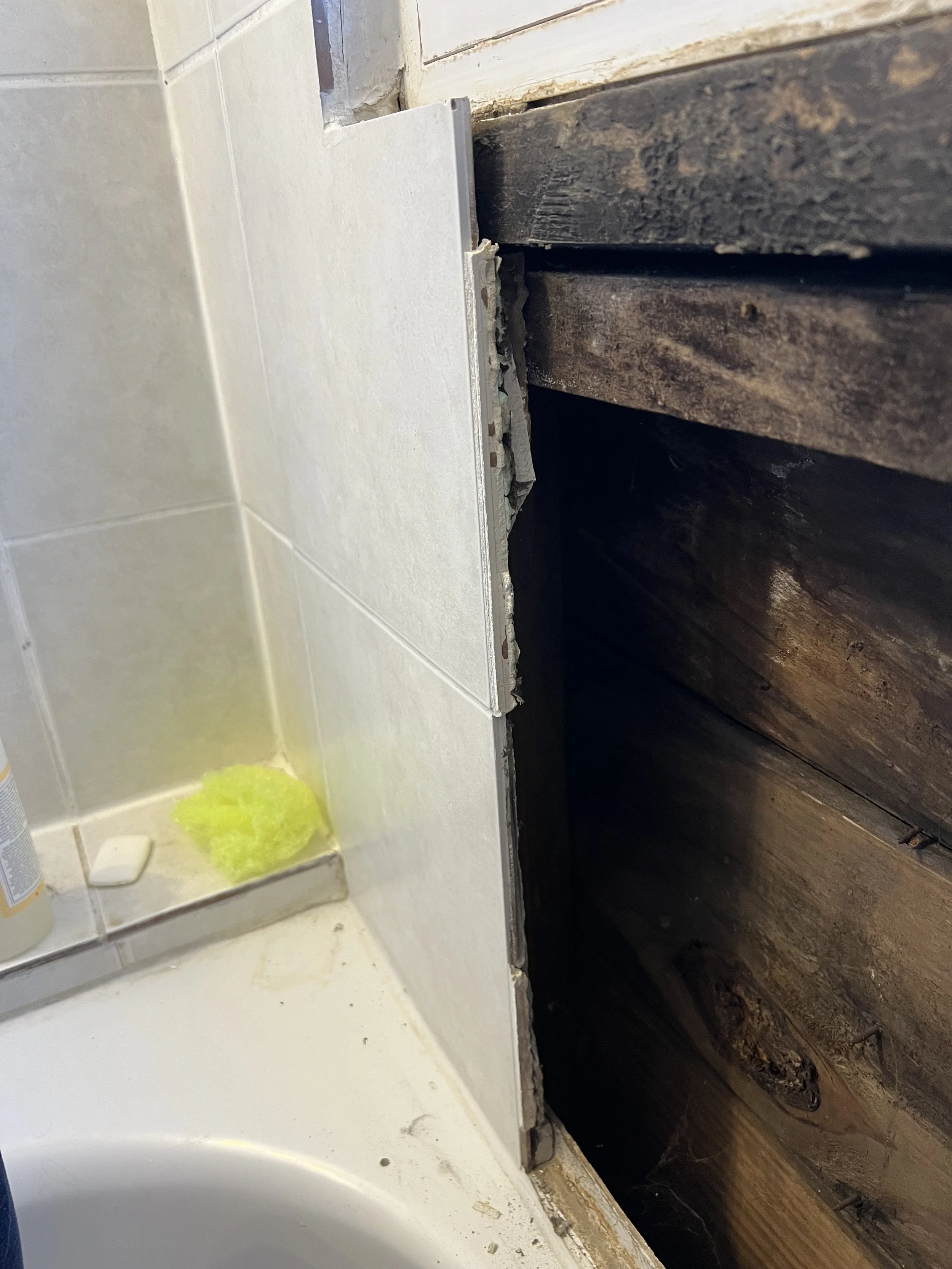
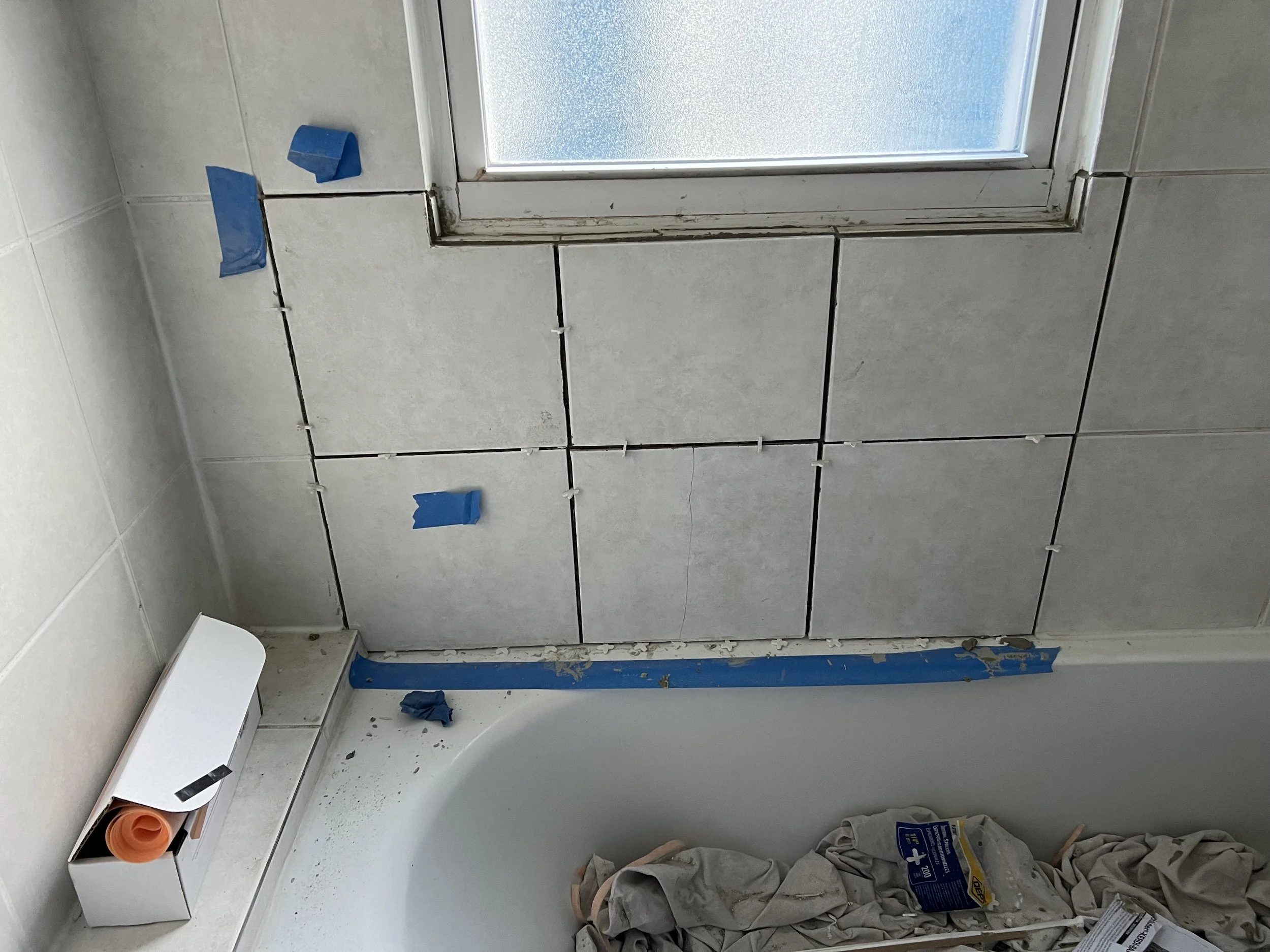
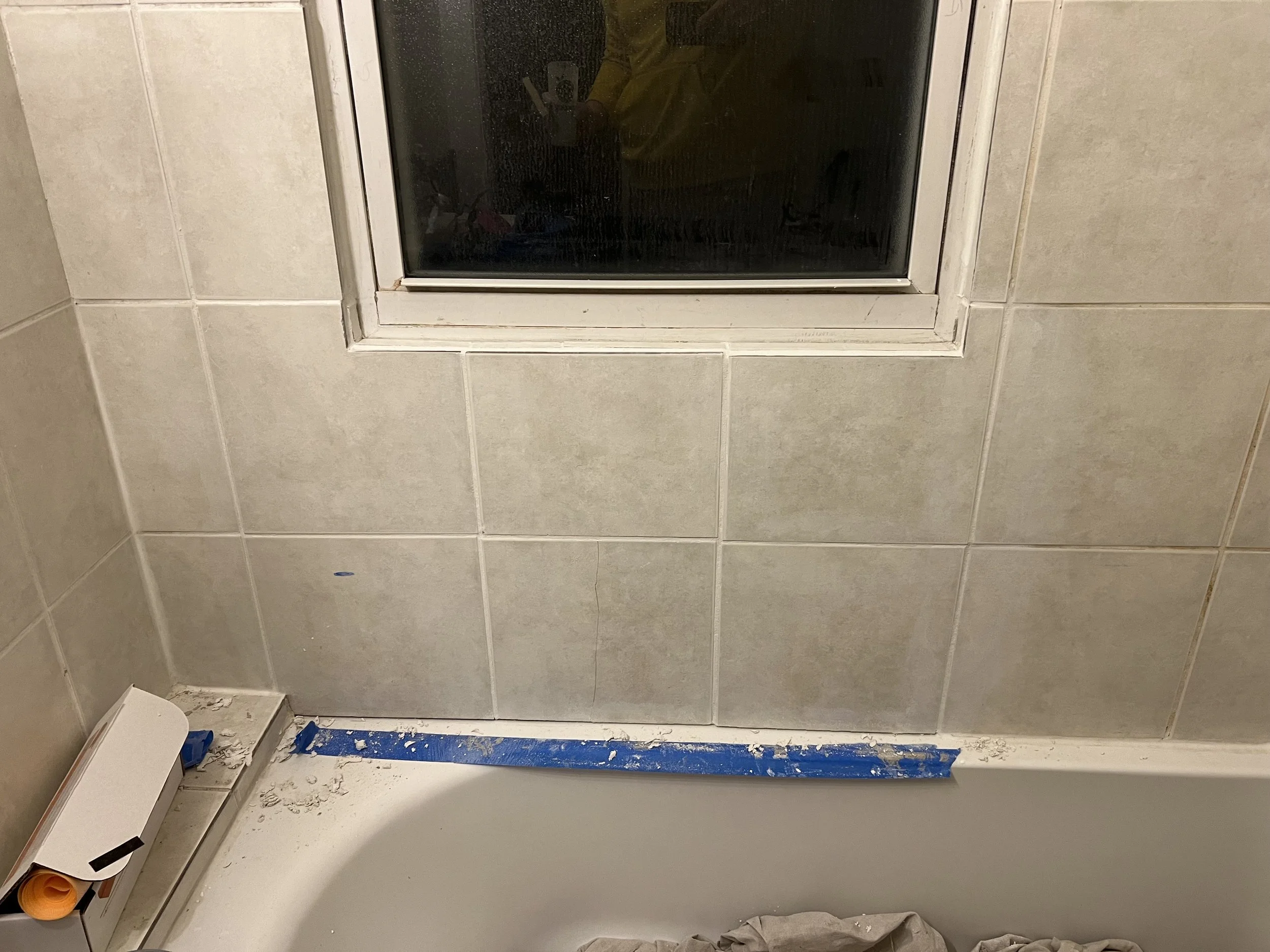
    The persistent shower leak in the basement proved to be a stubborn adversary. Despite replacing the toilet’s wax ring, recaulking the tub edge, and addressing minor tile issues, water continued to infiltrate after each shower. Diagnostic testing, including prolonged tub water flow without leaks, narrowed the problem to the shower wall below the window.

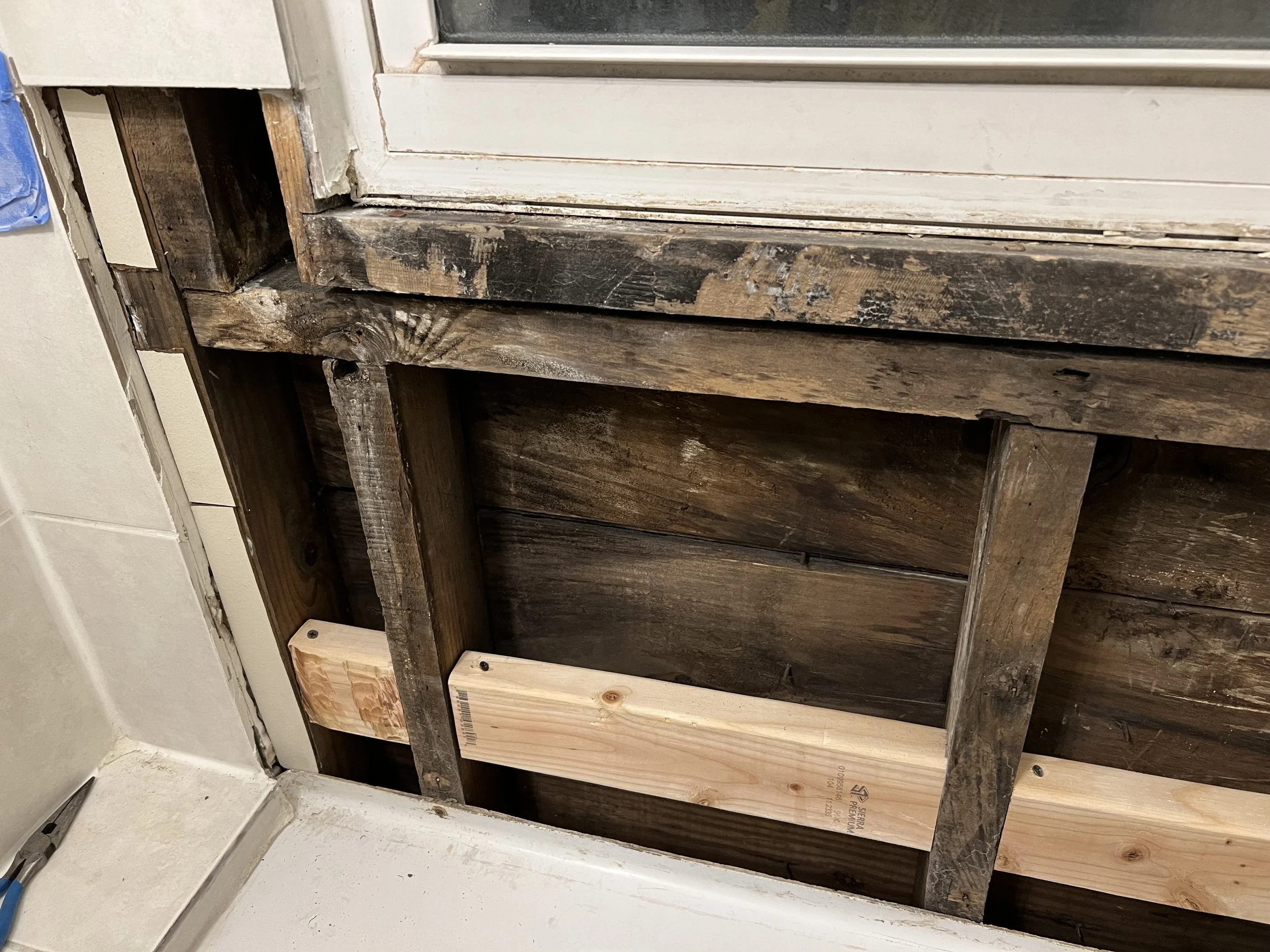
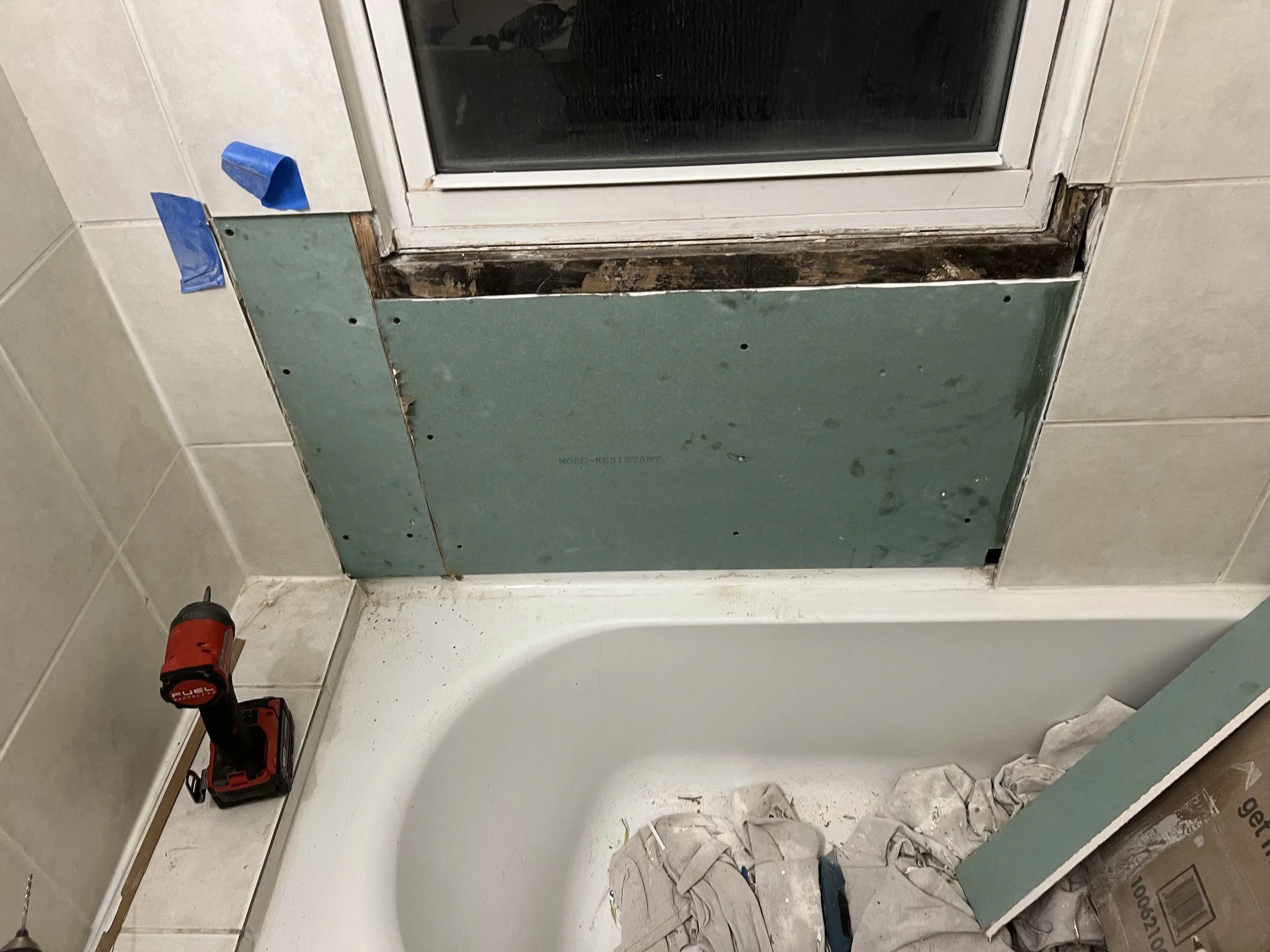
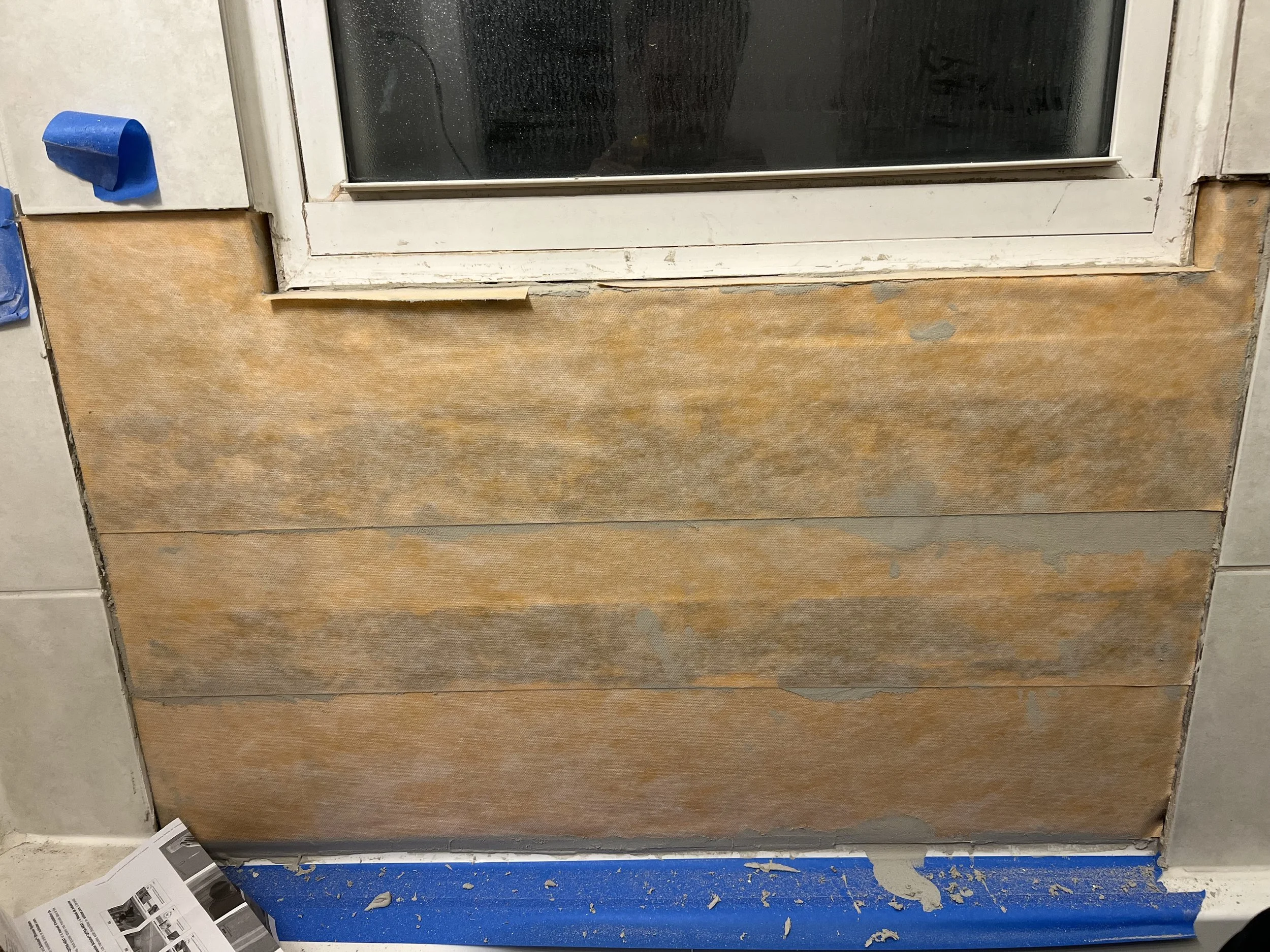
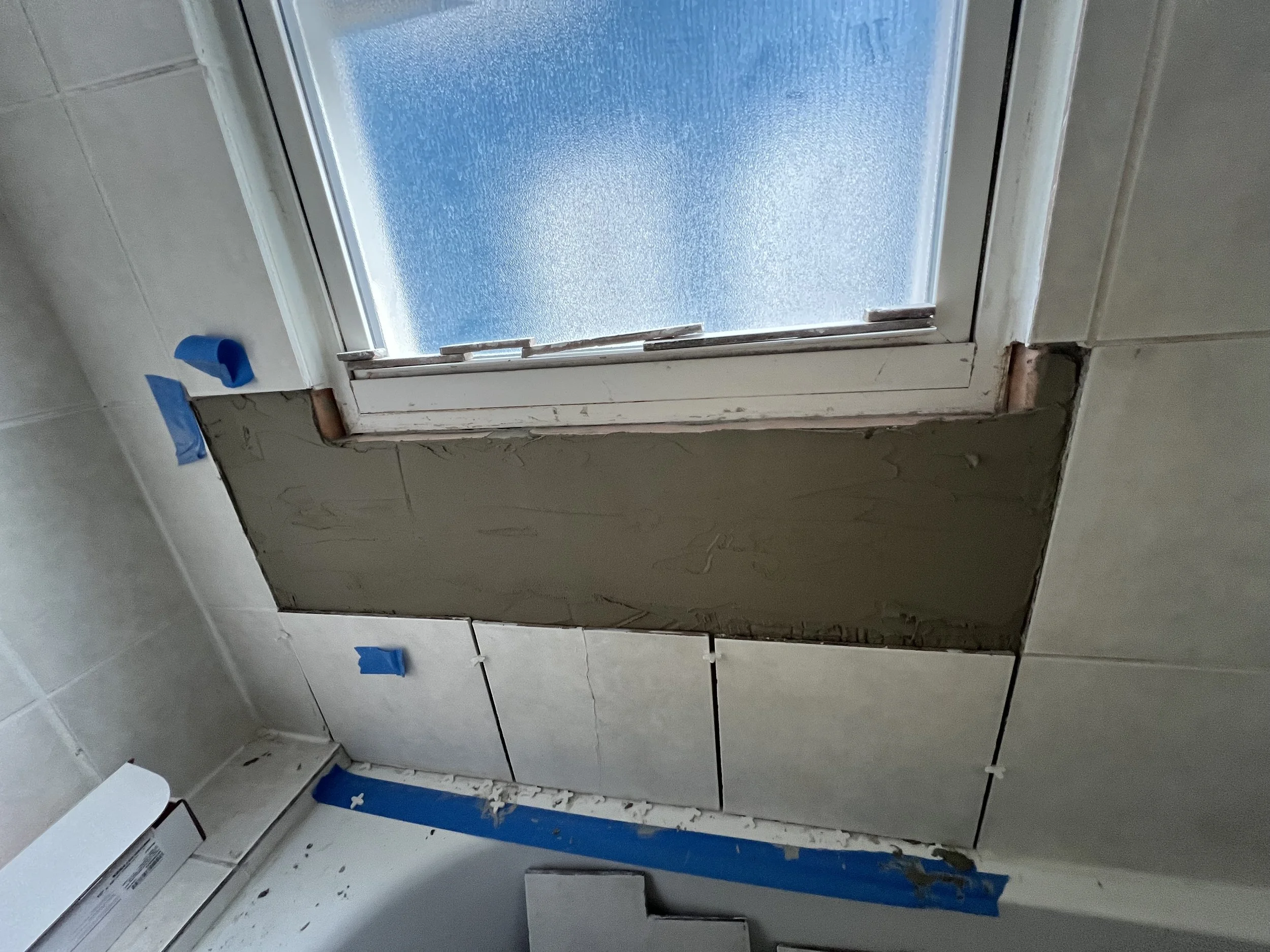
    I investigated further and found that grout cracks were allowing the water penetration. Upon removing several tiles, it became evident that the underlying drywall had severely deteriorated, leaving the tiles unsupported. Six tiles were removed to expose the damaged area. Structural supports were added to the studs, and new drywall was installed. To enhance waterproofing, I applied 10-inch Kerdi-band, followed by a mud layer.

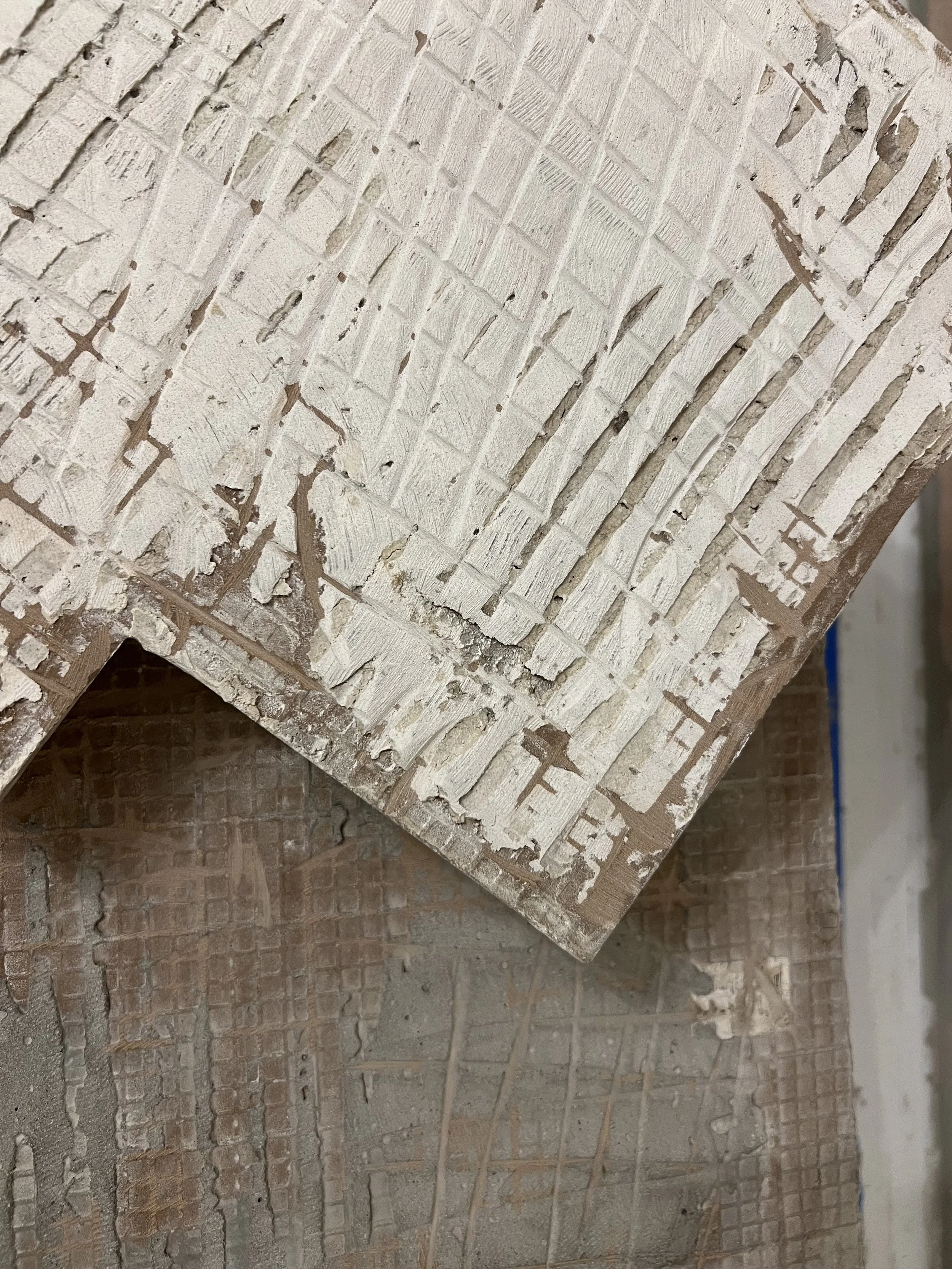
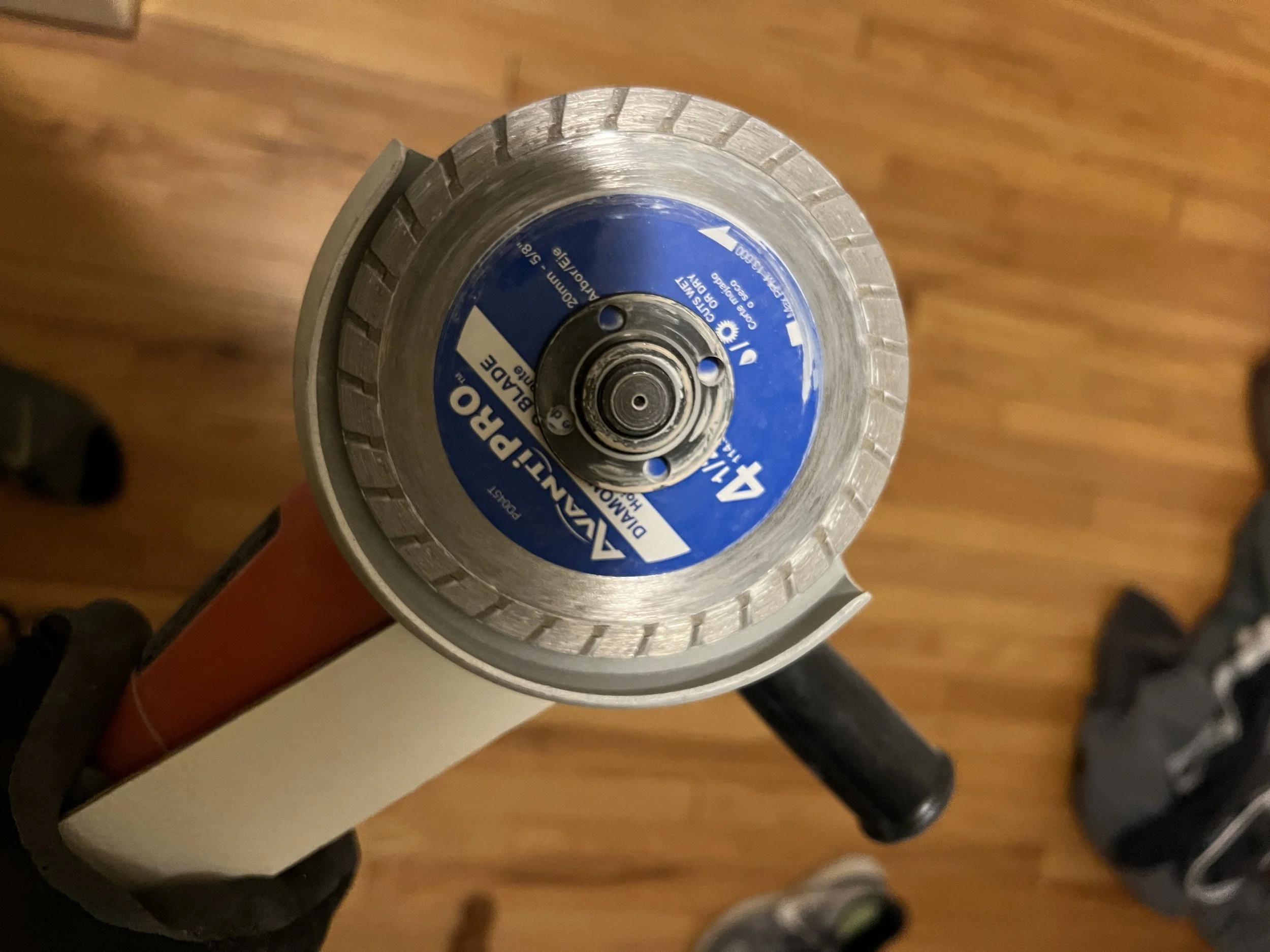
    The salvaged tiles required extensive cleaning to remove residual mortar and grout. A diamond cutoff wheel on an angle grinder proved effective for this task, despite some minor surface irregularities remaining. After tile reinstallation and fresh grouting, a deep clean and grout impregnator was applied around the entire shower for added water resistance.

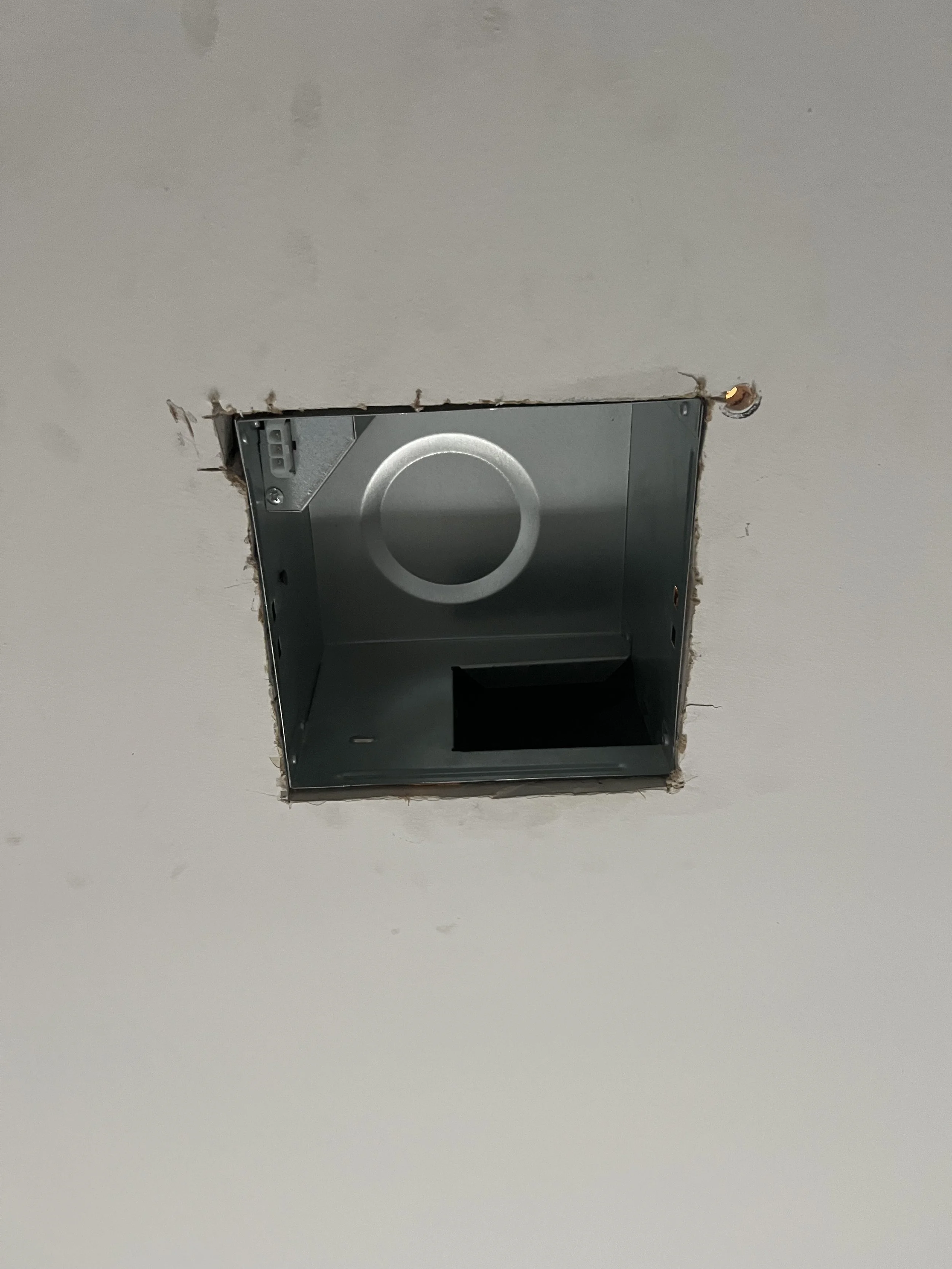
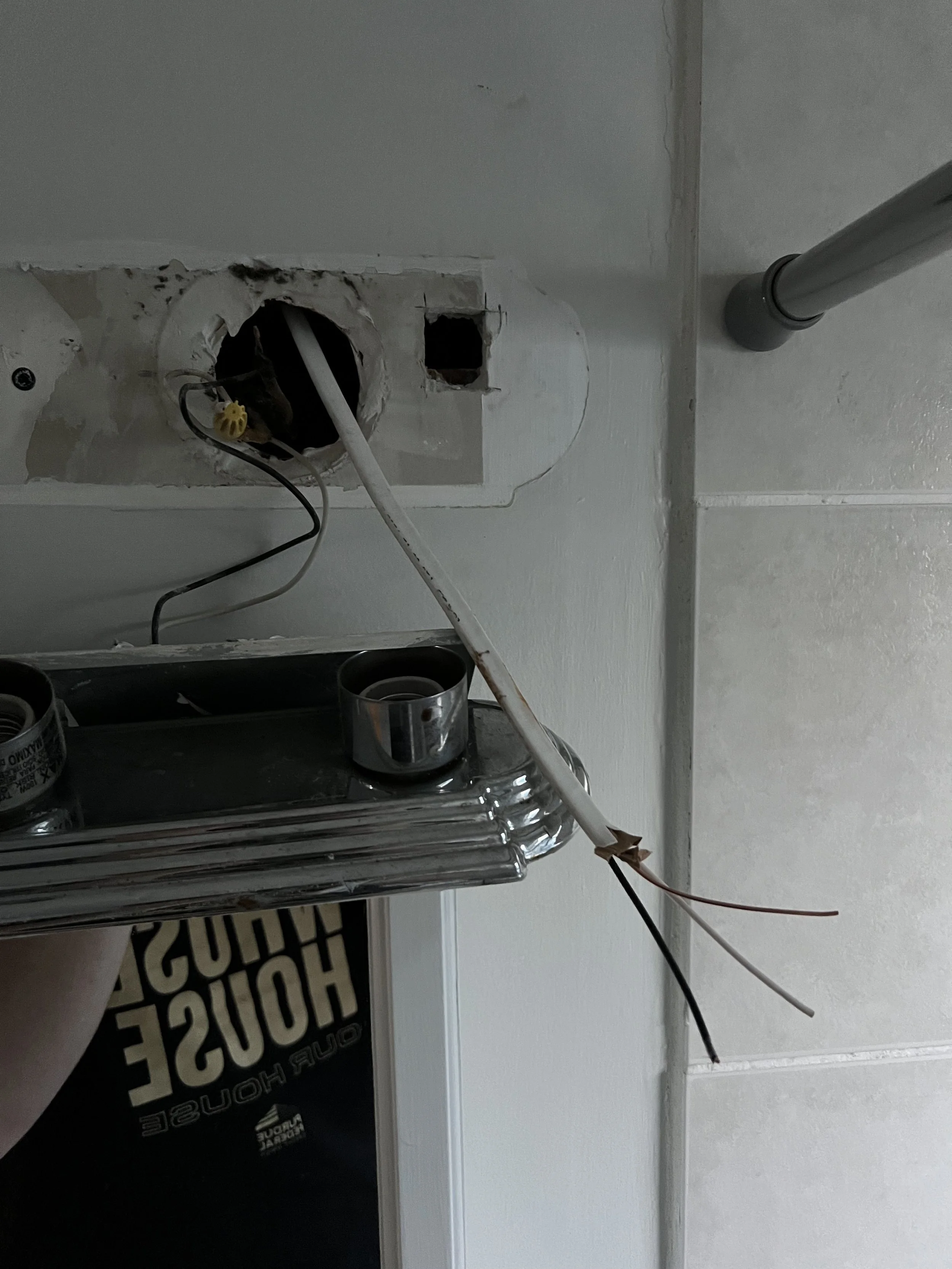
    Taking advantage of ceiling access, an exhaust fan was installed to improve ventilation. I used my SUV as a temporary platform for cutting the outside wall opening and securing the vent. There were many small roadblocks during this installation that required moment by moment problem solving and a lot of effort to stay calm.

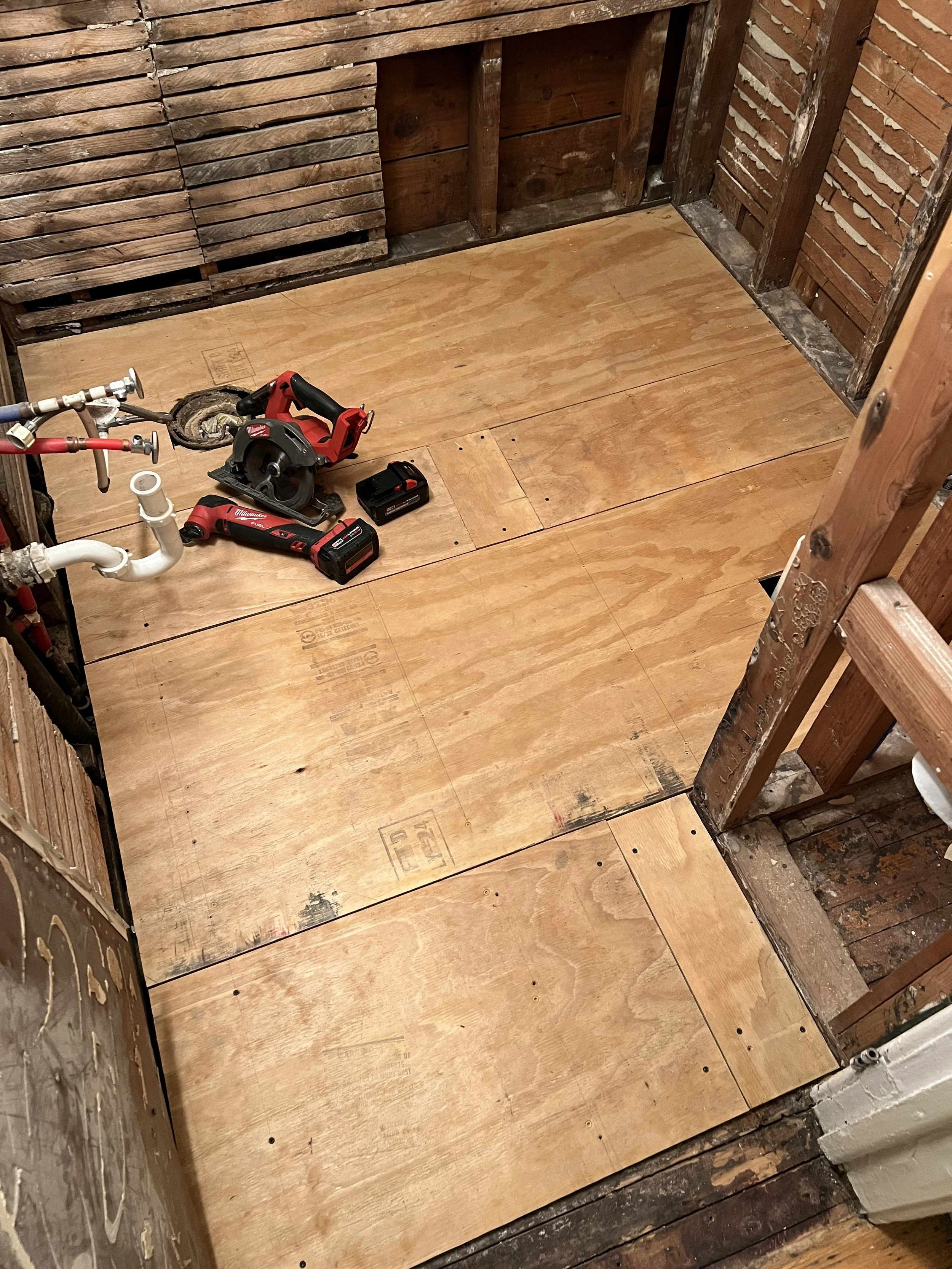
    The upstairs bathroom renovation continued with tackling the subfloor. I utilized old floor planks and oak flooring pieces to level the existing subfloor, ensuring a stable foundation. Additionally, I reinforced areas where joists had been previously altered, providing added structural support. My M18 Fuel impact driver, one of the best $100 I have spent.

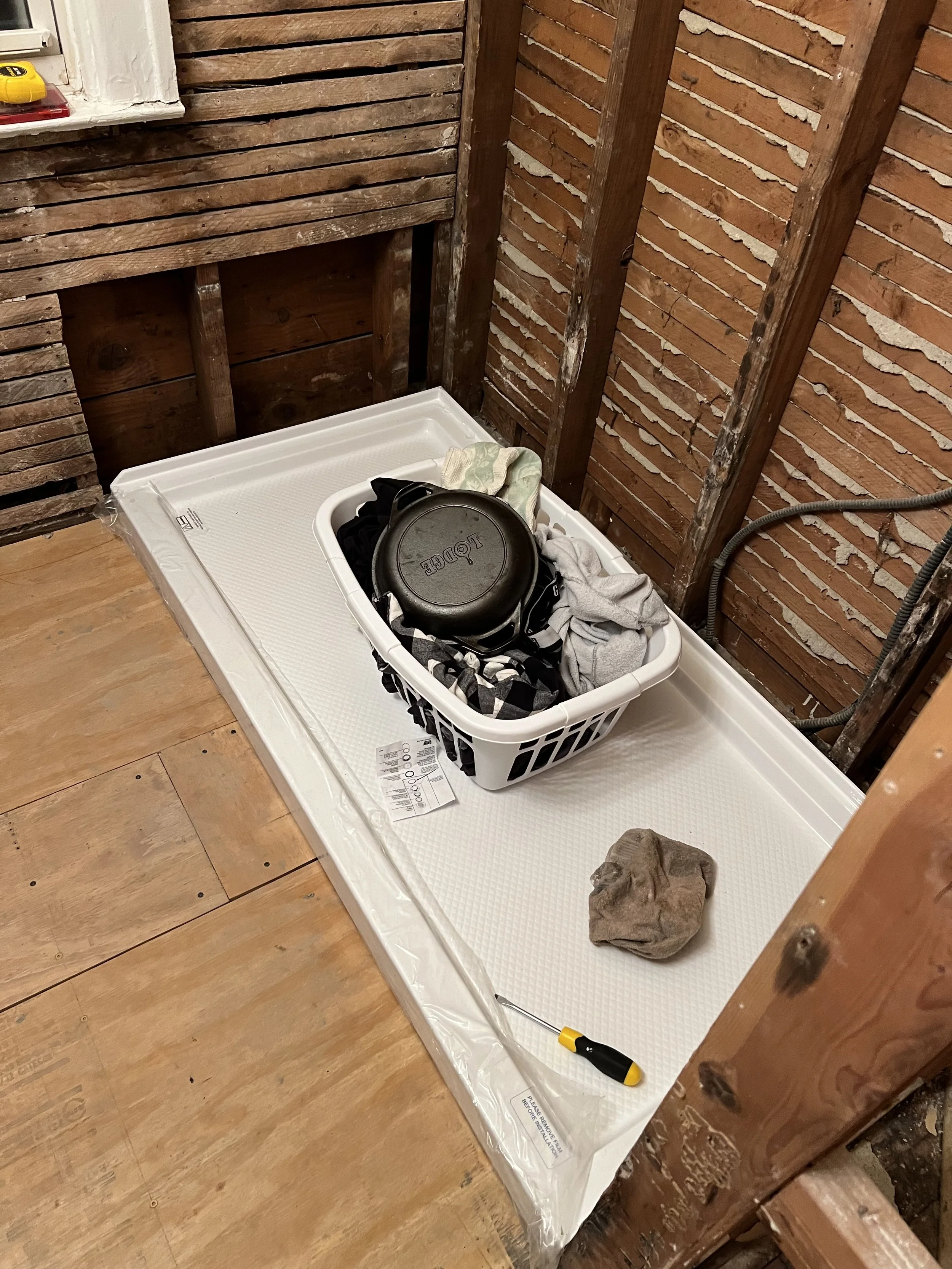
    The shower pan installation presented a new challenge: creating a mud bed. This process required careful mixing and placement, and I found myself needing to mix additional batches of mud mid-installation to ensure proper support for the pan.

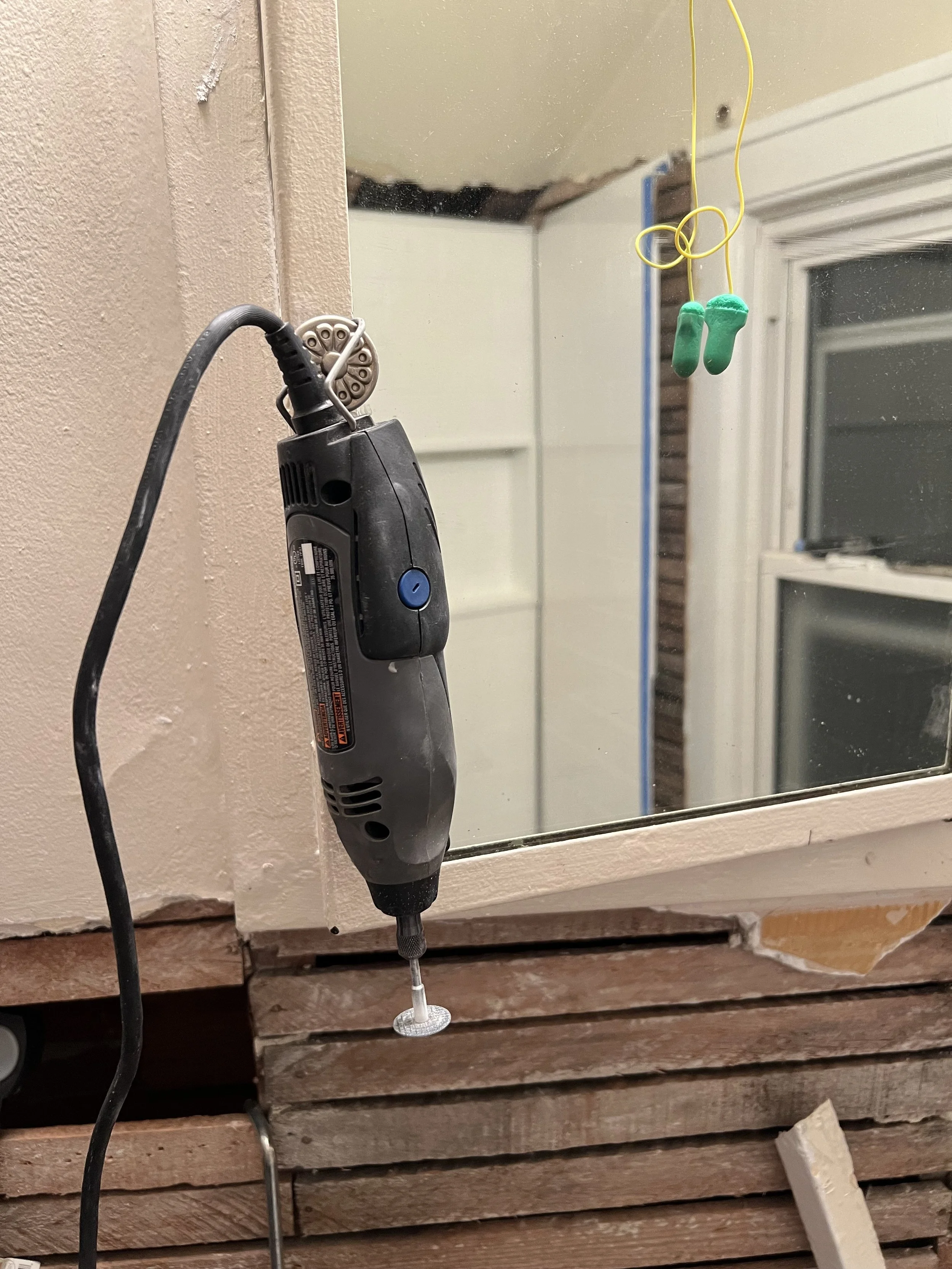
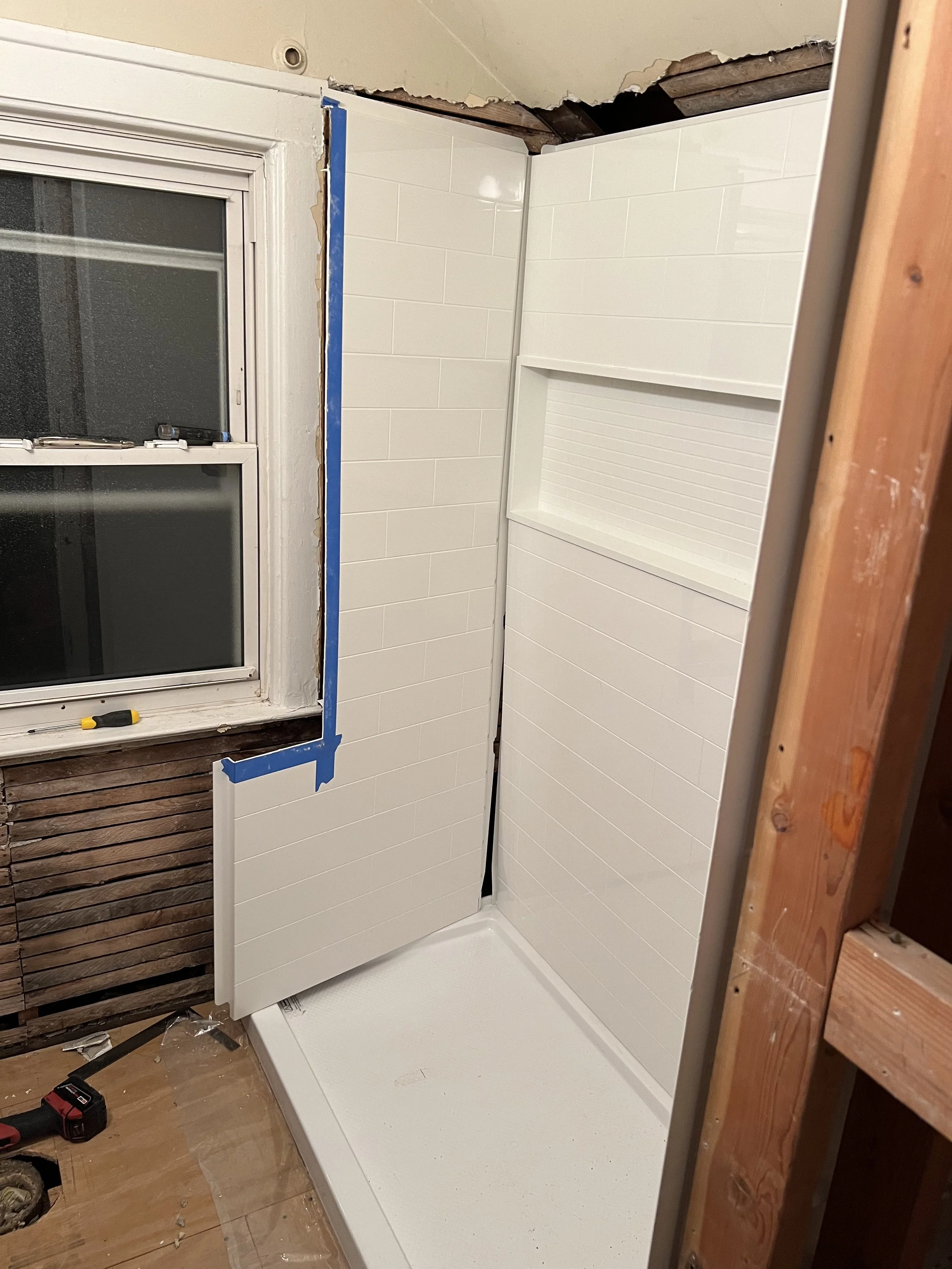
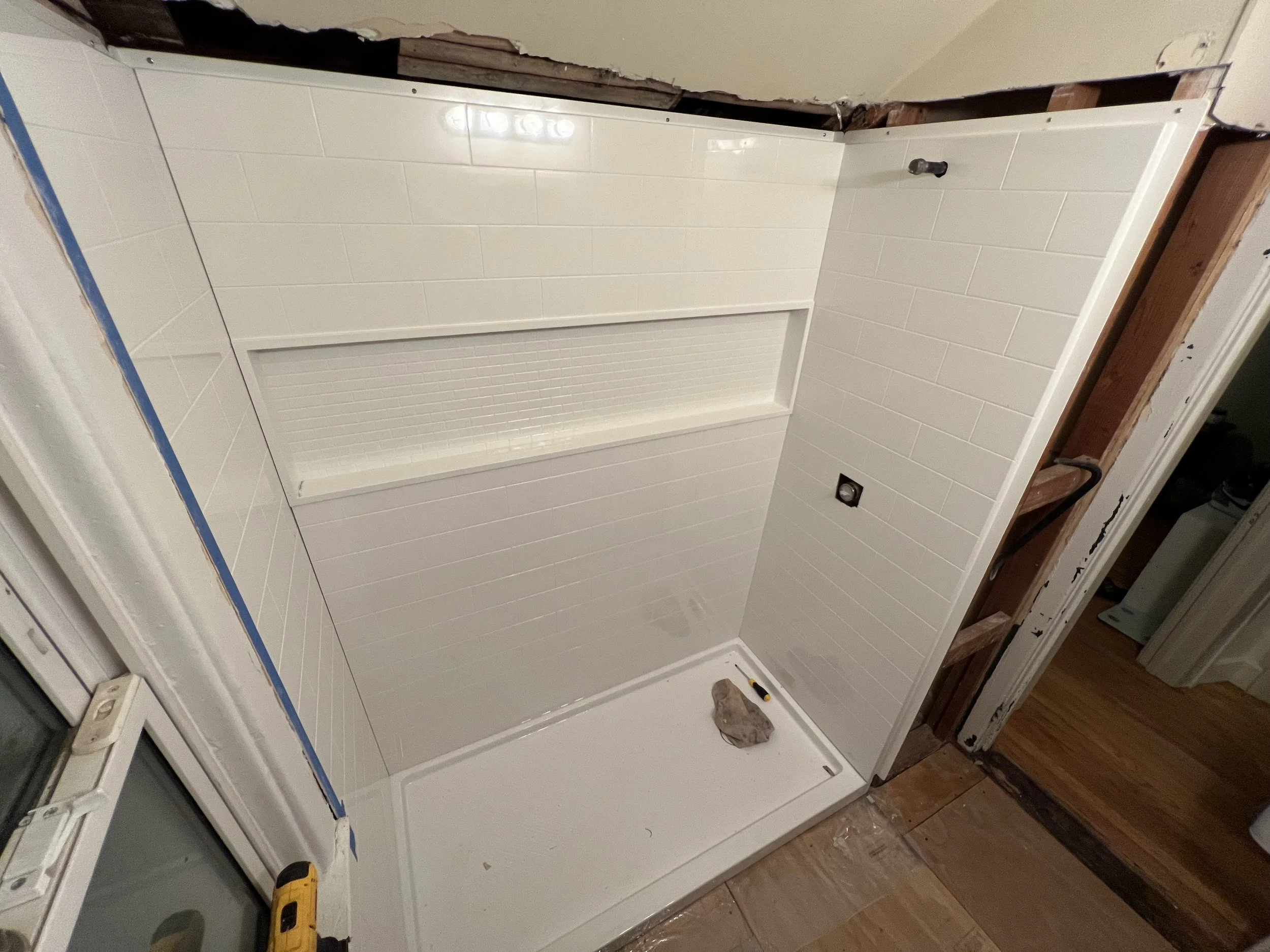
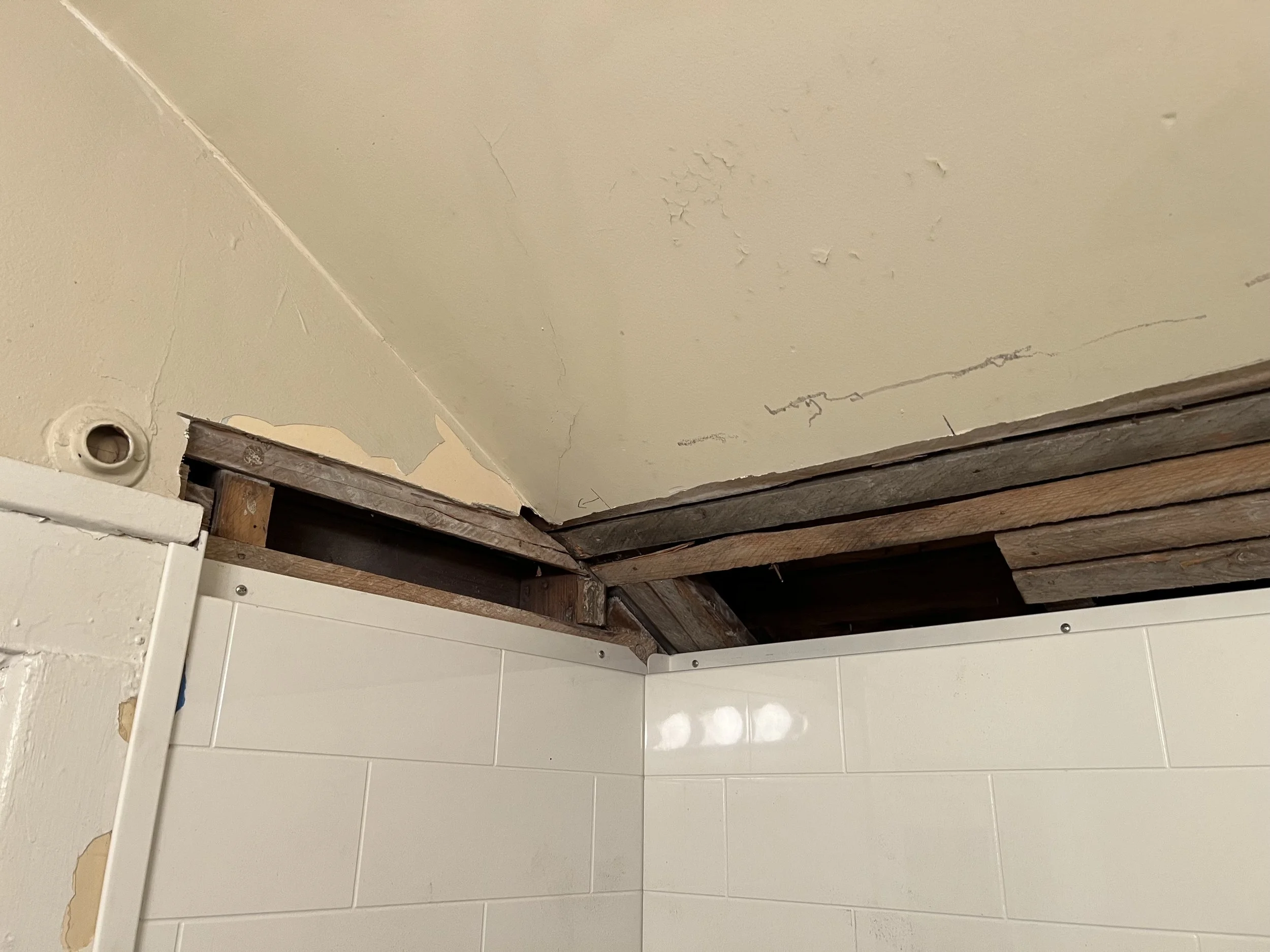
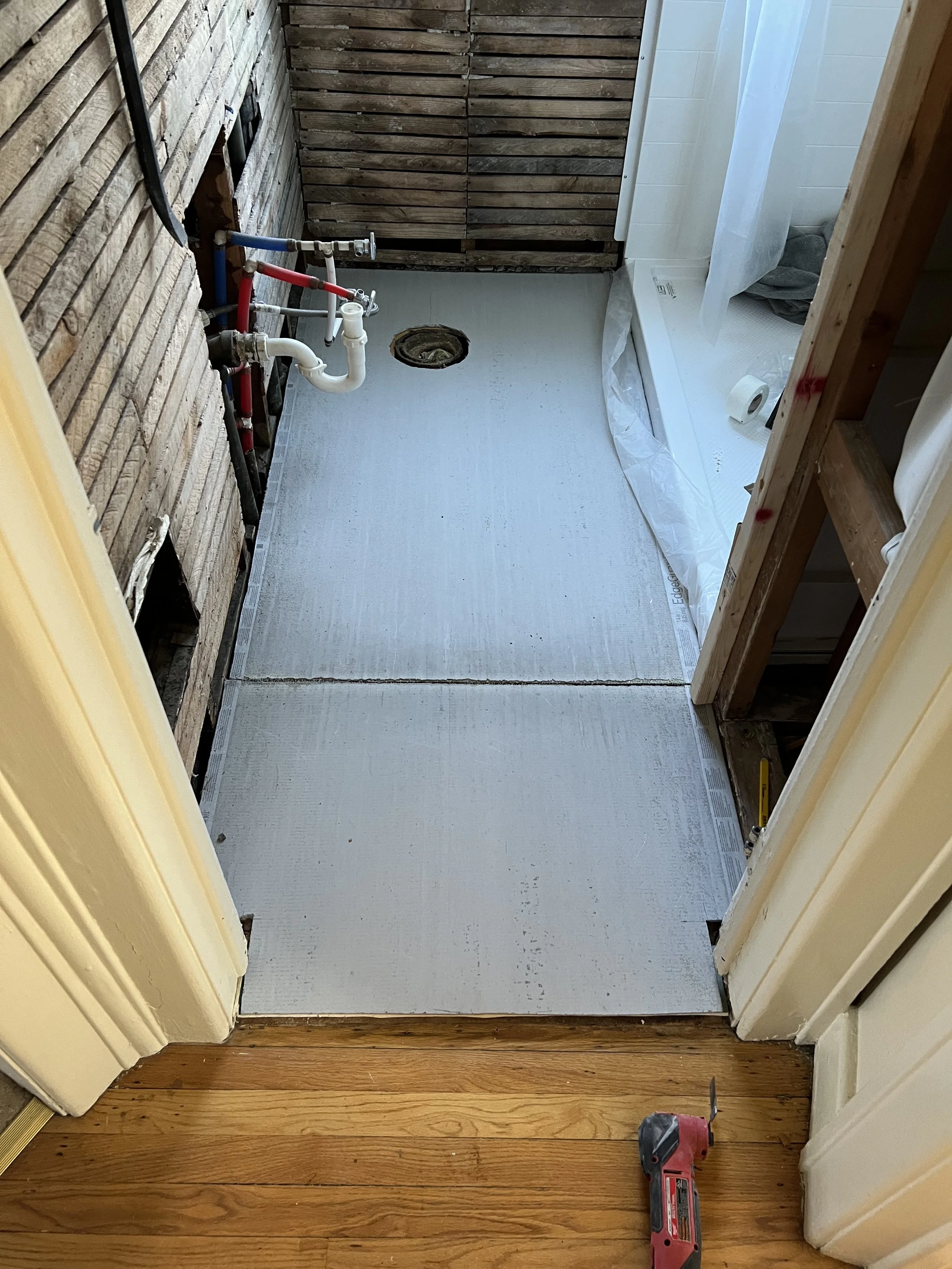
    Shower panel installation required unexpected vertical clearance due to their snap-together design, this required more drywall removal. The durable composite material, not plastic, ate a multi-tool blade, making my Dremel with a cutoff wheel the tool of choice.

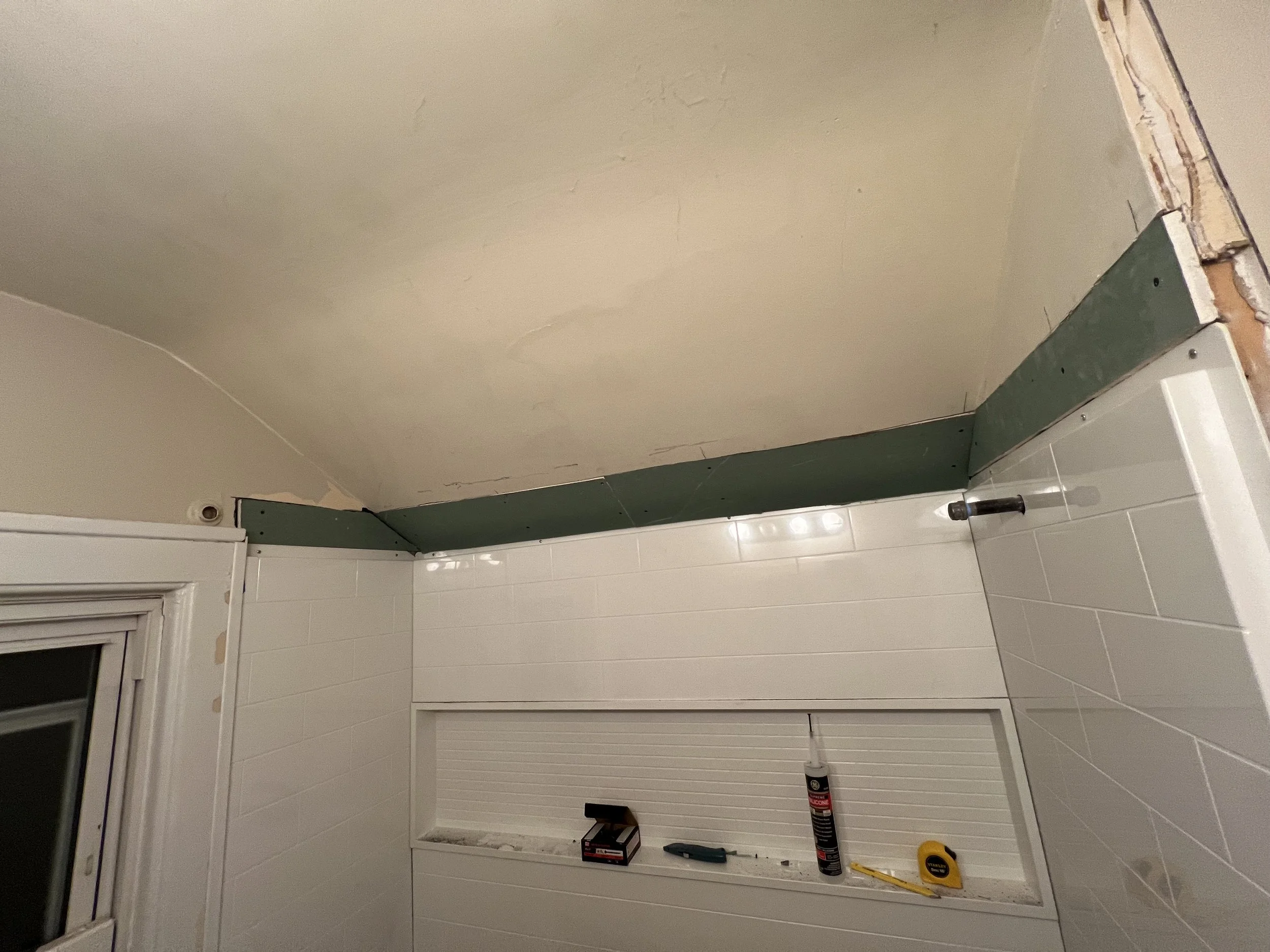
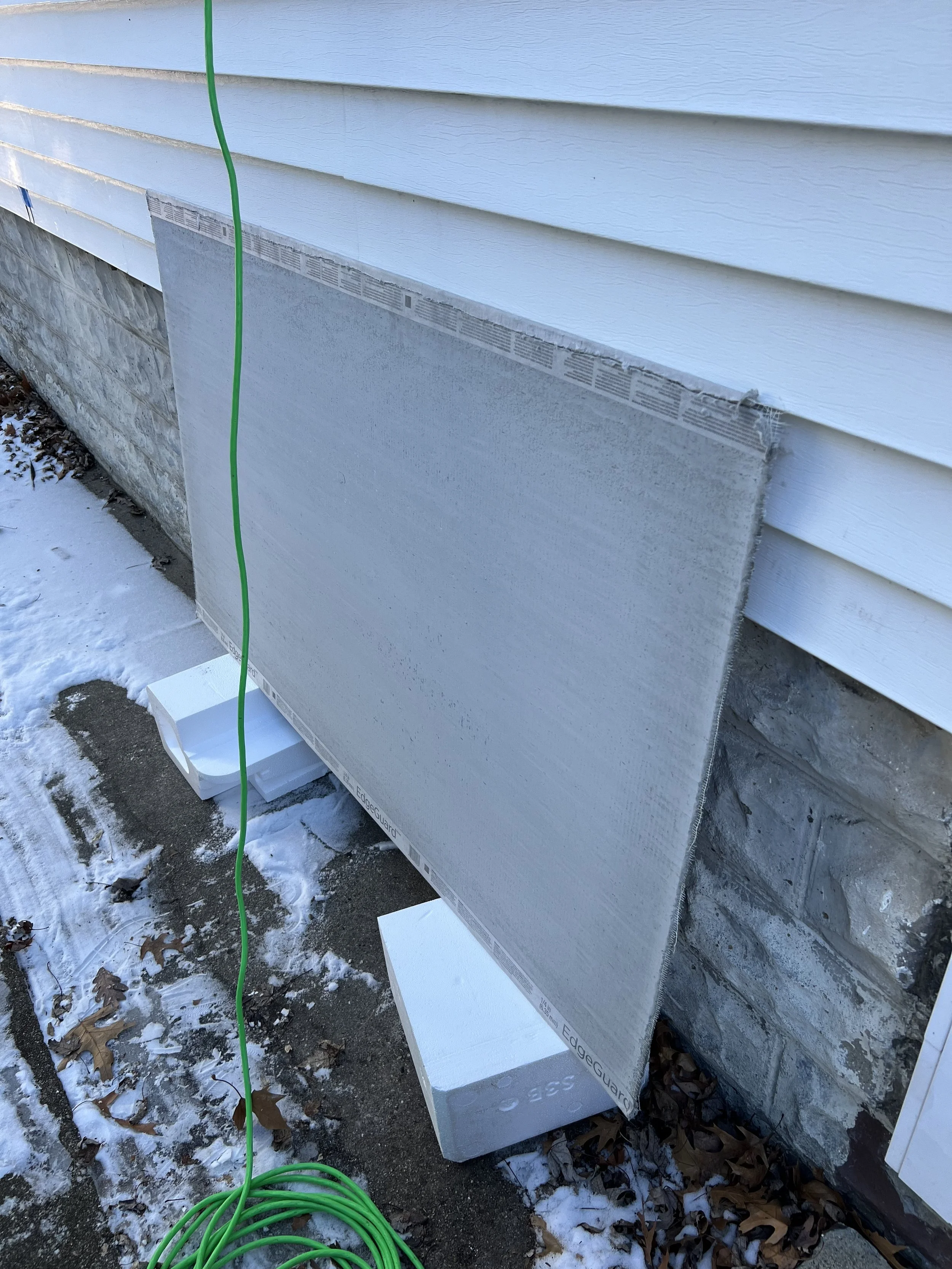
    Following the panel installation, I installed green board and mudded to create a smooth surface, then PVC trim was added for a clean finish around the panels. To enhance water resistance and provide a stable base for the flooring, 1/4-inch Hardie board was installed over the subfloor. My angle grinder equipped with a diamond blade proved invaluable for cutting both the existing lathe and plaster walls and the Hardie board. The bathroom was now prepared for the cosmetics phase and hardware installation.

      Closet Shelf
    Closet Shelf

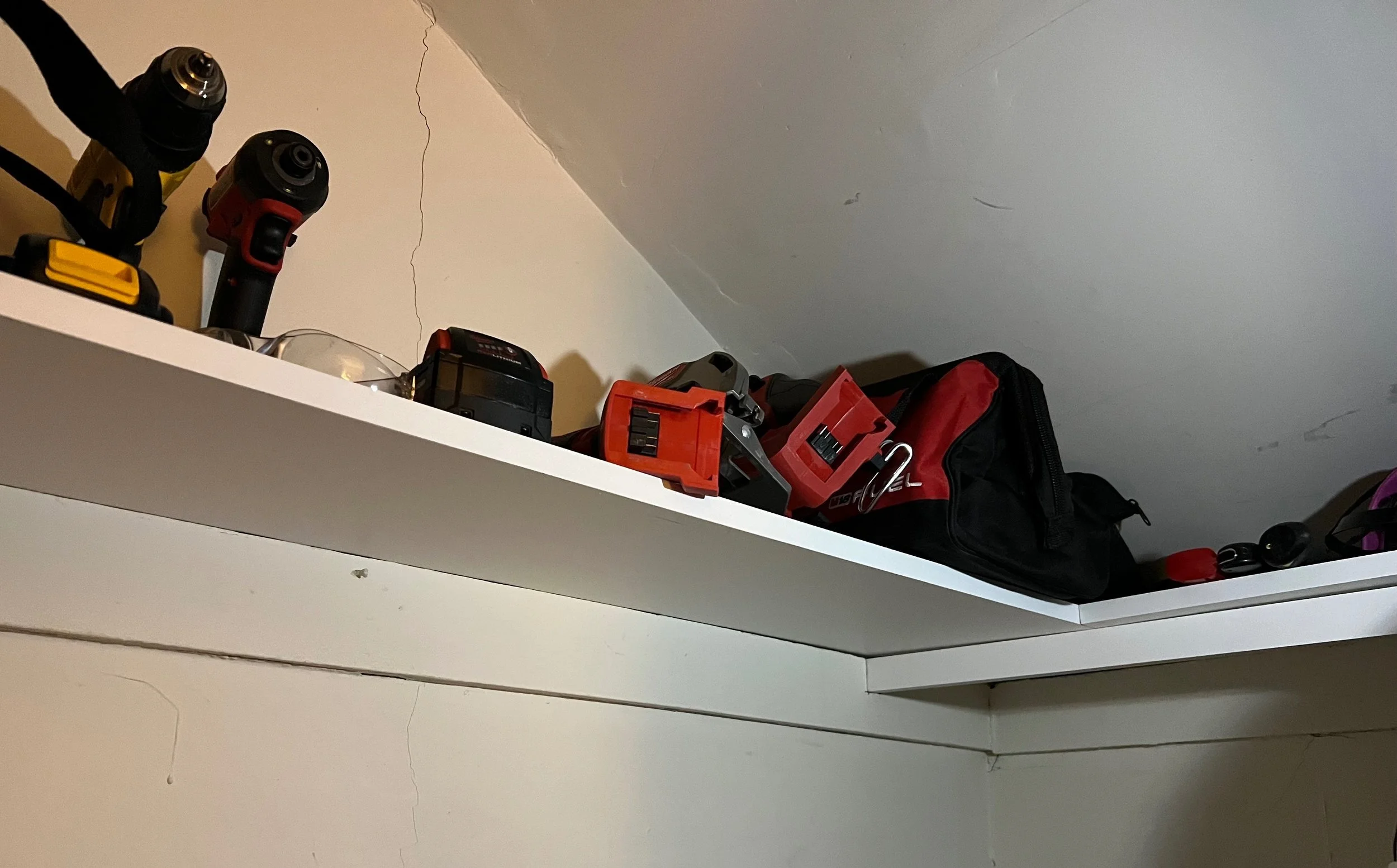
    Shortly after my wife moved in, I tackled a small organizational project. To clear my tools off the dining room table and out of sight, I built a tool shelf. I added a support bar on the right side and may need to add another along the front edge of the shelf, against the back wall. So far, it’s working well!

  • November/December 2024 – Screens, Squirrels, and Trees

    November began with replacing the screens on the front windows, then fighting squirrels and ended with the oak tree finally coming down.

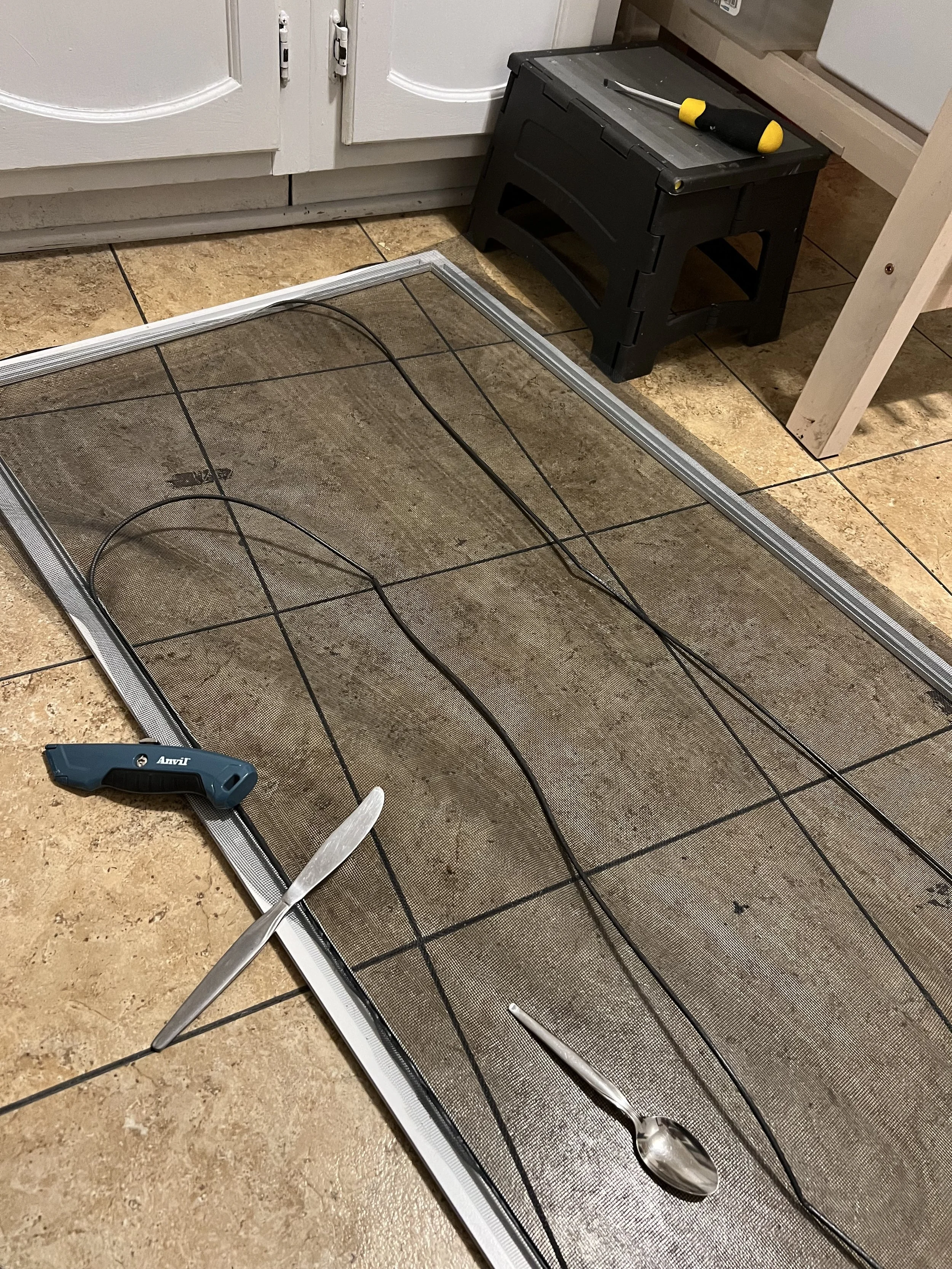
    November started with fixing the screens on the front porch downstairs. There are big windows, and it’s part of the Ferndale rental laws to have no holes in the screens of rental places. I didn’t have the right tools, so I ended up using a butter knife, spoon, and utility knife to cut and push in the screen components on the frame. Without the proper tools, this was much more time-consuming, but I managed to get it done. I think I made the screens a little too tight because the sides started to bow after I was done, but I was worried about them being loose since I was doing it for the first time and with the wrong tools.

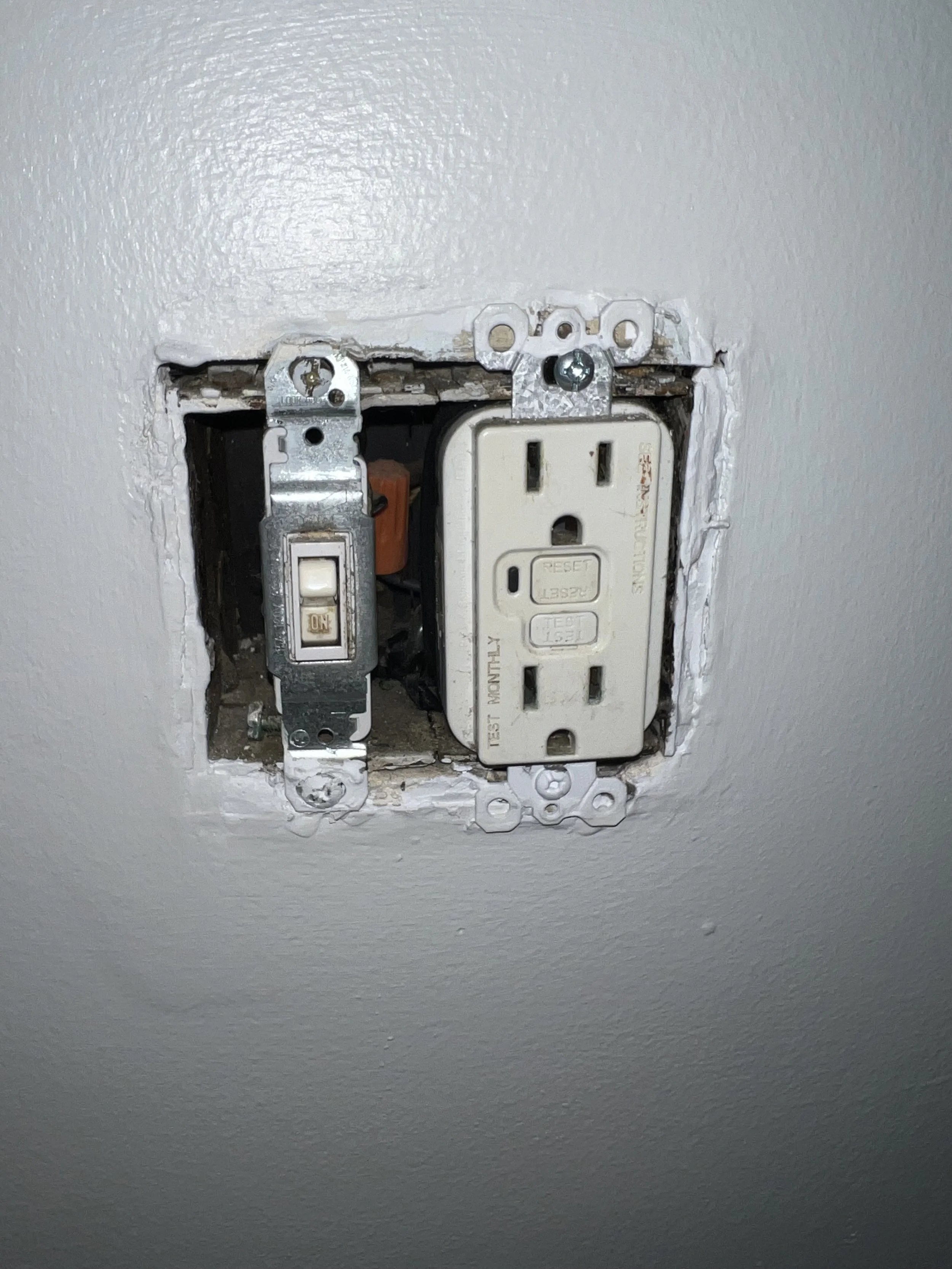
    Around November, I replaced most of the outlets and switches in the house. Many of them were old, super disgusting, and didn’t match the new paint I put in. The wiring was a mixed bag between new Romex wire and old tar and cloth wires. Some of the copper was extremely brittle, so I had to be very careful. What I’m assuming was more handyman work added a lot of time to replacing these because they didn’t use the screws on the sides of the outlets to fixate the wires. Instead, they pushed them into the sockets on the back, which is less time-consuming but a huge pain to work on later. Almost all the outlets were grounded, which I wasn’t expecting—I assumed almost none of them would be.

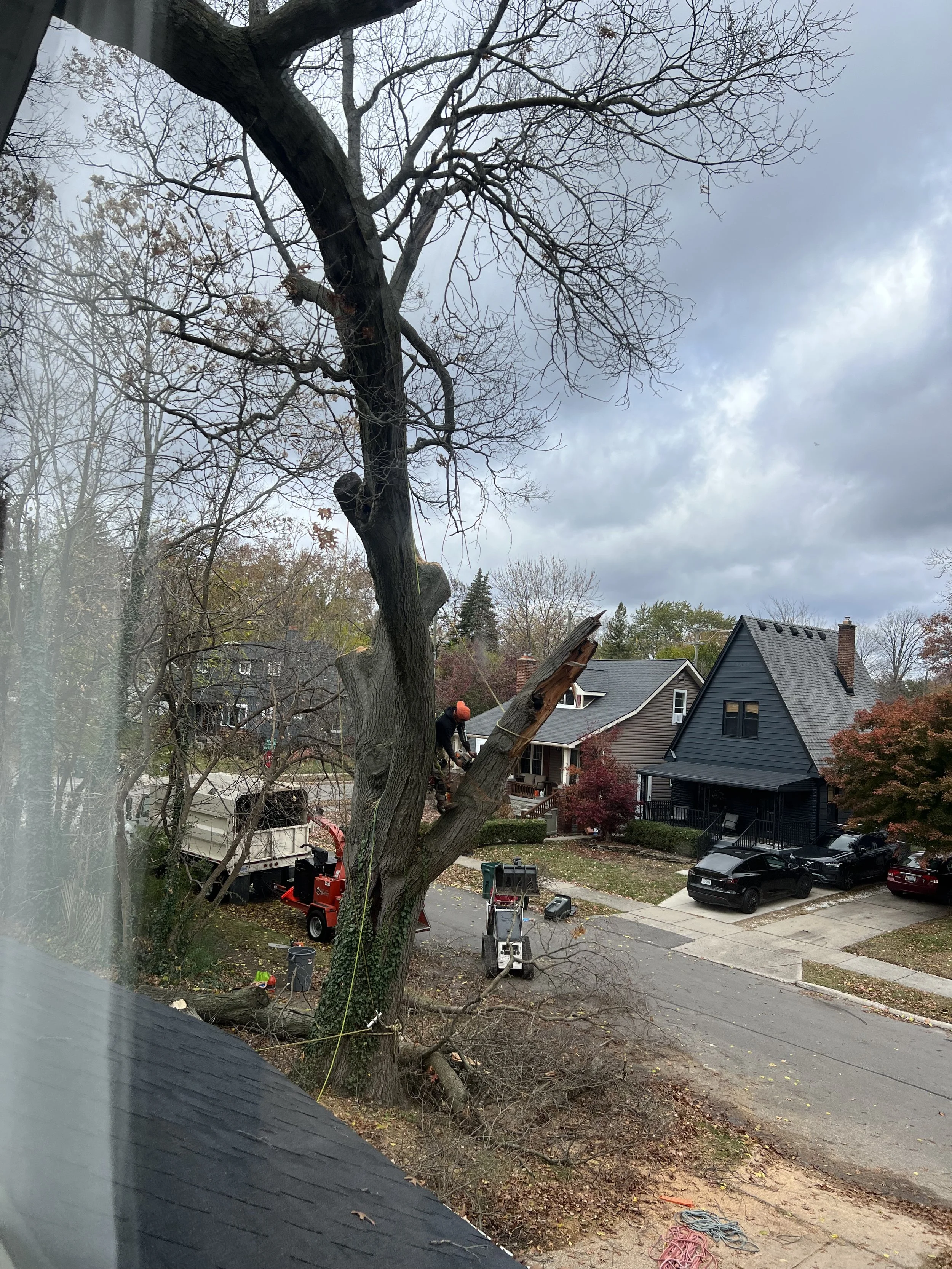
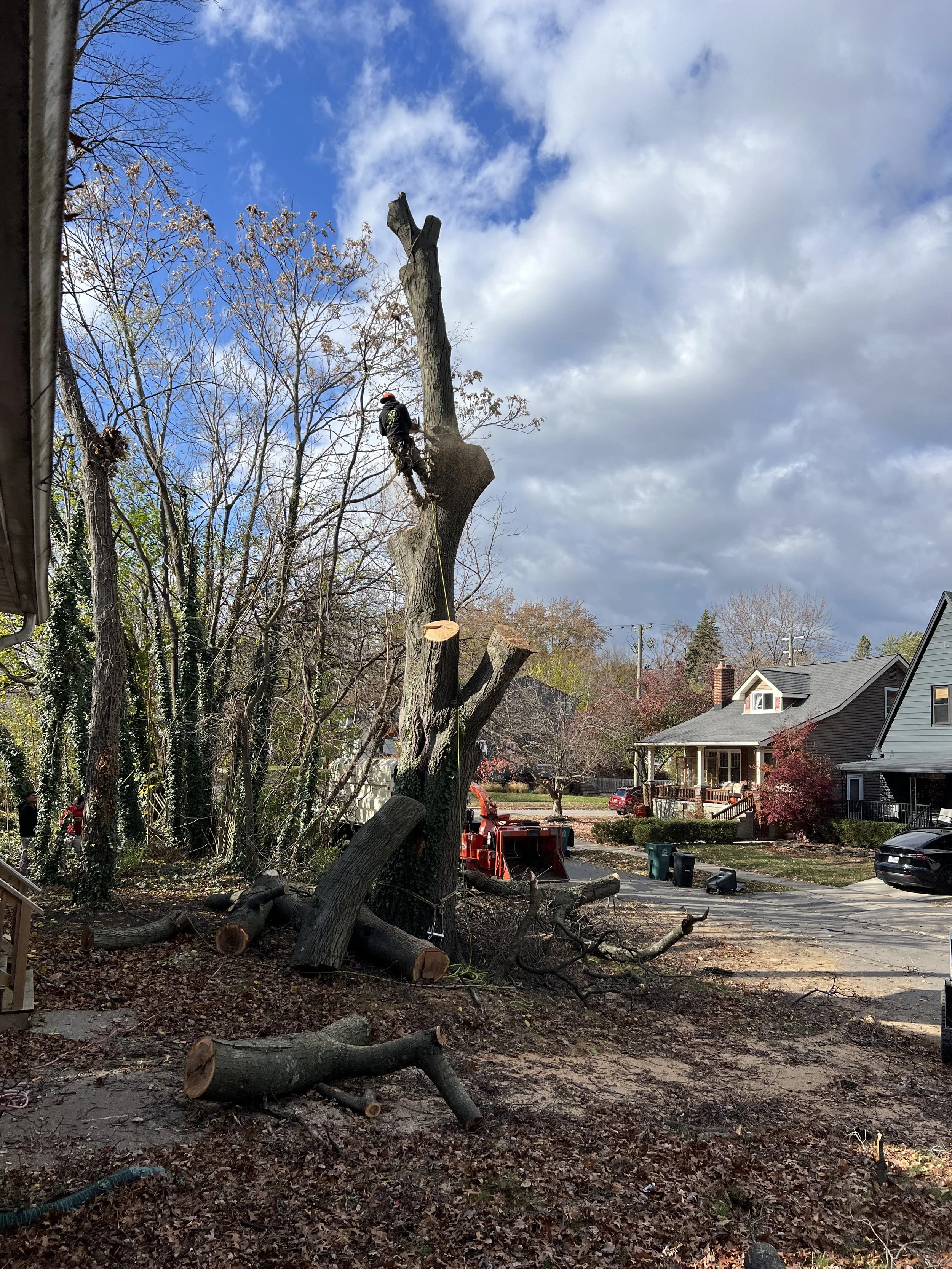
    In a previous post, I mentioned all the issues I had with the tree guy I tried to hire earlier in the summer. One of the other companies I talked to in the summer gave me a call to see if they could come trim any branches or do any other work for me during the winter when they have less work. I ended up negotiating with them to do the rest of the tree (basically the whole tree) for the same cost as the first guy, which I learned was quite low for a reputable tree company. Within a week, the tree was down. Some things are just worth the extra dollars for the sake of time and energy. It was pretty cool to watch and amazing how fast they did it!

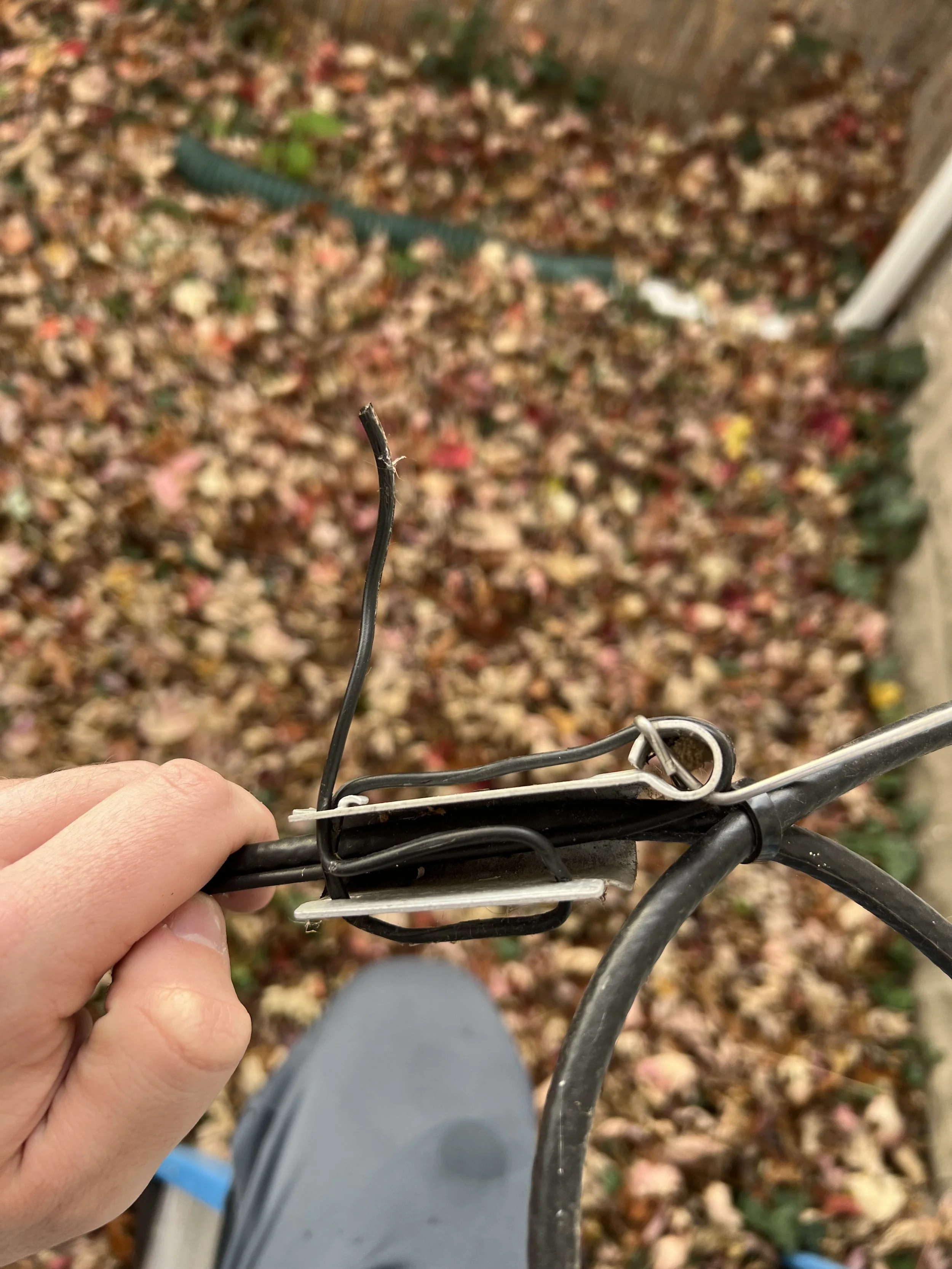
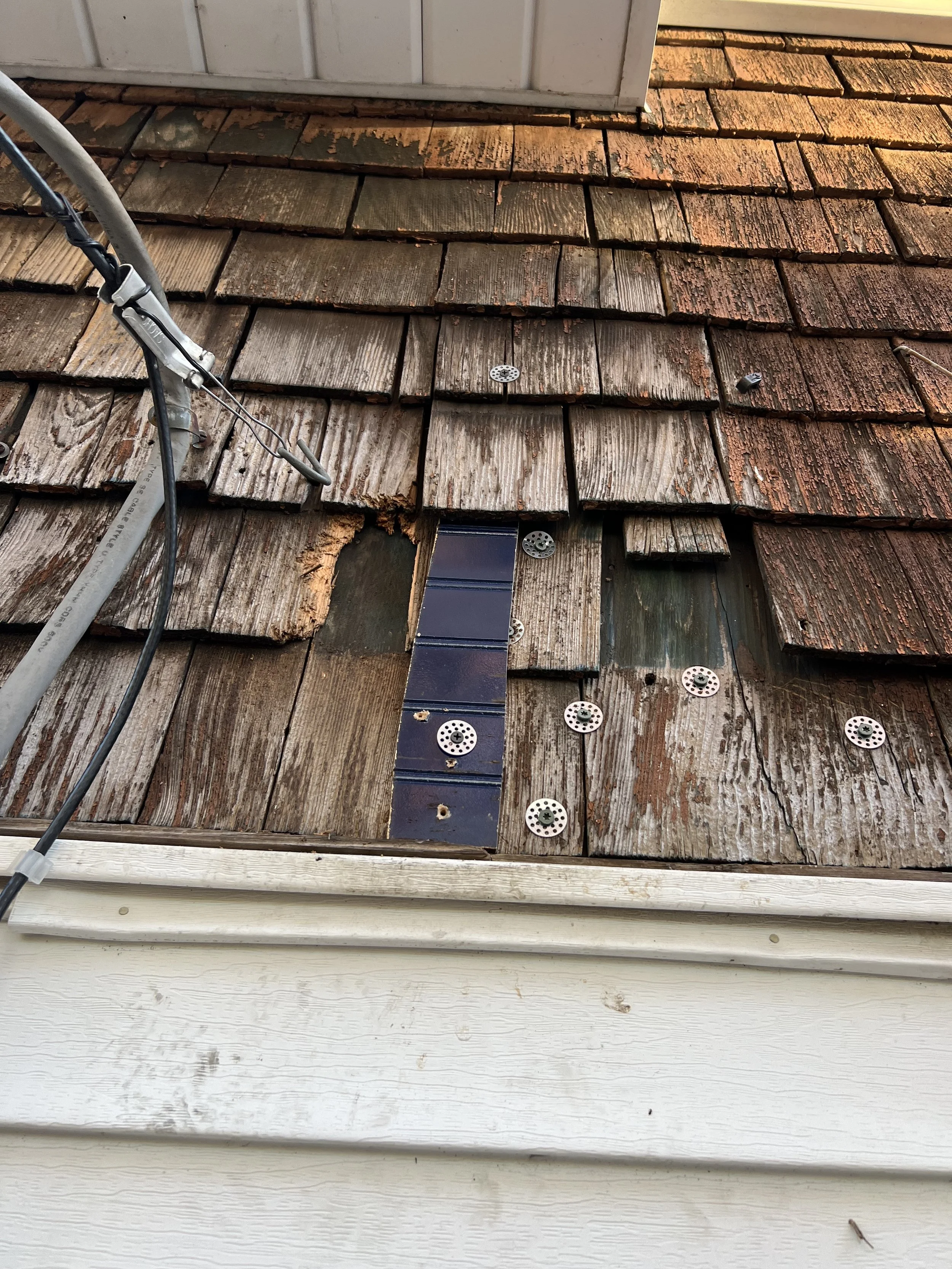
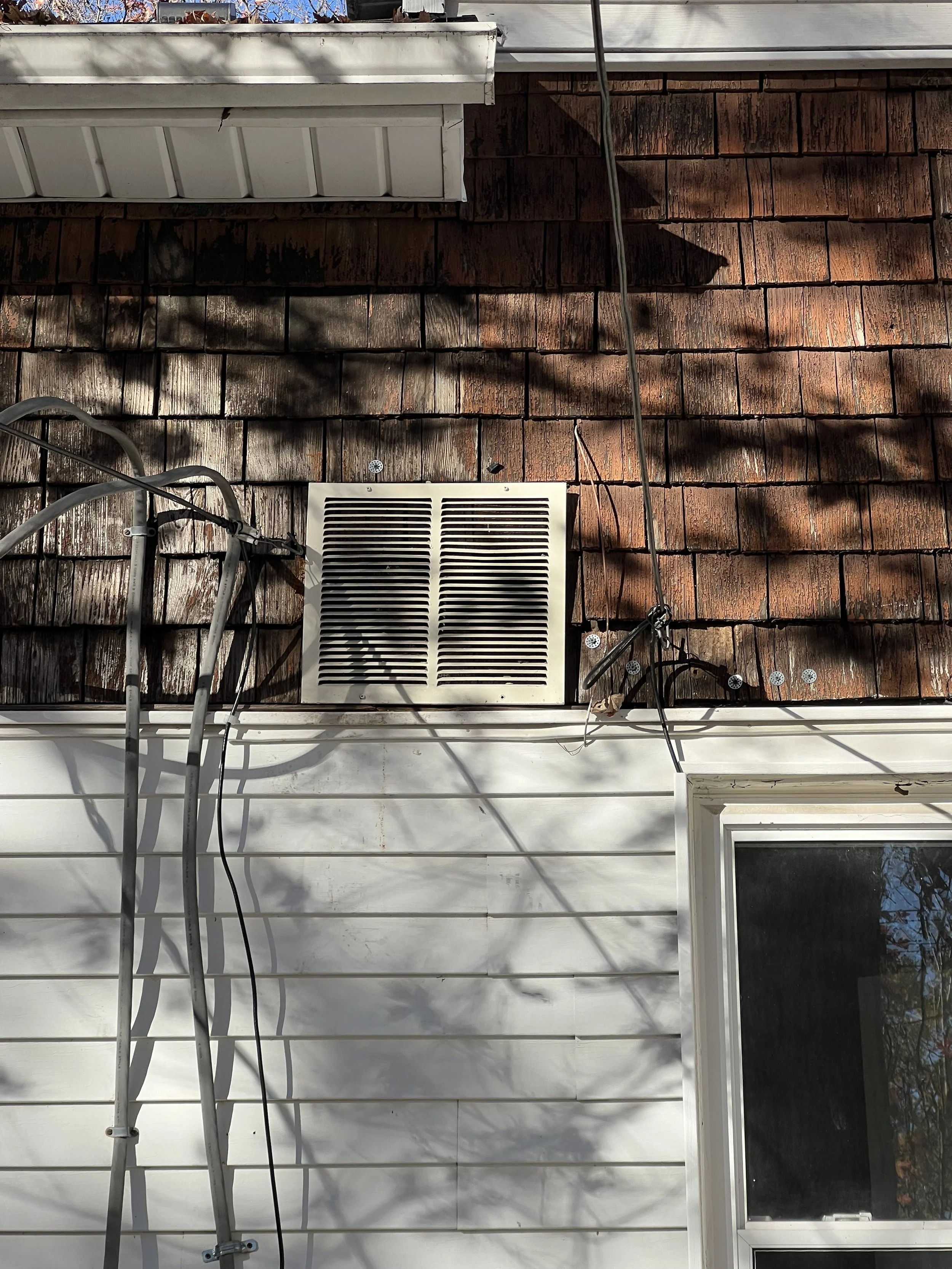
    Since purchasing the house, I knew I needed to fix the spot in the back where the cable/internet line came to the house. They were pulling the siding off, and there was a gap below the siding into the wall. The day before I was supposed to leave for a week, a fat squirrel got in and chewed its way up into the ceiling, running around in the attic and through the walls, building a nest. I removed the cable/internet line brackets and waited for the squirrel to come out. When I thought the squirrel was out, I tried to close up the flap in the evening. Turns out, the squirrel I had seen wasn’t the only one in there—one of them was already asleep for the night. I woke up in the morning and heard it crawling around, trying to chew its way out. It ended up chewing much of the cedar shingle and underlayment. I spent the whole day closing and opening the siding, thinking the squirrel had come out when it hadn’t or had chewed its way back in. Eventually, I watched it struggle to get out through the existing gap that I even propped open farther earlier in the day. Before putting the cables back up, I tightened the good one (it was sagging) and removed the other, which was an internet or TV line not in use anymore. After all the chewing, when I screwed back on the siding, there was still a small gap, and I was leaving, afraid the squirrels would chew on that and cause damage while I was gone. I remembered I had an oversized vent that I had removed from somewhere downstairs and ended up screwing that over the hole so there was nowhere for the squirrels to chew on and break through into the wall while I was gone. I added a small piece of wood beneath that to cover up the hole for heat and energy purposes.

  • October 2024 – Paint, Demo, Kitchen

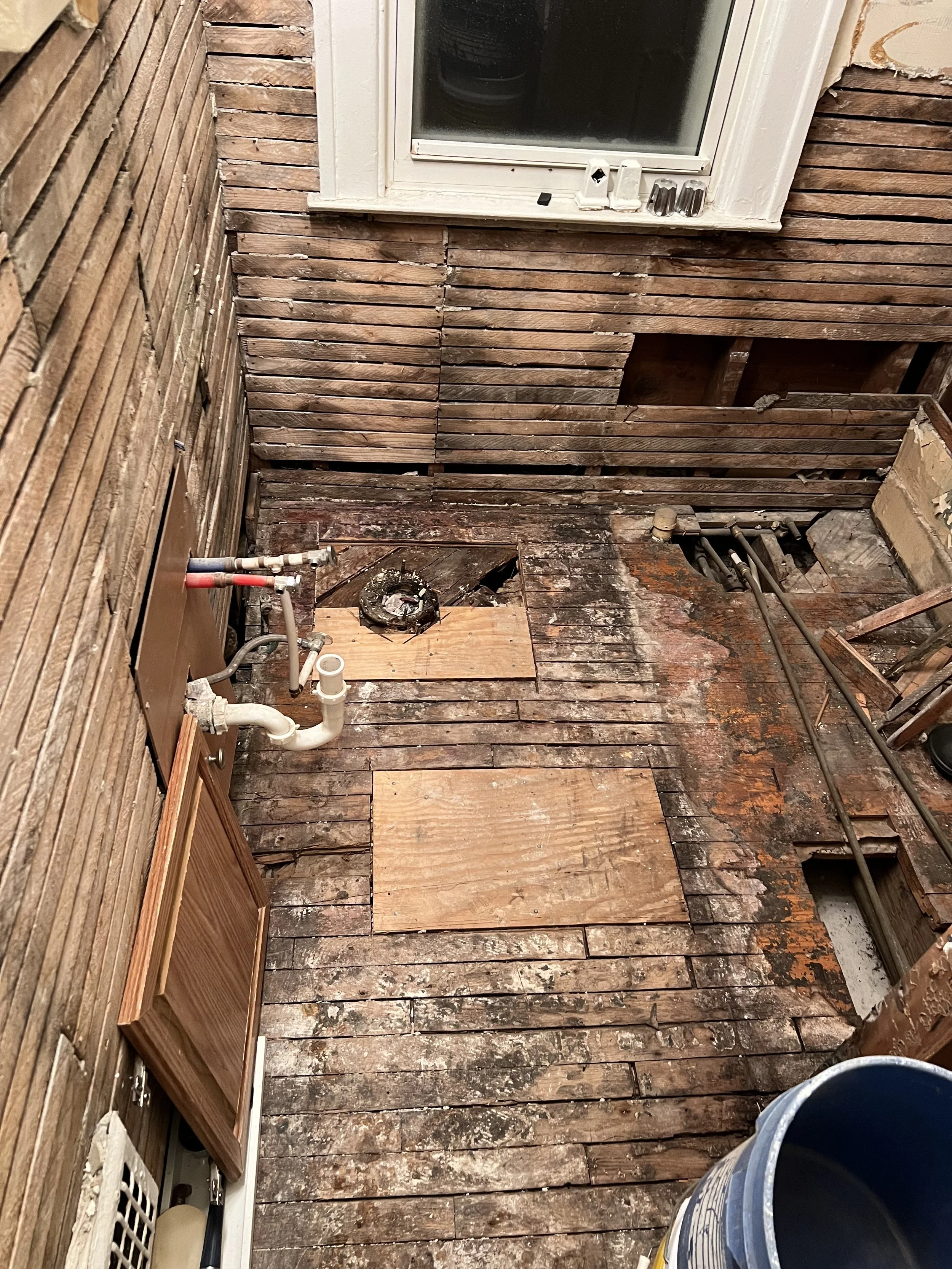
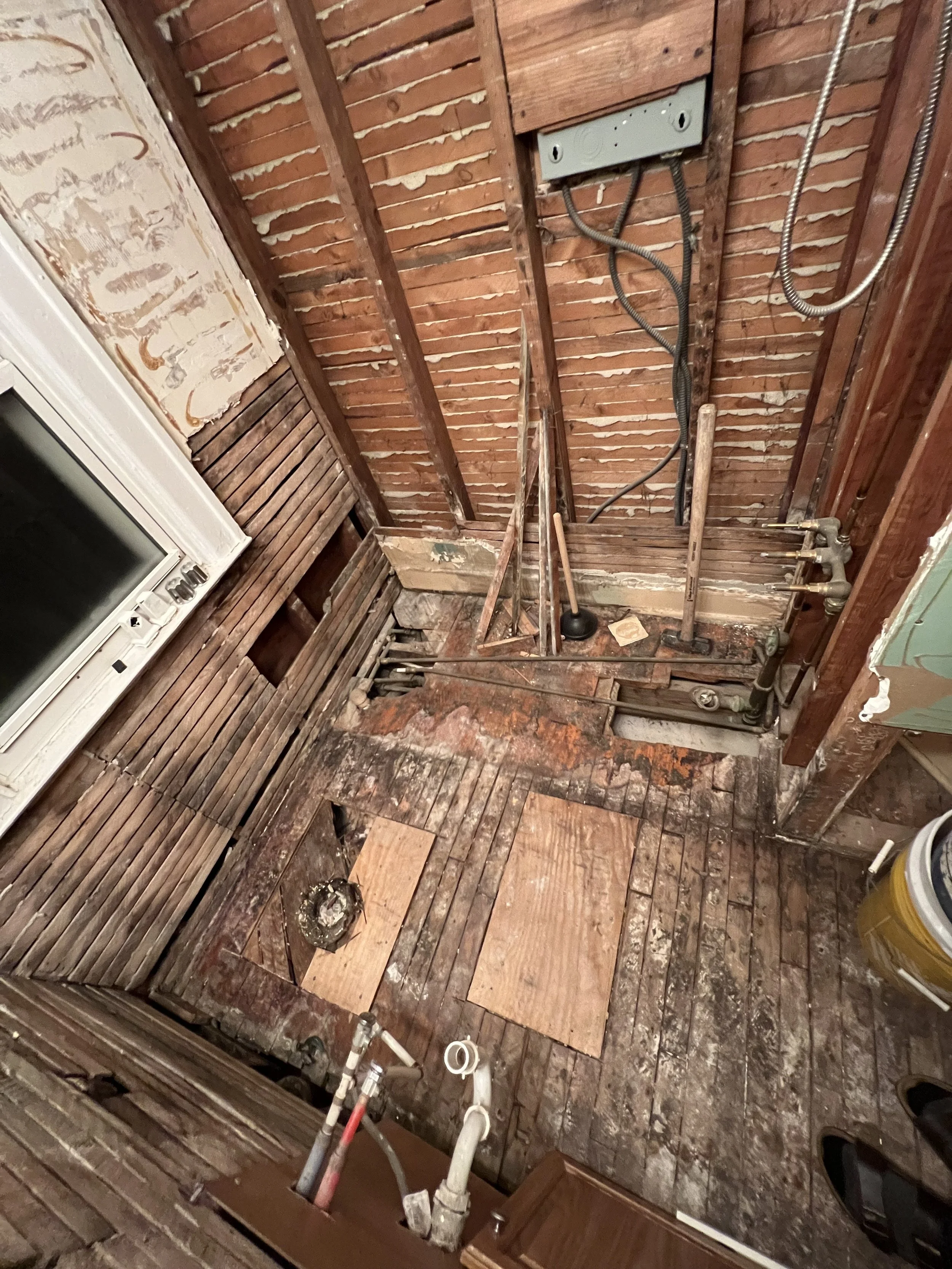
    October was a productive month where I was able to focus on the kitchen, finishing the demo of the bathroom in my unit, and take care of some pluming issues.

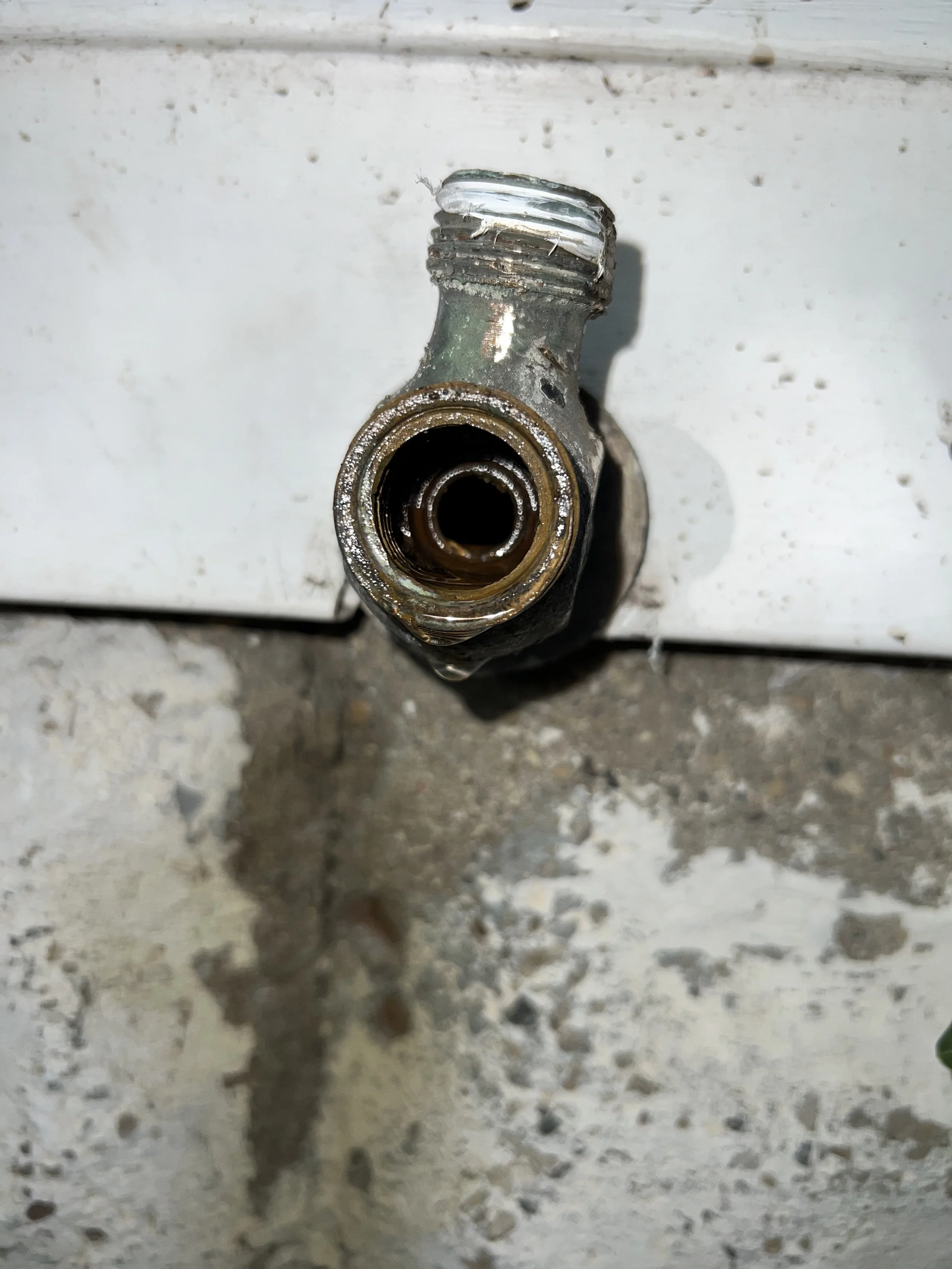
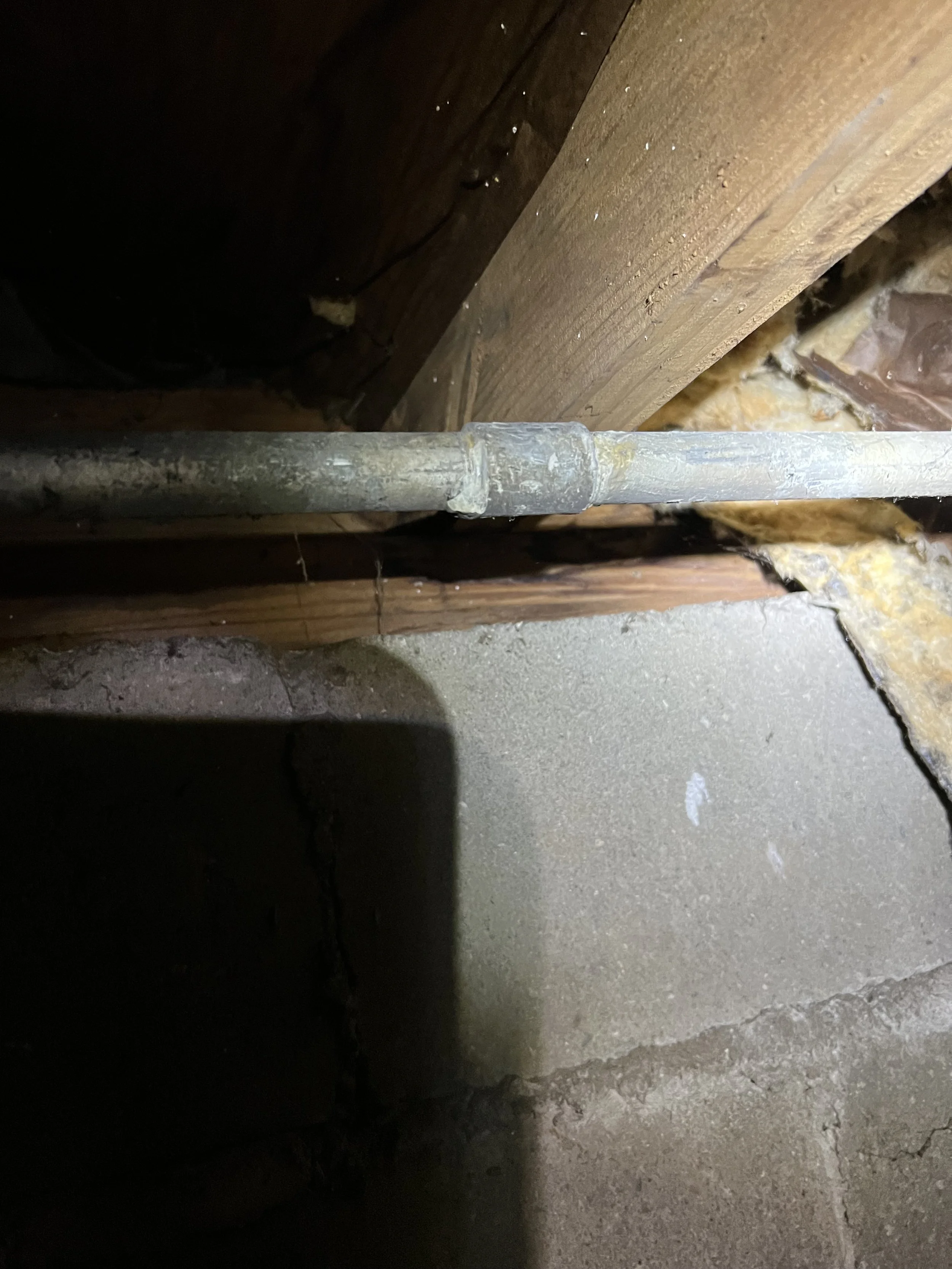
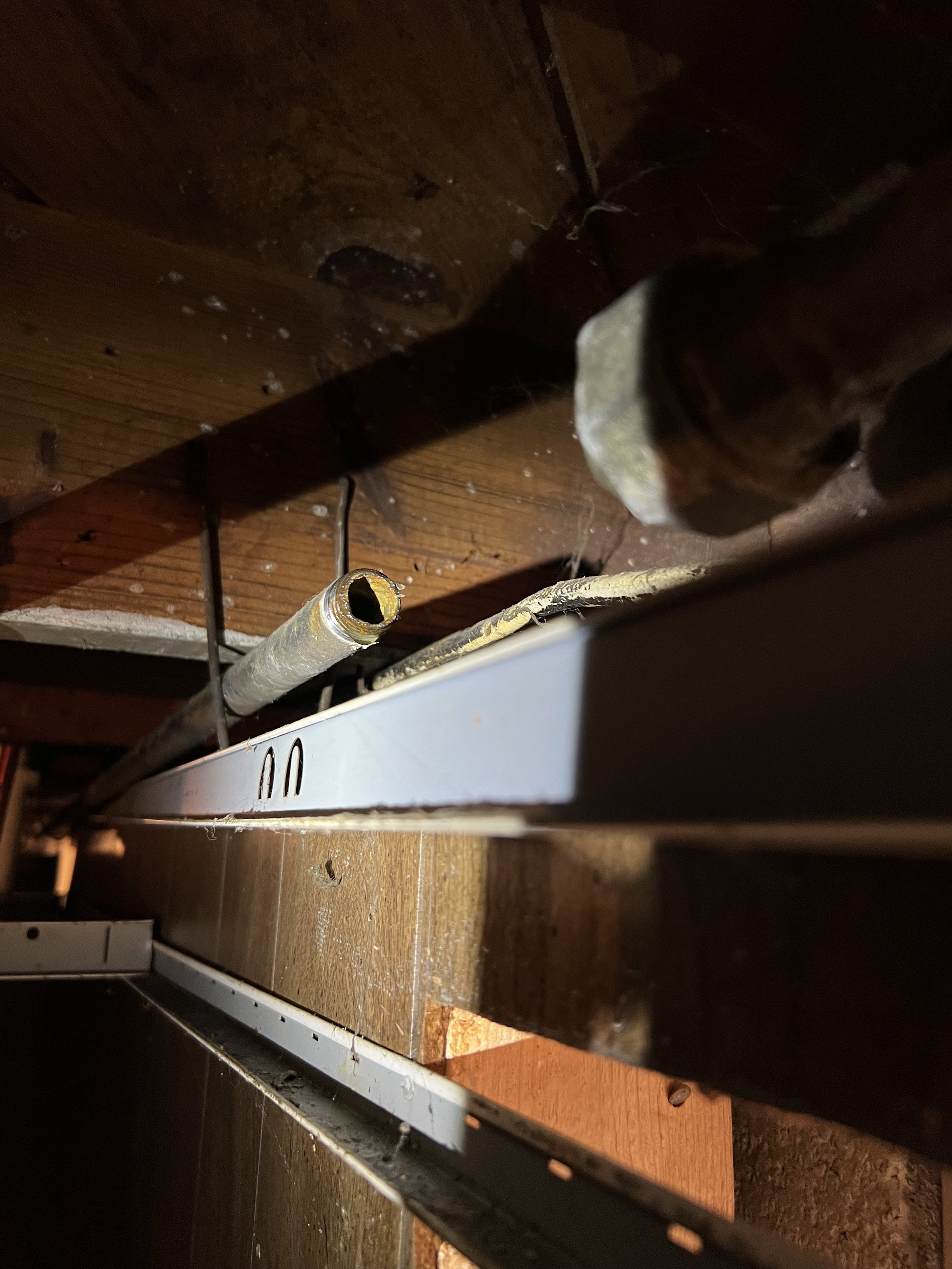
    Replacing the hose bib turned out to be quite a challenge, even though it seemed like it should have been a simple fix. Like most of my DIY projects, it ended up being unexpectedly difficult.

    I started by trying to remove the hose bib from the outside with a crescent wrench. I managed to loosen something, but it wasn’t the hose bib. To make things worse, the loosening started to feel like it was getting tighter again.

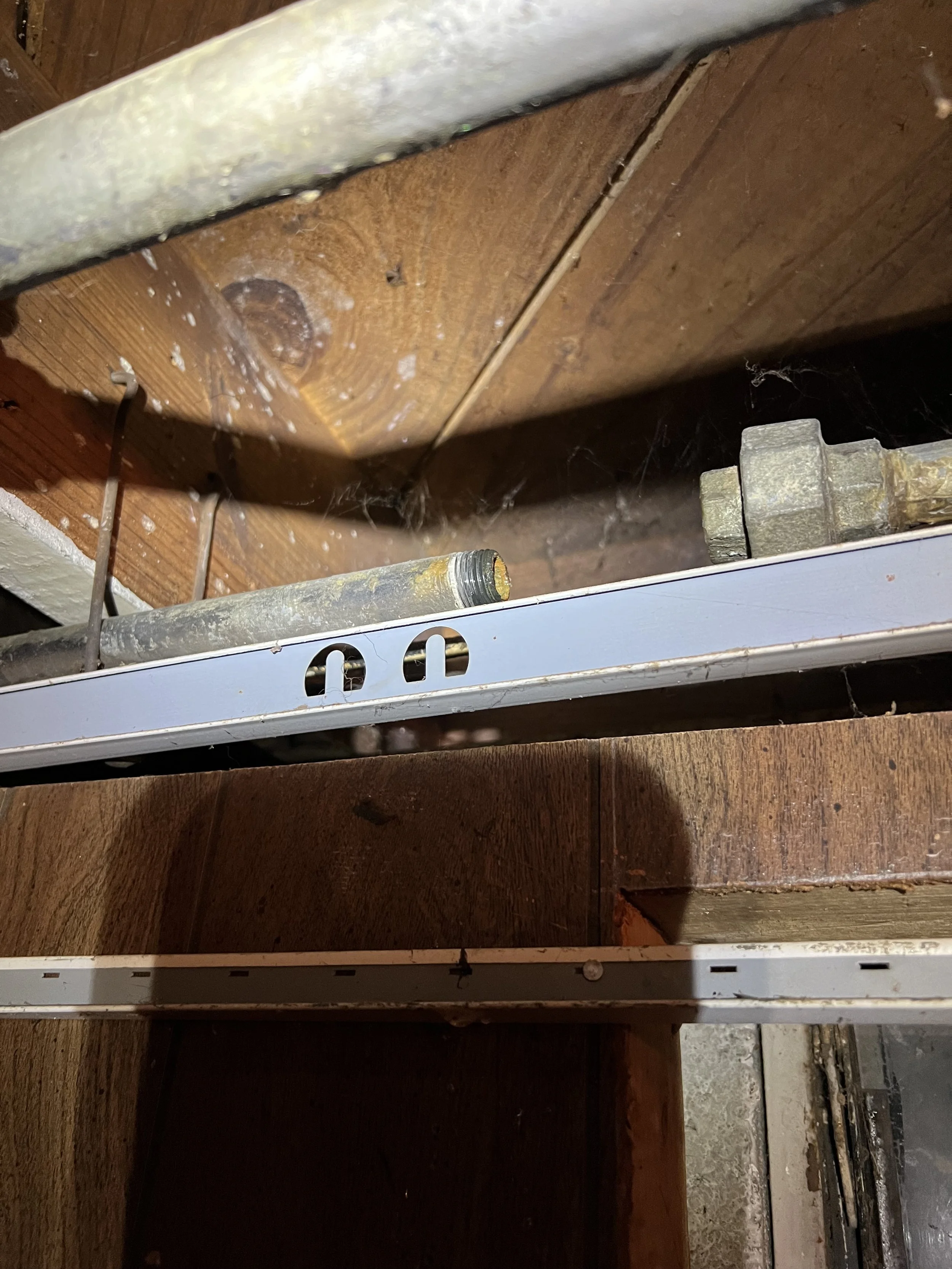
    When I checked in the basement, I found out that I had loosened the pipes two joints back, about 20-30 feet into the basement. The grounding cables connected to the pipe had wrapped around and twisted the line tight. So, I temporarily removed the cables and tried to figure out what to do next.

    I decided to get into the crawl space directly on the other side of the hose bib and loosen the joint there. After buying a pipe wrench and vice grips, I was able to loosen the joint at this location. Then, I fixed the joint I had accidentally loosened and reattached the grounding cables.

    Next, I installed a new 18-inch pipe and put the hose bib on from the outside. One big issue at each step was that the pipe wrench and vice grips were stripping the tooth depth in metal off of the pipes. Getting a tight enough grip to turn the pipe and have proper leverage without breaking more joints or the old pipes themselves was a struggle and a constant worry throughout the whole process.

    In the end, I managed to replace the hose bib, but it was definitely more complicated than I expected.

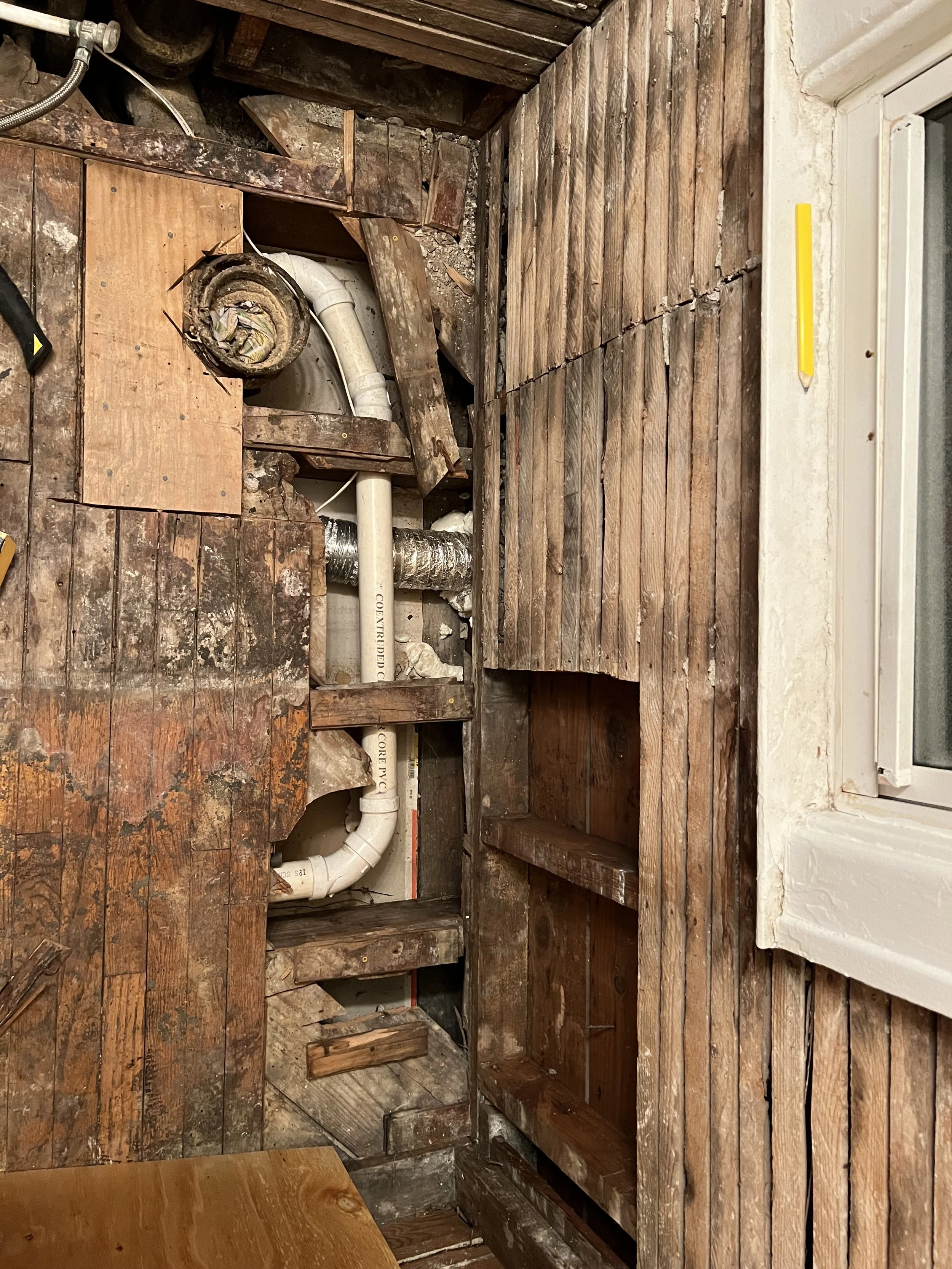
    The first two images above show the aftermath of ripping out the rest of the wall tile in my bathroom. The bathroom is completely gutted at this point, revealing some serious water damage and a ruined old oak floor. It’s kind of impressive how resilient the old oak is, though. Even in spots where water had destroyed the outer layer, the middle was still solid.

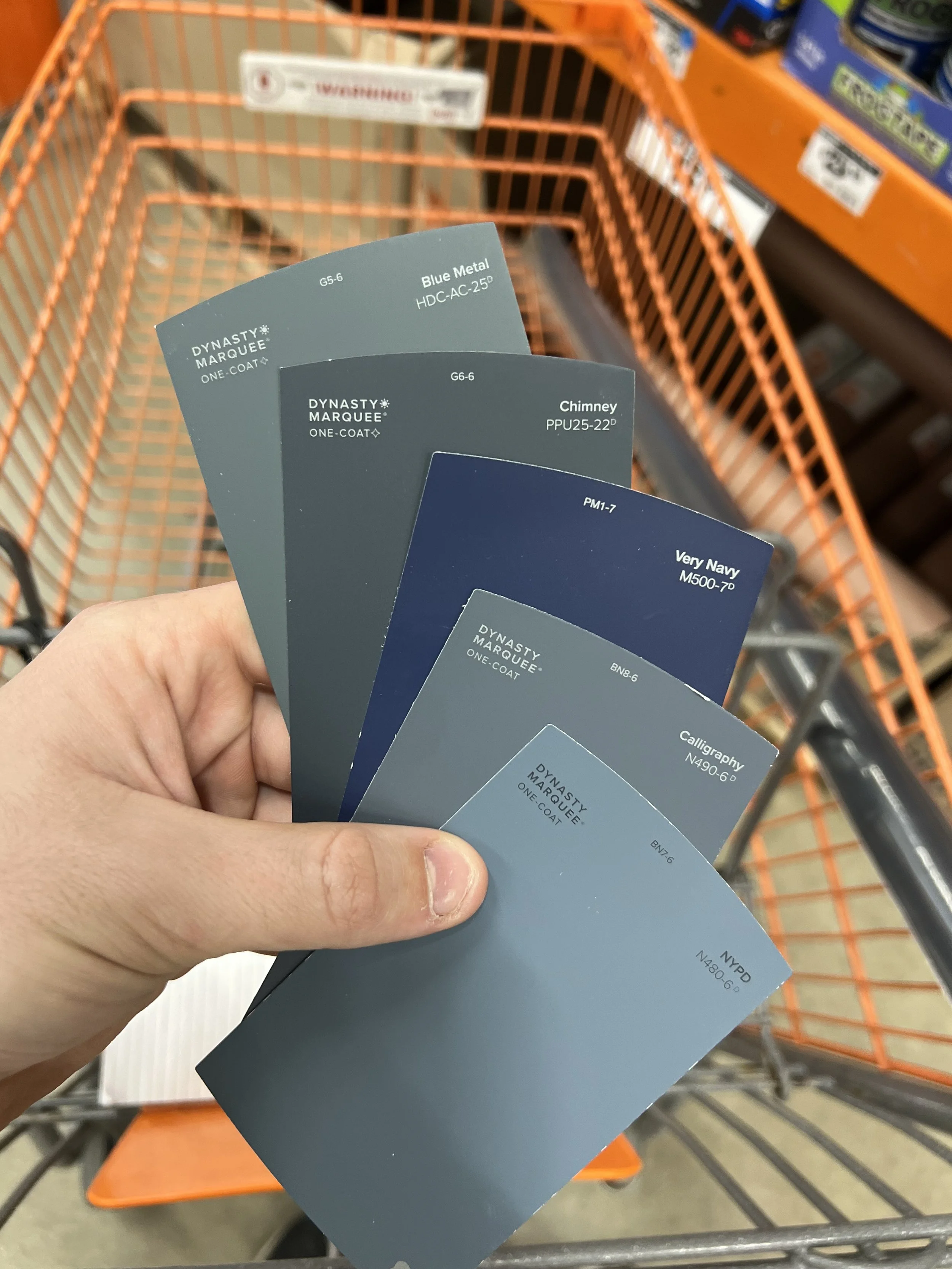
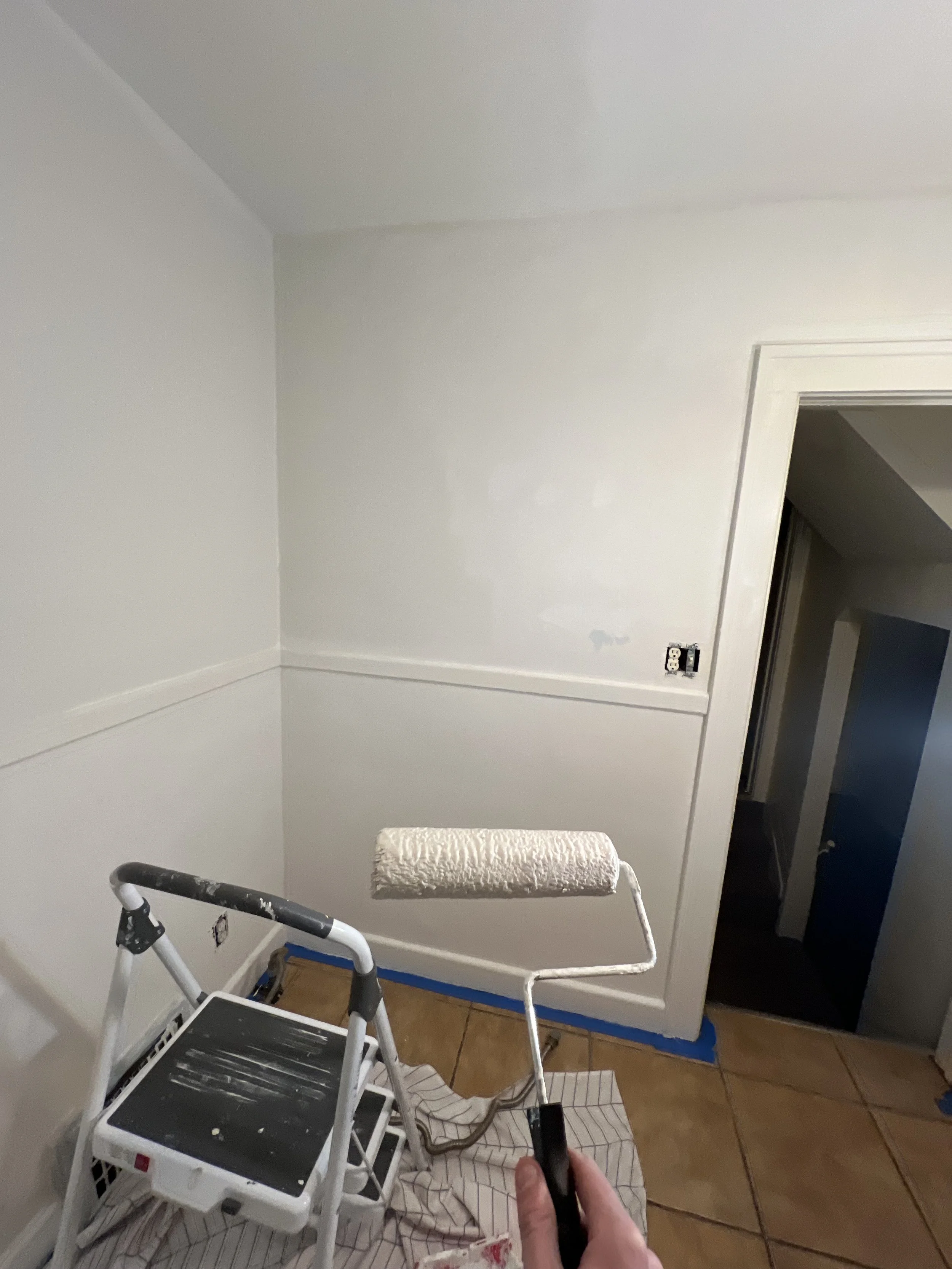
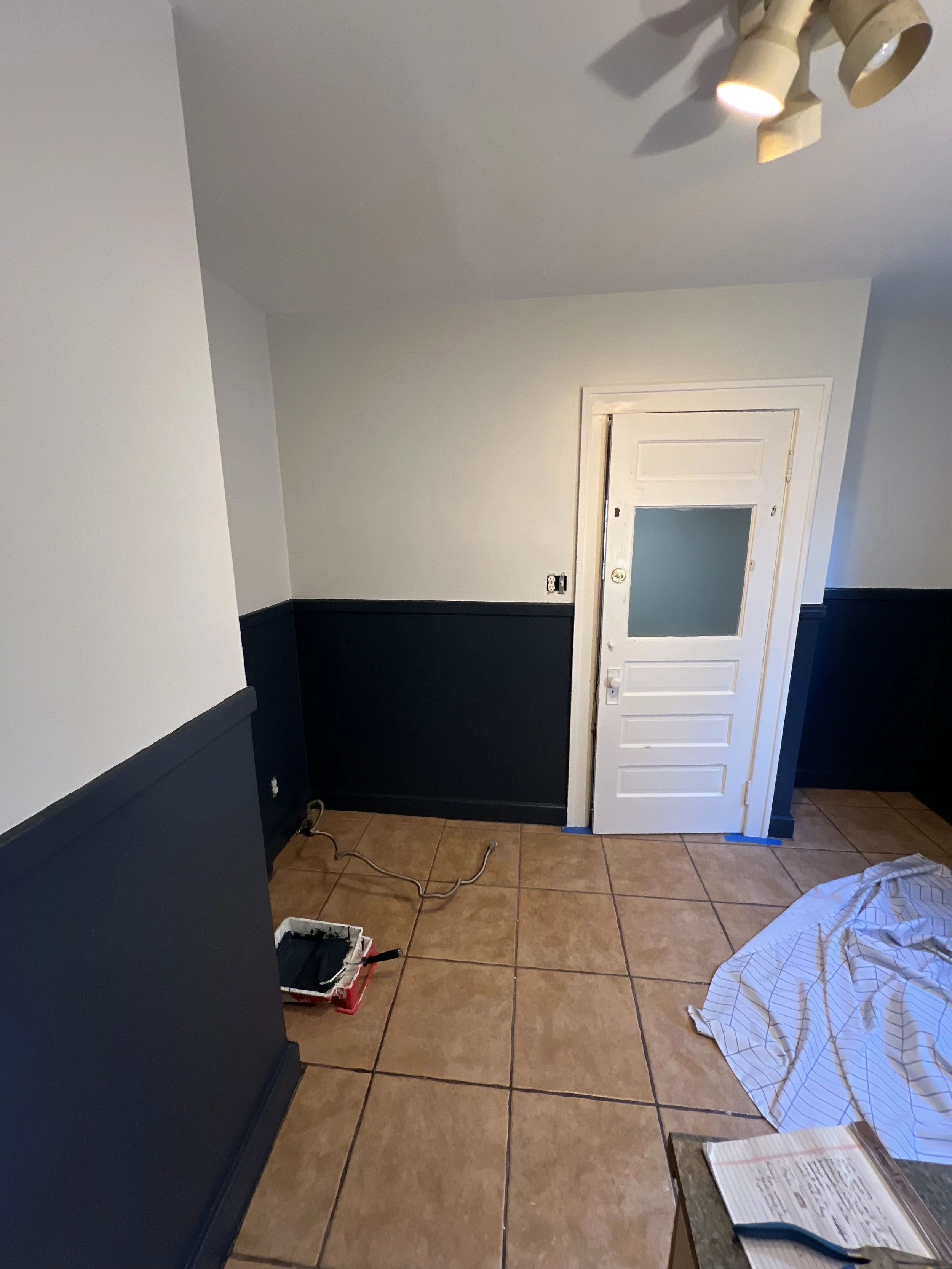
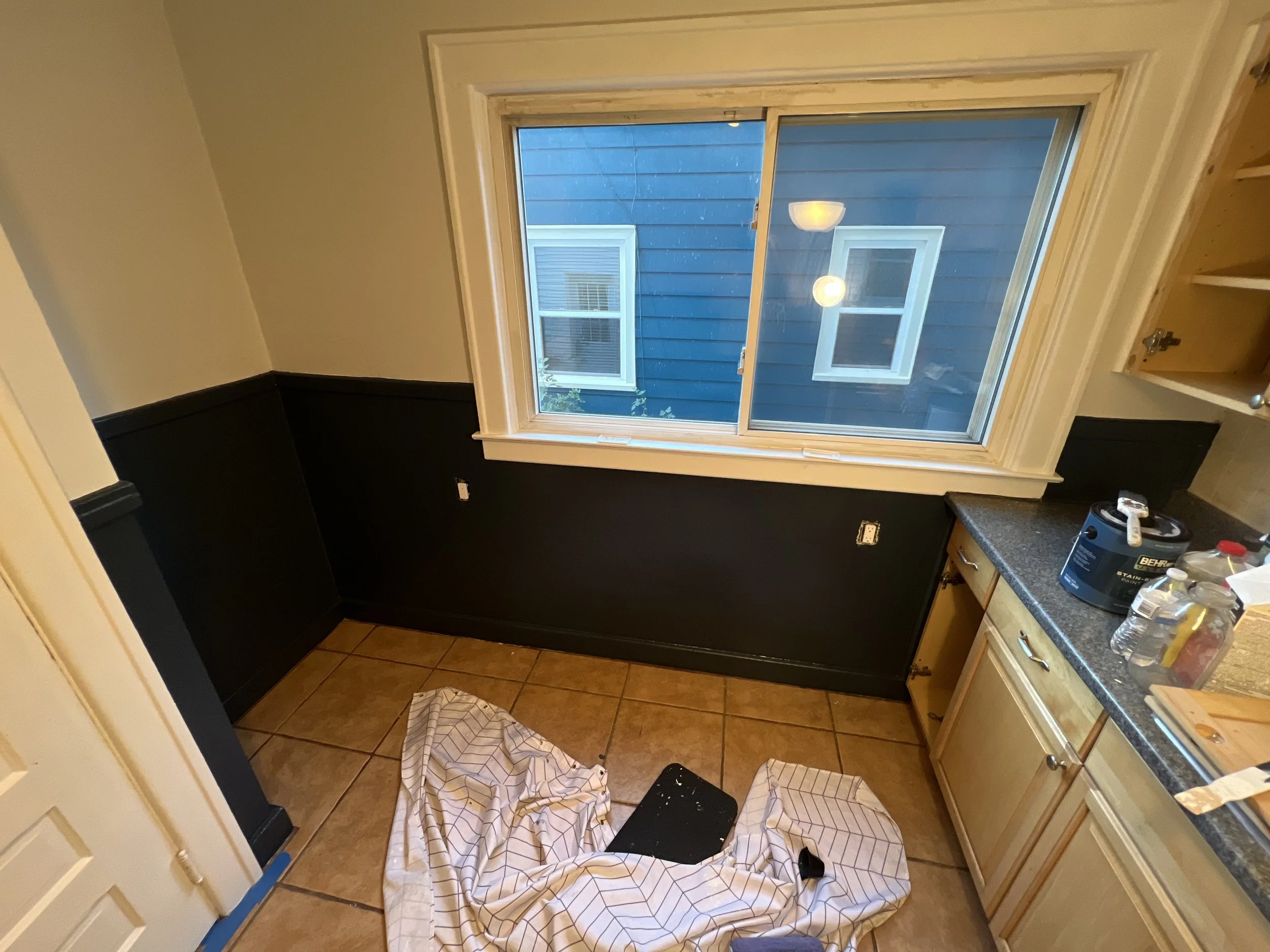
    One of the last areas to prime and paint was the kitchen. I knew I didn’t want all white, and I needed to do something to make those floor tiles look better (they’re so ugly). After spending some time on Pinterest and Google Images, I decided on a dark navy or bluish grey. I ended up picking Behr Midnight Blue, which I didn’t even notice until I was at the cash register and saw it on display. I painted the trim and the bottom half of the kitchen that color, and it made a huge difference! (especially for the appearance of the tile).

    A friend helped me remove the old kitchen and stove. They were still operational but disgusting and on their last legs. The gas stove especially was a potential fire hazard with rust all over it. I decided it wasn’t worth my time to try and sell or recycle them. I put them on the curb, and within a few hours, a scrapper came by and picked them up. Maybe not the best financial decision, but I was done adding extra tasks at that point.

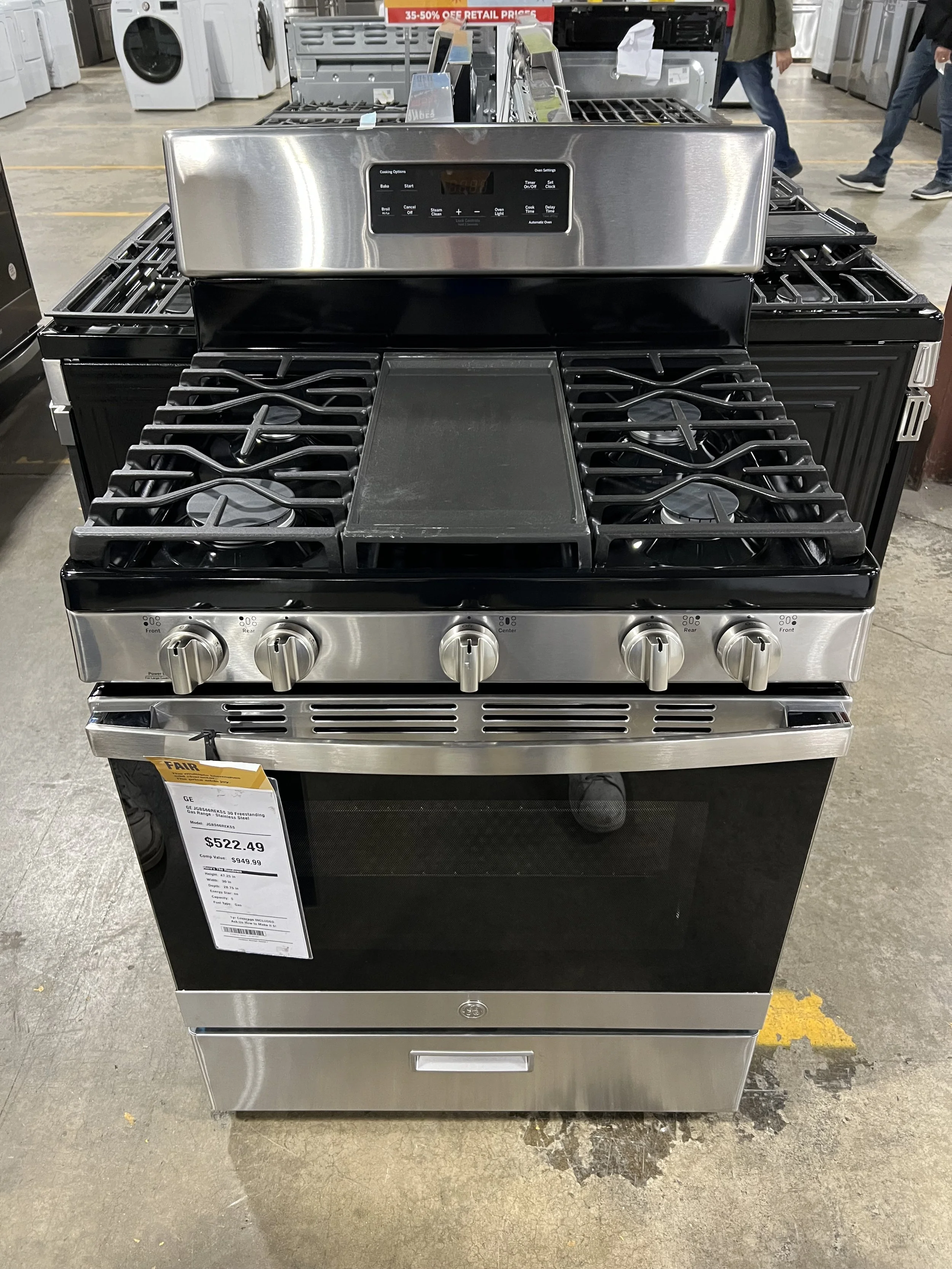
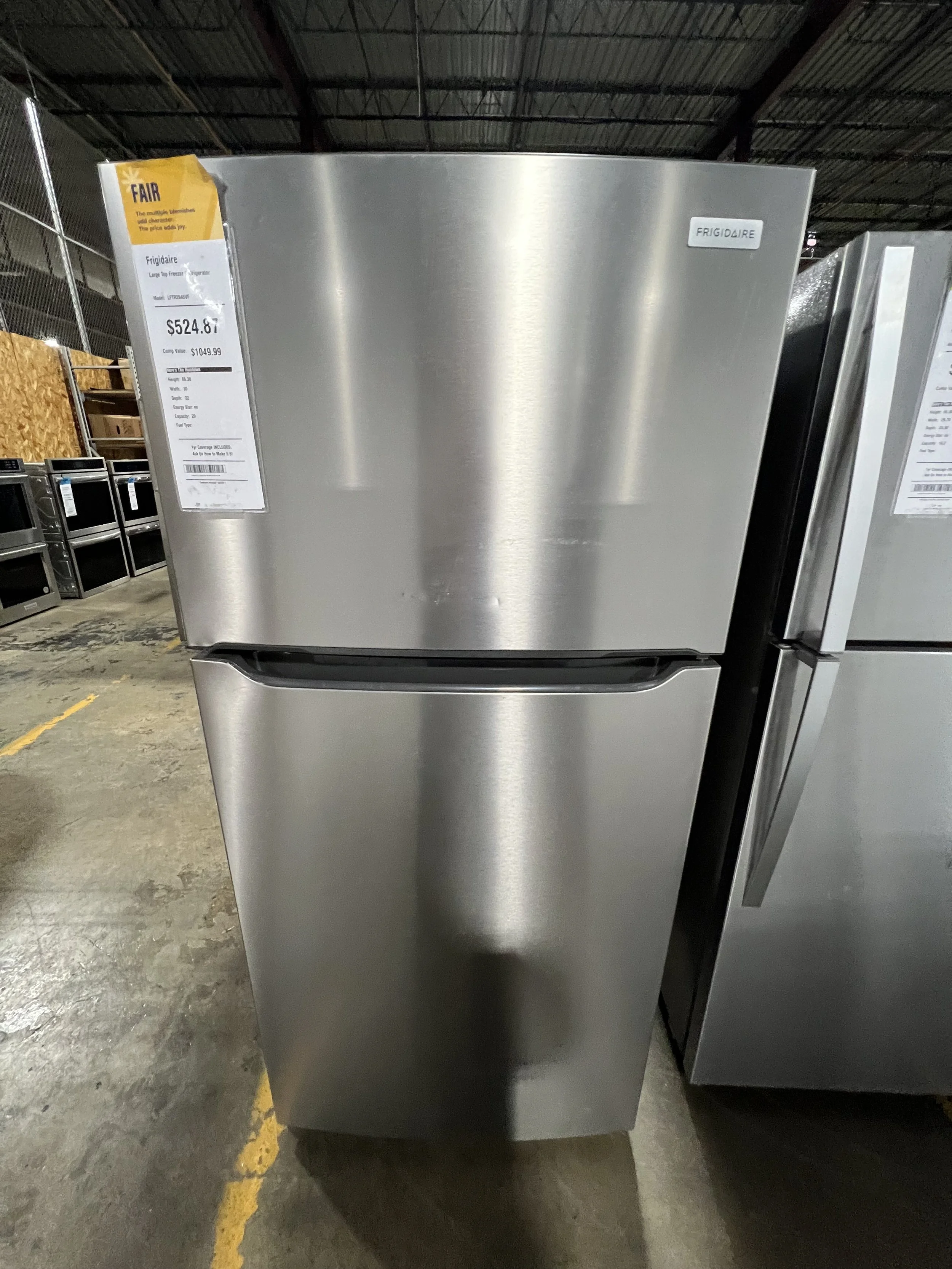
    I bought two new stainless-steel appliances from American Freight that will hopefully last for a few decades and help command a higher rent price. The stove upstairs is electric, so I’m personally jealous of whoever ends up renting downstairs because of the new gas one.

  • Buck Converter

    Buck Converter

    The purpose of this exercise was to review basic buck converter design. I originally learned this in class at Purdue but have not used it in 4 years and needed a refresher. I will continue this exercise with further reviews on other power converter topologies.

    I chose components and a scenario that is maybe not the most elementary buck converter design, but this forced me to consider aspects of design I would have otherwise missed.

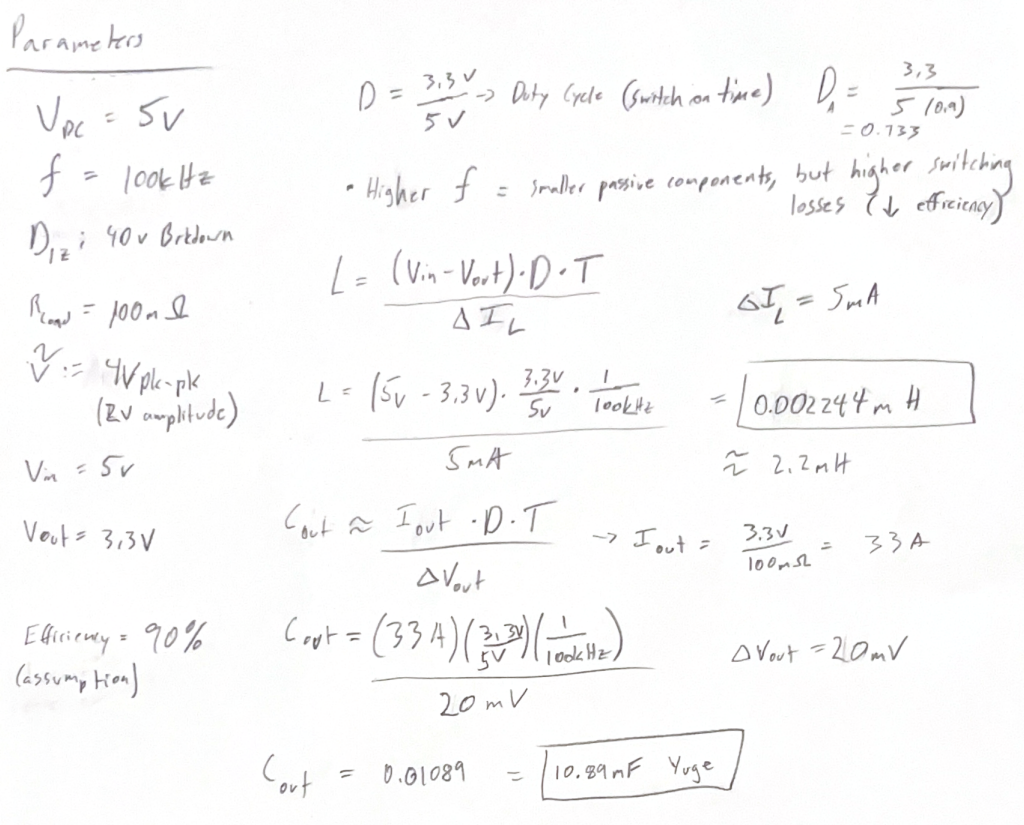
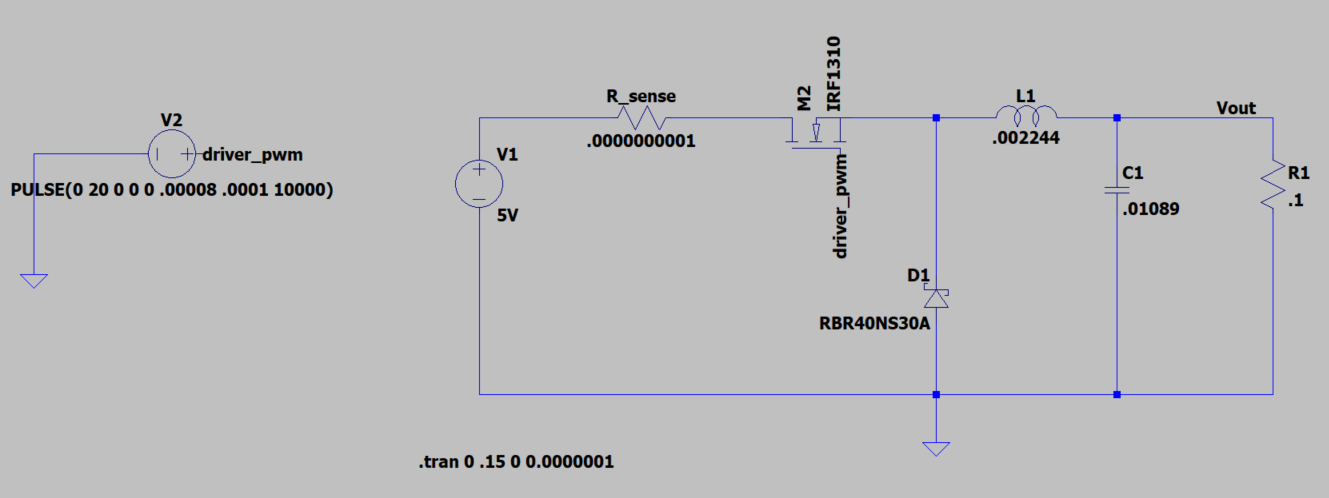
    With some help from a Texas Instruments PDF and the web, I calculated the Inductor and Output Cap from a parameter list I defined. I approached these parameters with an eMotor/electromagnetic background and intentionally chose a low resistance load.

      Hand Calculations for Cout and L
    Hand Calculations for Cout and L

    Next Step was to create a model in LTspice. I started with generic spice components and improvised from there.

     LTspice Model
    LTspice Model

    The generic components I started with were not working correctly, I believe this was due to the large current draw and low pulse voltage. This led me to find appropriate components for the output current I calculated (33A). I chose a Schottky diode with an average forward current of 40 Amps and 30V breakdown voltage. I then changed to an N-type mosfet with a 42A continuous current rating. These component changes with an extended simulation window to overcome the transient time for the large passive components finally gave me some results close to what I was looking for.

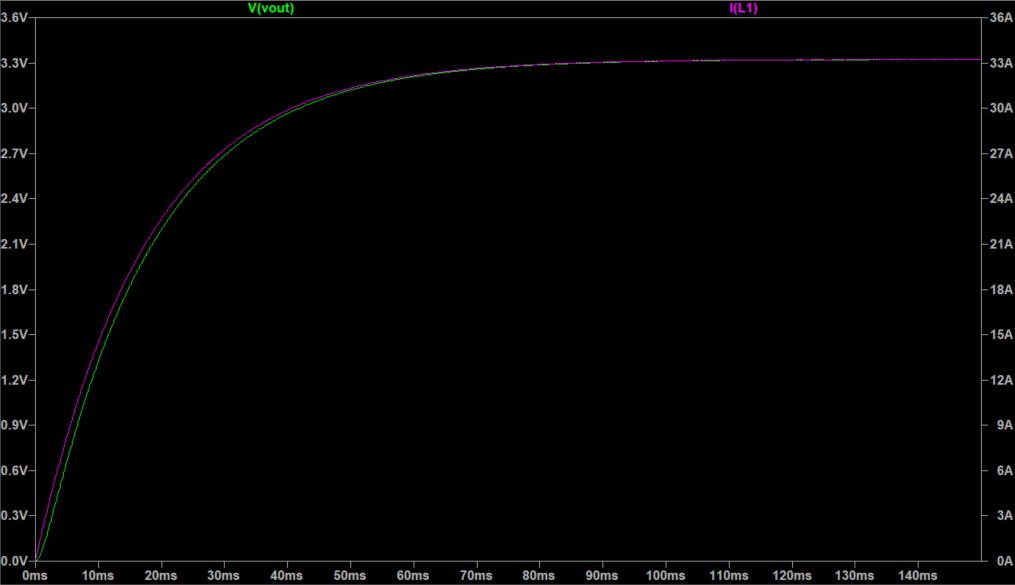
      Outputs Measured At the Load
    Outputs Measured At the Load
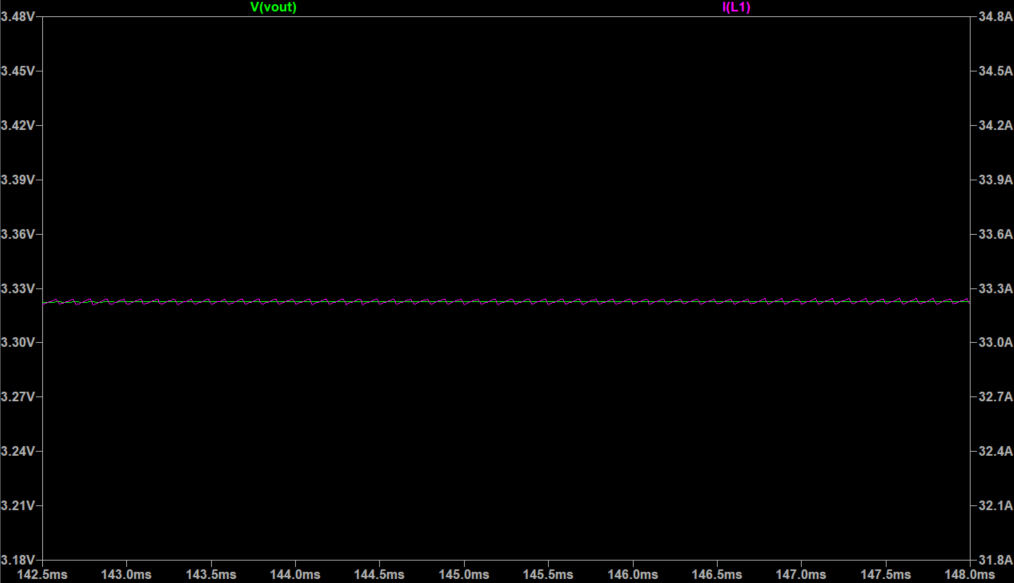
      Steady State Values
    Steady State Values

    As you can see above, the transient is pretty long, around 60-70ms. This was expected with a 10mF cap and 2.2mH inductor on the output. There could be controls or design changes implemented depending on the use cases to help mitigate this transient time.

      Duty Cycle and Efficiency
    Duty Cycle and Efficiency

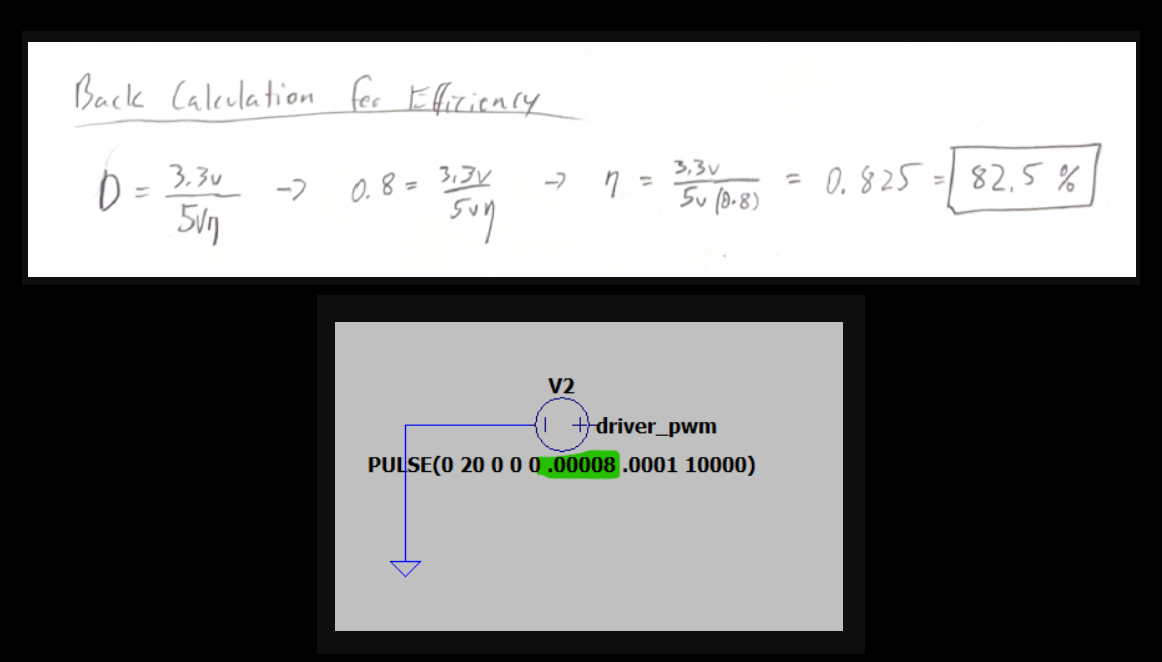
    From my estimations, the efficiency at this operating point is around 82.5%. I started out by calculating a duty cycle with an assumption of 90% efficiency, the output was around 3.0V. I manually adjusted the “Ton” parameter of the gate driver to achieve the desired output of 3.3V. The duty cycle that achieved 3.3V was 80%. I then plugged this back into the duty cycle equation and solved for the efficiency parameter. In ideal calculations it would be 66%, which highlights the inefficiencies of this design. My assumptions are that these losses mainly come from the switch and diode.

    I plan to revisit this design and try implementing improvements to increase efficiency. This would include plotting the losses on the diode vs the MOSFET at different duty cycles and evaluating the effect of replacing the diode with a switch. It might come down to needing a more efficient MOSFET with a lower Rds(on).

    Websites and documents used:

  • PCB Drone Motor – 01

    PCB Drone Motor – 01

    A quick intro to the project:
    This is a personal project inspired by my opinions on the future of electric motors and their use cases. I believe that we need to continue to find ways to make motors smaller, lighter, more power dense, and easier to manufacture all while simplifying the number of subcomponents. This will benefit every industry, but my specific focus is robotics and drones. In the future, these items will be mass produced at volumes far beyond almost any other electric motor use case, therefore every pound, penny, and second count!

    I started working on this in late January of this year (2025) and conducted research, wrote analytical analysis scripts, and designed a prototype. The first prototypes were ordered at the beginning of March and I expect to begin proof of concept and functional testing as soon as they arrive.

    If all goes well, I plan to try and patent aspects of my design at somepoint. For this reason, I will not share all the details on the design and operation.

    I will make more detailed posts on this project in the coming weeks/months, please come back every so often to check for updates!

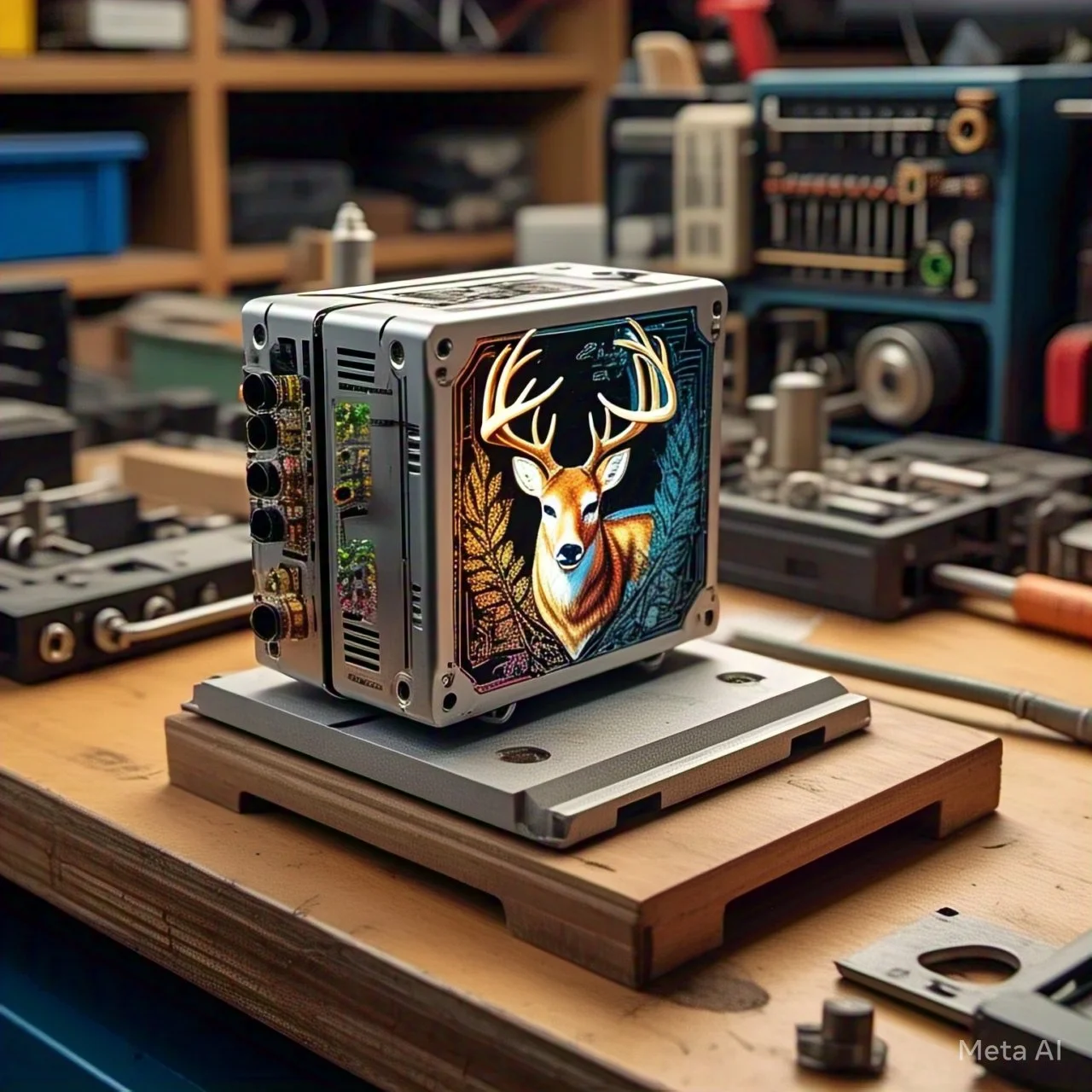
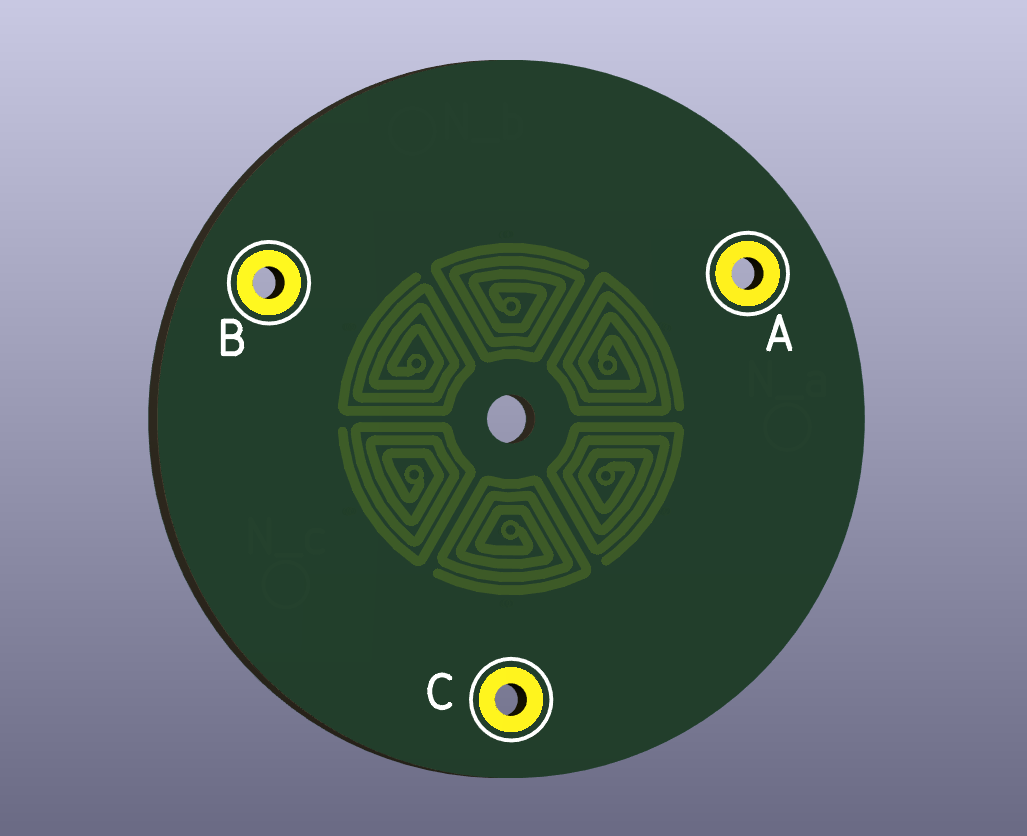
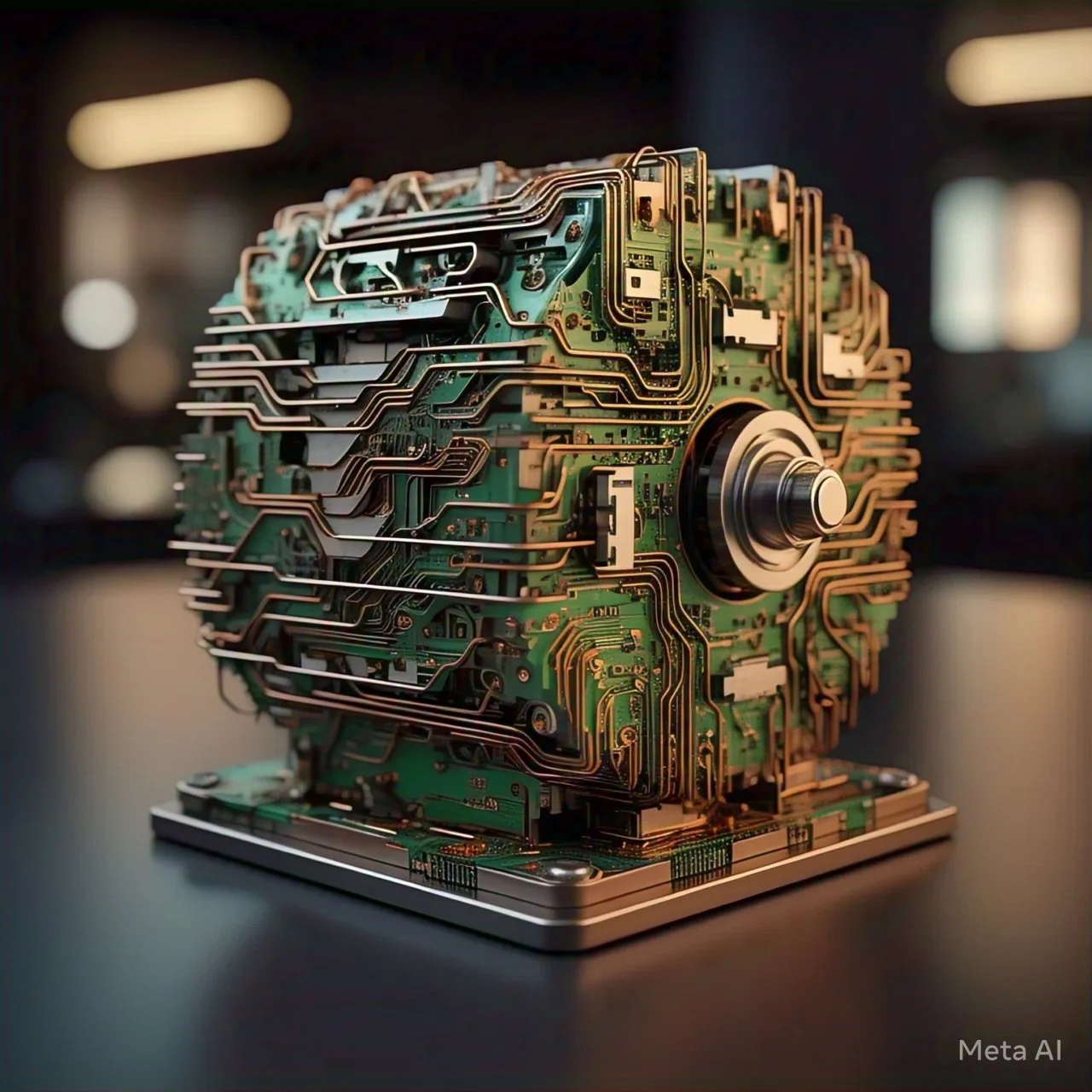
    Below is an image of the stator prototype I just sent for manufacturing.

      Stator Prototype Sample Image
    Stator Prototype Sample Image
  • AI & Machine Learning Course

    AI & Machine Learning Course

    Throughout winter and summer 2024, I completed the Post Graduate Program in AI and Machine Learning: Business Applications from UT Austin. The 6-month program provided valuable insights into Python use cases, machine learning, and LLM applications. The number of opportunities and the level of freedom afforded by open source and Python was an eye-opening experience. All class modules included lectures, quizzes, hands-on application through mentored learning sessions, and an implementation project.

    The following sections were covered in the class:

    Module 1: Python Foundations
    Module 2: Machine Learning
    Module 3: Advanced Machine Learning
    Module 4: Neural Networks
    Module 5: Computer Vision
    Module 6: Natural Language Processing

    To keep things concise, I will post my Google Collab python projects (Google’s version of jupyter notebooks) below as html downloads:

    Certificate of Completion:

     Checkout the link above this certificate if you are interested in the class.
    Checkout the link above this certificate if you are interested in the class.